
#1 · Best overall
Age Range
0+ months
Approx. Price
Mid-range
Standout Feature
3 play modes, 17+ activities, cloud tummy time pillow

As an Amazon Associate, Parents Love Best earns from qualifying purchases. Learn more
A baby activity gym gives your newborn a safe, padded spot to kick, reach and practice tummy time. Here are six worth buying in 2026.
The Skip Hop Silver Lining Cloud Activity Gym is a 3-in-1 play gym for back play, tummy time and seated play.
Prices change often on Amazon and other retailers, so treat the figures below as a guide and check the current listing.


The best baby activity gym grows with your baby, cleans easily, and fits your floor space. Use these criteria to compare any play gym before you buy, whether it comes from this list or not.
A gym rated 0 to 9 months costs more per month of use than one rated to 36 months.
Back play, tummy time and seated play let one gym cover several developmental stages.
A prop pillow or low-hanging toys keep young babies on their tummy longer.
A larger, padded mat gives a rolling baby room to move without hitting the hard floor.
Movable toys encourage reaching in different directions instead of always straight up.
High-contrast black-and-white patterns hold a newborn's attention while vision develops.
Music and lights entertain some babies but overstimulate others, so match the gym to your baby.
Spit-up is constant in the first months, so a machine-washable mat saves real time.
A gym that folds flat suits apartments, travel and grandparents' houses.
Wood arches, organic cotton and BPA-free toys matter to parents who want fewer plastics.
Each baby activity gym below was chosen for a specific need. Read the “Best for” and “Not ideal for” lines first to narrow your shortlist quickly.
The Skip Hop Silver Lining Cloud Activity Gym is a 3-in-1 play gym for back play, tummy time and seated play. It earns the top spot because it balances activities, comfort and price better than any other gym on this list.
The cloud pillow is the reason this gym wins for newborns. Many babies fuss during their first tummy time sessions, and propping the chest slightly lets them lift their head and see the toys. That small change often turns a 1-minute session into a 4-minute one.
The color scheme suits parents who dislike loud primary colors. The mat uses soft greys and pastels, then adds small pops of bright color on the toys where babies actually look. Your living room stays calm, and your baby still gets enough contrast to stay engaged.
The 17+ activities are spread across the arch and the mat, not crammed into one electronic toy. Your baby gets crinkle, squeak, ribbons, a light and music from different spots, which encourages reaching in several directions instead of staring at one point overhead.
As your baby learns to sit, you can remove the arch and use the toys and mat for seated play. When your baby outgrows the gym, an ExerSaucer or a baby jumper is a common next step. This stretches the gym’s useful life past the newborn months, which matters at a mid-range price.
First-time parents who want one gym that handles newborn tummy time through seated play.
Parents who want zero electronic sounds or a fully plastic-free gym.
Lovevery The Play Gym is a wooden-frame activity gym with 5 developmental zones and 24 stage-based activities, designed with child development specialists. It is the most expensive gym here, and it is the best choice for parents who want quiet, Montessori-inspired play.
The zone flaps are the feature no other gym on this list copies well. Each zone can be opened or closed, so you control how much your newborn sees at once. An overstimulated baby can get a simple black-and-white view, then more zones open as their attention span grows.
The card system keeps the gym fresh without buying new toys. You swap the cards in the focus zone from high-contrast patterns to faces to everyday objects as your baby’s vision develops. It is a cheap way to give a 4-month-old something new to look at.
The included Play Guide is useful for parents who run out of ideas after a few rounds of peek-a-boo. It explains which activities fit each age, so you know when to move the batting ring lower or start hiding the ball.
The Play Space Cover extends the gym into toddlerhood. Once your child crawls, the frame becomes a small fort for hide-and-seek. That second life helps justify the price for families planning more than one child.
Parents who prefer quiet, low-plastic, development-focused play and can spend more upfront.
Tight budgets or small apartments where floor space is limited.
The Melissa & Doug Ocean Easy-Fold Play Gym is a wooden play gym that folds flat with one button. It launched in July 2024 as the company’s first infant play gym (Melissa & Doug, 2024), and it solves the storage problem better than any other gym here.
The Quick-Close button is the main reason to pick this gym. You press it and the frame folds flat, with the mat and toys still attached. You can slide the whole gym under a sofa at night and have it set up again in seconds the next morning.
The reversible mat works like two gyms in one. Newborns start on the black-and-white side, which suits their early vision. Around 3 to 4 months, you flip it to the colorful ocean side to give an older baby more detail to explore.
The wide wooden arches give you easy access to your baby. You can reach in to pick them up or reposition a toy without bumping your head on a low arch, a small detail parents notice after the tenth pickup of the day.
All five toys are machine washable, which is rare. Most gyms ask you to spot-clean the hanging toys, so a full wash after a teething phase is a real advantage.
Apartment living, frequent travel, or families who visit grandparents often.
Parents who want one gym to last well into toddlerhood.
The Fisher-Price Rainforest Music & Lights Deluxe Gym is an electronic play gym where music, lights and nature sounds respond to your baby’s movement. It is the best pick for babies who light up with sound and cause-and-effect play.
Cause-and-effect learning is the main benefit here. When your baby swats a toy and the music starts, they begin to connect their own movement with a result. Many parents notice babies swatting on purpose within a few weeks of regular use.
The toucan doubles as a travel toy. You unclip it from the arch and take it to the car seat or stroller, where the 20-minute long-play mode keeps a fussy baby occupied on a short trip.
You can lower the toys or link them to the mat for tummy time. Placing a musical toy just in front of your baby’s face rewards them for lifting their head, which builds neck strength faster than an empty mat.
Fisher-Price has sold versions of this rainforest gym for years, so replacement parts and secondhand units are easy to find. That makes it a practical choice if you want to buy used and save money.
Babies who respond strongly to music and parents who want a budget-friendly electronic gym.
Easily overstimulated babies or parents who want a quiet, minimalist play space.
The Baby Einstein 4-in-1 Kickin’ Tunes Music and Language Discovery Gym is a play gym with a detachable kick piano. It is rated from birth to 36 months (Kids2, 2026), the longest age range on this list, at one of the lowest prices.
The kick piano rewards leg movement, which most gyms ignore. Babies on their back kick naturally, and here each kick plays a note. That gives young babies a way to make something happen before they can grab toys with their hands.
The piano keeps working after the gym stage ends. You can flip it up for seated play, then detach it completely and use it as a stand-alone toddler toy. That is how this gym reaches its 36-month rating.
The four-language feature exposes your baby to the sounds of English, Spanish, French and German. It is not a language course, but bilingual families often like hearing familiar words from the toy.
At around $50, the cost per month of use is the lowest on this list. If you only want to buy one gym and keep it until your child turns 3, this is the most practical choice.
Budget-conscious parents who want one gym that lasts from newborn to toddler.
Parents who want a quiet gym or a large mat for a rolling baby.
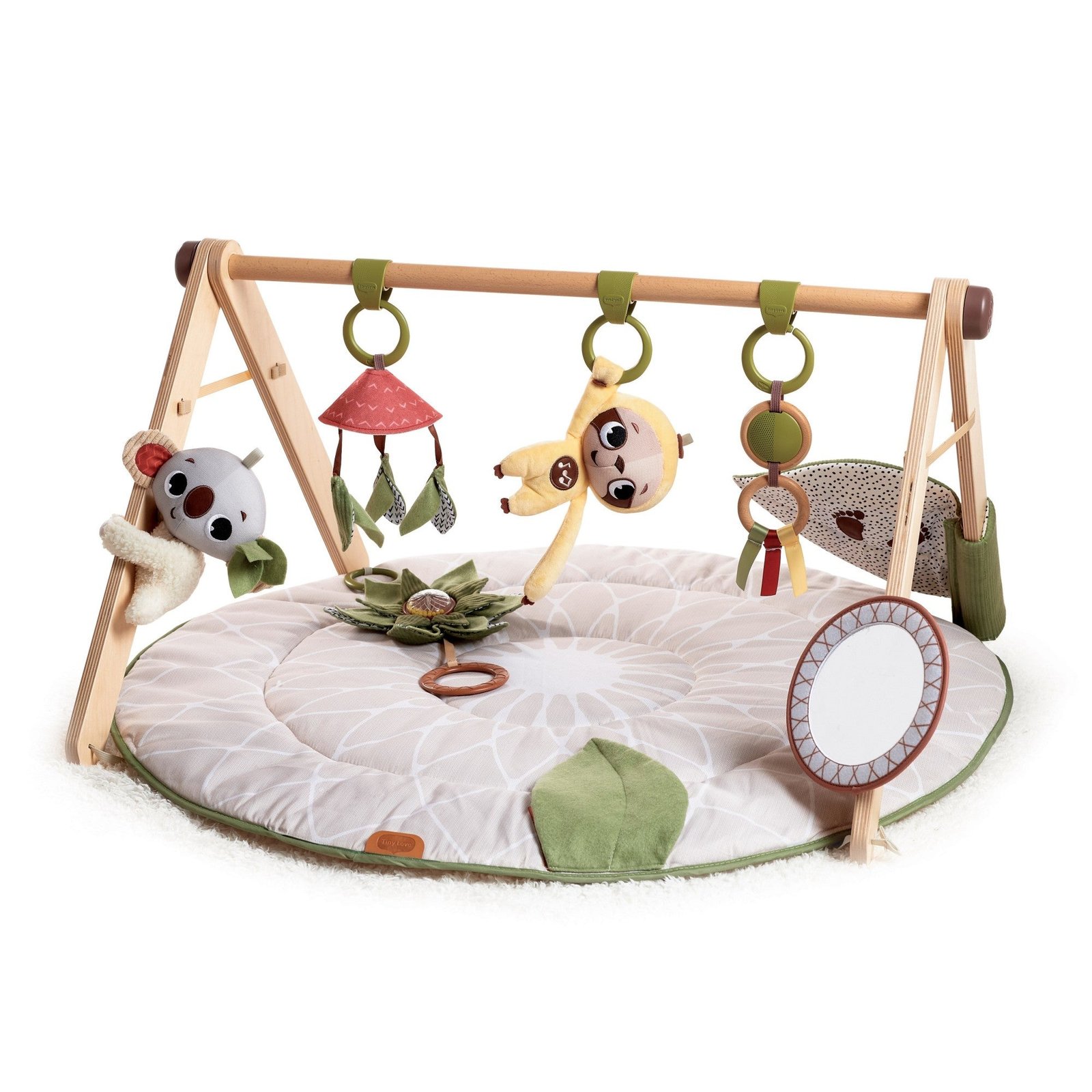
The Tiny Love Boho Chic Luxe Developmental Gymini is an activity gym with a stand-alone wooden arch and 20 activities. It is the best pick for parents who want a play gym that looks like home decor rather than a toy.
The stand-alone wooden arch is the biggest difference from other Gymini models. It does not rely on the mat to stay upright, so you can move it over a sitting baby or place it on a different blanket. The arch also looks like furniture, not plastic gear.
The double-padded mat is thicker than most mats here. On hard floors, that extra padding protects a baby who is starting to roll and push up during tummy time.
The 12 milestone cards give you photo props and development notes for each month. Parents who share monthly baby photos often use them, and the tips explain what skills to watch for next.
Batteries come in the box, which is unusual in this category. You can set up the musical sloth and start playing on day one without a trip to the store.
Parents who keep the gym in a shared living space and care how it looks.
Babies who need lots of sound and lights to stay engaged.
The right baby activity gym depends on your baby’s current stage and how long you want to use it. Newborns need contrast and tummy time support, while older babies need toys they can grab and seated play options.
For a newborn, choose a gym with high-contrast visuals and a tummy time pillow. The Lovevery Play Gym and Melissa & Doug Ocean gym both include black-and-white patterns, and the Skip Hop cloud pillow helps newborns tolerate tummy time.
Most babies can use a play gym from birth for supervised back play and short tummy time sessions. The AAP says tummy time can start the day your baby comes home from the hospital (American Academy of Pediatrics, 2026). Most babies use the arches until they sit or crawl, usually between 6 and 9 months.
Most babies use the arch and hanging toys for 6 to 9 months. Gyms with detachable toys or a fort cover last longer. The Baby Einstein Kickin' Tunes gym is rated to 36 months because its piano works as a stand-alone toy (Kids2, 2026).
A baby activity gym is safe when your baby is awake, supervised and on a flat floor. The gym is a play space, never a sleep space, and the AAP says healthy babies should always sleep on their backs on a firm, flat surface (American Academy of Pediatrics, 2026).
Stay with your baby during every tummy time session, and turn them onto their back if you need to step away.
Place the gym on the floor, never on a bed, sofa or raised surface where a rolling baby could fall.
Move your baby to a crib or bassinet if they fall asleep on the mat, since soft mats and pillows are not safe sleep surfaces.
Remove or raise the arch once your baby can pull on it to sit or stand, so it does not tip.
Start with 2 to 3 tummy time sessions of 3 to 5 minutes a day and build to 15 to 30 minutes a day by 7 weeks (American Academy of Pediatrics, 2026).
Varying your baby's position while awake also lowers the chance of a flat spot on the back of the head. The AAP suggests limiting time in swings, bouncers and car seats and spending more time on the floor (American Academy of Pediatrics, 2026).
Most buying mistakes come from choosing a gym for looks or features alone instead of your baby’s stage and your home.
A gym rated to 9 months may feel expensive by month 8, so compare the price against how long you will use it.
Lights and music entertain some babies but overstimulate others, so pick a gym where you can turn sound off or remove the electronic toy.
A small mat becomes cramped once your baby starts rolling, usually around 4 to 6 months.
If you live in a small space, a gym that stays assembled will sit in the middle of your floor for months.
Spread toys to the sides and lower some to the mat, since the AAP recommends placing toys in a circle to build the muscles for rolling and crawling (American Academy of Pediatrics, 2026).
A baby activity gym is a padded play mat with one or more arches that hold hanging toys. Babies lie under it to look, reach and kick, and the mat doubles as a tummy time surface. Many models also convert for seated play.
Yes, for most families. A baby activity gym gives your baby a clean, defined floor space for supervised play and tummy time, which the AAP recommends every day from the first day home (American Academy of Pediatrics, 2026). A blanket and a few toys work too, but a gym keeps toys within reach and holds attention longer.
The Melissa & Doug Ocean Easy-Fold Play Gym is the best choice for small spaces. Its Quick-Close button folds the frame flat with the mat and toys still attached, so it stores under a sofa or bed (Melissa & Doug, 2024).
The AAP recommends tummy time 2 to 3 times a day for 3 to 5 minutes at first, increasing as your baby enjoys it. Aim for 15 to 30 minutes total each day by 7 weeks of age (American Academy of Pediatrics, 2026).
No. A baby should never sleep on a play mat. If your baby falls asleep during play, move them onto their back in a crib or bassinet with a firm, flat mattress and no soft objects (American Academy of Pediatrics, 2026).
A play mat is a padded floor surface on its own. A play gym adds arches with hanging toys above the mat. Most play gyms let you remove the arches, so the mat keeps working after your baby outgrows the toys.
Check the label first, because care rules differ by brand. Most mats are machine washable on a gentle cycle, while electronic toys need spot cleaning with a damp cloth. The Melissa & Doug Ocean gym is one of the few where both the mat and toys are machine washable.
The Skip Hop Silver Lining Cloud Activity Gym is the best baby activity gym for most families, because it handles newborn tummy time, back play and seated play at a fair price. If you want quiet, development-focused play and can spend more, choose the Lovevery Play Gym.
For a tight budget and the longest use, the Baby Einstein 4-in-1 Kickin’ Tunes Gym lasts until age 3. If floor space is your main problem, the Melissa & Doug Ocean Easy-Fold Play Gym folds away in seconds.