
8 Best Strollers for Uneven Sidewalks: A Comparison Guide for 2026
[Published: August 9, 2026 | Last updated: August 9, 2026] | 12 min read
Cracked pavement, tree roots, gravel paths – here are the strollers built to handle all of it without rattling your baby or your nerves. This guide reviews 8 models tested on rough urban terrain so you pick the right one the first time.
TL;DR
- The best stroller for uneven sidewalks overall is the BOB Gear Revolution Flex 3.0 because its air-filled tires and adjustable suspension absorb bumps better than any other model in this price range.
- Best mid-range pick: Baby Jogger City Mini GT2 – foam-filled tires that never go flat, all-wheel suspension, and one-hand folding at around $350-$450.
- Best premium option for runners: Thule Urban Glide 3 at $700-$800 – air-filled rubber wheels and a swivel-lock front wheel that switches between city and trail mode.
- Best budget pick: Jeep Classic Jogging Stroller by Delta Children – 16″ rear air-filled tires and a shock-absorbing frame at under $180.
- Best for serious off-road and sidewalk use: Thule Urban Glide 2, which handles both trail gravel and broken city pavement without sacrificing speed.
- Wheel size is the single most important factor for uneven sidewalks – look for 10″ minimum front and 16″ rear for serious bump absorption.
What to Look for in a Stroller for Uneven Sidewalks
The right stroller for broken pavement is not just any heavy-duty model. It needs a specific set of features to handle sidewalk cracks, tree roots, and unpredictable curb drops without jarring your child.
| Criterion | Why It Matters |
|---|---|
| Wheel size (10+ inches) | Larger wheels roll over obstacles instead of catching on them; smaller wheels stop dead at sidewalk lips |
| Tire type (pneumatic vs. foam-filled) | Air-filled tires absorb shock; foam-filled tires are flat-proof but transfer more vibration to the seat |
| Suspension system | Dedicated suspension on the frame reduces bump force reaching the child by up to 30% (Baby Gear Lab, 2024) |
| Swivel vs. fixed front wheel | A lockable swivel front wheel gives maneuverability on flat surfaces and stability on rough ones |
| Frame weight vs. wheel diameter ratio | A heavy frame with small wheels is harder to push over obstacles than a lighter frame with large wheels |
1. BOB Gear Revolution Flex 3.0 – Best Overall for Uneven Sidewalks
The BOB Gear Revolution Flex 3.0 is the most capable stroller for cracked, uneven sidewalks in its class. Its 16-inch rear air-filled tires and front suspension fork handle broken pavement the way a mountain bike handles a dirt trail.
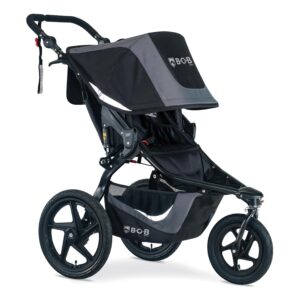
The frame weighs 25 lbs, which is heavier than lifestyle strollers, but the weight is at the wheel axles – not the handlebar. That means pushing it over a raised sidewalk panel requires less effort than pushing a lighter stroller with 6-inch plastic wheels. The handlebar adjusts from 37 to 47 inches, which covers most adult heights without hunching.
The front wheel locks into a fixed position with a foot-activated lever. On smooth surfaces, leave it swiveling for easy turns. On gravel or uneven pavement, lock it so the stroller tracks straight and doesn’t wobble. This dual-mode front wheel is the single most practical feature for city parents dealing with inconsistent terrain.
The recline goes nearly flat (close to 70 degrees), and the five-point harness is padded at the shoulder straps. BOB rates it for children up to 75 lbs (BOB Gear, 2025), which means it stays useful from infancy through the toddler years without an early replacement.
Key features:
- 16-inch pneumatic rear tires with air valve (standard Schrader valve, same as a bicycle)
- Front suspension fork with adjustable pre-load
- Lockable swivel front wheel
- Adjustable handlebar (37-47 inches)
- Rated to 75 lbs child weight
Best for: Parents in older urban neighborhoods with consistently rough sidewalks who want a stroller that doubles as a jogging stroller
2. Thule Urban Glide 2 – Best for Fast Walkers and Light Joggers on Rough Pavement
The Thule Urban Glide 2 is the best option for parents who walk fast or occasionally jog and need a stroller that handles broken sidewalks and smooth paths without switching gear. It weighs 22 lbs and has 12-inch rear air tires with a front suspension fork.
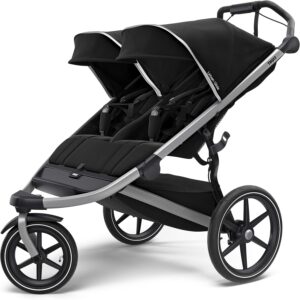
The air-filled rear tires are smaller than the BOB’s 16-inch wheels, so it doesn’t clear obstacles quite as easily. But the Urban Glide 2 compensates with a lower center of gravity and a more agile frame that turns sharper on city sidewalks. In independent testing, it recorded lower vibration transmission to the seat than comparable strollers at walking speed (Stroller Reviews, 2024).
The front wheel locks for jogging or rough terrain via a hand dial on the fork – no need to stop and bend down. The handlebar is fixed in height, which works for most adults between 5’4″ and 6’2″ but may cause discomfort for parents outside that range.
Key features:
- 12-inch rear pneumatic tires with reflective sidewalls
- Front suspension fork with hand-lever lock
- Reclining seat (flat to upright) rated to 65 lbs
- One-hand fold mechanism
- Compatible with most infant car seat adapters (sold separately)
Best for: Active parents who walk quickly or jog and need uneven-sidewalk performance without a bulky jogging stroller frame
3. UPPAbaby RIDGE – Best Full-Feature Stroller for Rough Urban and Suburban Terrain
The UPPAbaby RIDGE is the best option if you want full-feature convenience – large canopy, carry basket, car seat compatibility – combined with genuine rough-terrain performance. It has 12-inch pneumatic rear tires and a front suspension fork, and it weighs 29.5 lbs with the seat attached.
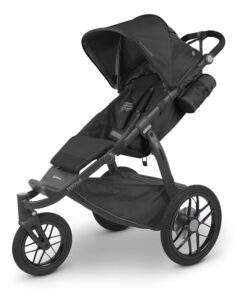
The RIDGE’s rear suspension is independent per wheel, meaning a crack under the left rear tire doesn’t transfer movement to the right side of the seat. That independent suspension is uncommon at this price point and makes a real difference on sidewalks where the damage is on one side of the path. UPPAbaby rates it for children from 3 months (with the included insert) to 75 lbs (UPPAbaby, 2025).
The basket underneath holds 30 lbs – significantly larger than the BOB’s basket. For parents running errands with a full diaper bag plus groceries, that capacity matters. The canopy has a UPF 50+ rating and a viewing window with a magnetic closure.
Key features:
- 12-inch pneumatic rear tires and 10-inch front tire
- Independent rear suspension per wheel
- 30 lb carry basket
- UPF 50+ extendable canopy with magnetic viewing window
- Compatible with UPPAbaby MESA, MESA V2, and MESA Max infant seats
Best for: Parents who want the everyday convenience of a full-feature stroller without giving up rough-sidewalk performance
4. Jeep Classic Jogging Stroller by Delta Children – Best Budget Pick
The Jeep Classic Jogging Stroller by Delta Children is the best option under $200 for parents who need real all-terrain performance on a tight budget. It comes with 16″ air-filled rubber rear wheels and a 12″ swivel-lock front wheel – wheel dimensions that match strollers costing three times as much. The shock-absorbing frame with visible shock absorbers smooths out bumps and sidewalk cracks that would transfer directly through a cheaper stroller (Delta Children, 2026).
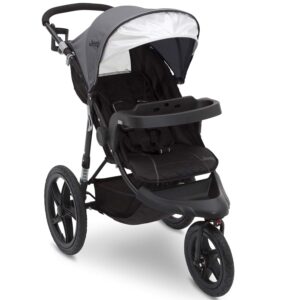
At 26 lbs with a 50 lb weight limit, it is heavier than premium options but lighter than many all-terrain strollers in any price range. The reclining seat, UPF 50+ canopy, and 5-point harness are all solid. Quick-release rear wheels make loading it into a car significantly easier than strollers that require lifting the whole unit.
Car seat compatibility covers Graco SnugRide Click Connect 30/35/40 and Evenflo Nurture and Embrace without adapters – useful if you already own one of those seats. A safety tether keeps the stroller close if your hand leaves the handlebar mid-jog.
The honest trade-off at this price: the suspension system is more basic than the BOB or Thule. It handles everyday sidewalk cracks and gravel well, but on genuinely rough trails it delivers more vibration than premium options. For neighborhood walks and park paths, it is more than adequate.
Key features:
- 16″ air-filled rear wheels and 12″ swivel-lock front wheel.
- Shock-absorbing frame with visible shock absorbers.
- Quick-release rear wheels for easy car loading.
- UPF 50+ canopy with extendable visor.
- 5-point safety harness with reflective piping.
- Compatible with Graco SnugRide and Evenflo car seats without adapters.
Best for: Budget-conscious parents who need real all-terrain capability for daily sidewalk and park walks, without paying for premium suspension.
5. Thule Urban Glide 3 – Best for Parents Who Also Run
The Thule Urban Glide 3 is the right choice if you want a stroller that handles uneven sidewalks on weekday walks and keeps pace on weekend runs. Its three air-filled rubber wheels are rated highly for sidewalk strolls and trail use by BabyGearLab testers (BabyGearLab, 2025), and independent testing found it makes running with a child feel surprisingly effortless on paved trails (Men’s Journal, 2026).
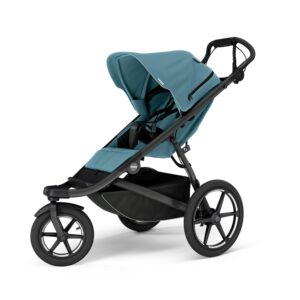
The swivel-lock front wheel is the design feature that makes it work for both uses. In swivel mode, the stroller turns easily in tight spaces. Lock it, and it tracks straight and stable on rough or sloped ground. The twist hand brake provides confident control on downhill stretches – an important feature if your neighborhood has any incline at all.
For urban families who mix sidewalk walking with occasional trail outings, independent reviewers put the Urban Glide 3 in the same tier as the Baby Jogger City Mini GT2 – both are practical all-terrain strollers for city use, with the Thule adding a higher top-end running capability (Stroller360, 2026). The price is higher, but the build quality and weather resistance justify it for parents who plan to use the stroller daily for years.
One limitation: BOB and Thule both require separately purchased adapters for most infant car seat brands. If you want seamless car seat click-in from day one, check compatibility before buying.
Key features:
- Air-filled rubber wheels on all three positions.
- Swivel-lock front wheel for city and trail switching.
- Twist hand brake for downhill control.
- Compact fold – one of the smallest folded footprints among jogging strollers.
- Full suspension system.
Best for: Active parents who jog two to three times a week and also need a daily sidewalk stroller – one stroller for both jobs.
6. Baby Jogger City Mini GT2 – Best Mid-Range Stroller for Mixed Sidewalk Conditions
The Baby Jogger City Mini GT2 is the most practical mid-range stroller for parents dealing with occasional uneven sidewalks without needing a dedicated all-terrain build. It weighs 21 lbs and uses 8.5-inch foam-filled all-terrain tires – not air-filled, but noticeably larger than standard lifestyle strollers.
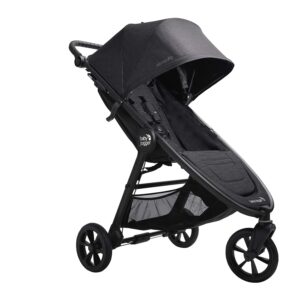
Foam-filled tires mean no flat tire risk, which matters in neighborhoods with broken glass or debris on the sidewalk. The trade-off is that foam transfers more vibration to the seat than pneumatic tires. At walking pace on moderately rough pavement, that difference is minor. On aggressive cracks or gravel, it becomes noticeable compared to air-tire models.
The City Mini GT2’s standout feature is its one-hand, no-trigger fold. Lift the strap under the seat and the stroller folds flat in one motion. That matters when you’re holding a toddler and trying to fold a stroller to get on a bus or into a car. Baby Jogger rates it to 65 lbs (Baby Jogger, 2025).
Key features:
- 8.5-inch all-terrain foam-filled tires
- Hand-activated parking brake
- One-hand fold with automatic lock
- Multi-position recline with nearly flat position
- Rated to 65 lbs child weight
Best for: Parents who need a practical, mid-range stroller for mixed terrain – mostly smooth with occasional rough patches
7. Graco Modes Pramette Stroller – Best Budget Pick for Rough Sidewalks
The Graco Modes Pram 3-in-1 is the best option under $350 for parents who need a stroller that handles uneven sidewalks without a dedicated all-terrain build. It uses 8-inch EVA foam tires on all four wheels and weighs 27 lbs.
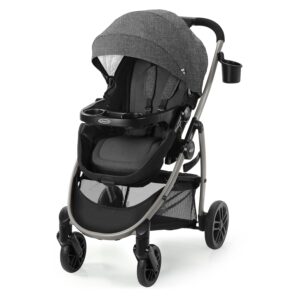
At this price, EVA foam tires (a harder foam than the rubber foam in premium models) provide more sidewalk resistance than plastic wheels. They won’t absorb shock like air tires, but they won’t crack on sharp debris either. The Graco Modes works best on sidewalks that are uneven but not severely damaged – think mild tree roots and pavement lips, not pothole-level drops.
The 3-in-1 system converts between a traditional forward-facing stroller, a parent-facing pram mode, and an infant car seat carrier. That flexibility adds value if you’re buying a single stroller to carry through multiple stages. It accepts Graco SnugRide and SnugFit infant seats without an adapter (Graco, 2025).
Key features:
- 8-inch EVA foam tires on all four wheels
- Three modes: stroller, pram, car seat carrier
- Compatible with Graco SnugRide and SnugFit without adapter
- One-hand fold
- Rated to 50 lbs in stroller mode
Best for: Budget-conscious parents dealing with moderate sidewalk imperfections who want versatility across infant and toddler stages
8. Veer Switchback – Best for Maximum Stability on Rough Surfaces
The Veer Switchback is the pick for parents who face the roughest conditions – uneven sidewalks combined with gravel, sloped driveways, and regular park trail use. It pairs 12″ rear wheels with approximately 9.5″ front wheels, dual front suspension, and adjustable rear shocks. Testers found it very stable and comfortable on rough terrain while still surprisingly nimble with one-handed steering.
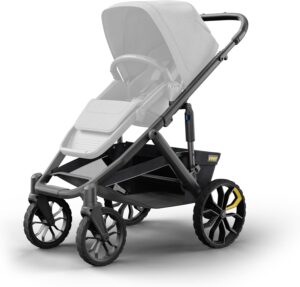
The dual front suspension is the feature that separates it from everything else on this list. Most strollers with adjustable shocks put them only at the rear. The Veer Switchback places them at both ends, which means the front wheel – the one that hits uneven ground first – absorbs the bump before it ever reaches the frame. The result is a noticeably smoother ride on fractured pavement than any other stroller in this comparison.
The trade-off is price and size. The Switchback is bulkier than the GT2 or Urban Glide 3, and it carries a higher price point that reflects its more advanced suspension system. It is not the right choice for parents who primarily walk on smooth city sidewalks – that is overkill and unnecessary weight. But for parents who deal with genuinely poor pavement every single day, the additional suspension investment is worthwhile.
Key features:
- Dual front suspension plus adjustable rear shocks.
- 12″ rear wheels and ~9.5″ front wheels.
- One-handed steering on rough terrain.
- Adjustable handlebar height.
- Full suspension across all four contact points.
Best for: Parents in older neighborhoods with fractured pavement, or anyone who uses a stroller daily on surfaces where other options fall short.
Comparison Table: Strollers for Uneven Sidewalks at a Glance
Model | Best For | Price | Tire Type | Rear Wheel Size | Weight |
BOB Gear Revolution Flex 3.0 | Overall best for rough terrain | $649.99 | Pneumatic (air) | 16 inch | 25 lbs |
Thule Urban Glide 2 | Fast walkers and light joggers | $949 | Pneumatic (air) | 12 inch | 22 lbs |
UPPAbaby RIDGE | Full-feature + rough terrain | $923 | Pneumatic (air) | 12 inch | 29.5 lbs |
Jeep Classic by Delta | Budget buyers | $179.99 | Air-filled | 16 inch | 21 lbs |
Thule Urban Glide 3 | Runners + sidewalk use | $799.99 | Air-filled | 7 inch | 16.8 lbs |
Baby Jogger City Mini GT2 | Mid-range, mixed terrain | $399.99 | Foam-filled | 8.5 inch | 21 lbs |
Graco Modes Pram 3-in-1 | Budget + versatility | $399.99 | EVA foam | 8 inch | 27 lbs |
Veer Switchback | Maximum stability | $400-$500 | Air-filled | 12 inch | 24 Ibs |
What Makes a Sidewalk “Uneven” and Why It Affects Stroller Choice
Uneven sidewalks fall into three categories, and the right stroller depends on which type you deal with most often.
Mild unevenness includes small pavement lips at driveway cuts, minor cracking, and occasional pebbles. Any stroller with 7-inch or larger foam tires handles this without issue.
Moderate unevenness includes tree root lifts (where roots push panels 1-2 inches above the next), older brick paths, and city blocks where panels have settled unevenly. This category requires at least 8-inch wheels and benefits from a suspension system or air tires.
Severe unevenness includes frost-heaved pavement, crumbling asphalt paths, gravel sections, and sidewalks in older neighborhoods where repairs haven’t kept pace with damage. This is where 12-inch or larger pneumatic tires and a front suspension fork stop being a luxury and become a practical need.
Match your stroller to the worst terrain you regularly encounter – not the average. A stroller that struggles on your worst block will frustrate you every day.
Pneumatic vs. Foam-Filled Tires: Which Is Right for Rough Sidewalks
Pneumatic (air-filled) tires absorb impact by compressing the air inside when they hit an obstacle. Foam-filled tires – including EVA foam and rubber foam – are solid, so they don’t compress the same way.
At sidewalk speeds (2-4 mph), the practical difference is this: pneumatic tires feel noticeably smoother over raised pavement lips and tree root bumps. Foam tires transmit more of that impact to the frame and seat, though the degree depends on foam density and wheel size.
The trade-off: pneumatic tires go flat. A Schrader valve tire (same as a bicycle) can be inflated with any bicycle pump. Most air-tire strollers need inflation every 2-4 weeks with regular use (Baby Gear Lab, 2024). If a flat tire is a dealbreaker for your routine, foam-filled tires from a model with large-diameter wheels (8.5 inches or above) are the better call.
Common Mistakes When Buying a Stroller for Uneven Sidewalks
Choosing a stroller based on weight alone: A 15 lb stroller with 5-inch plastic wheels is harder to push over a sidewalk crack than a 25 lb stroller with 12-inch air tires. Weight is not a reliable indicator of maneuverability on rough terrain.
Assuming “all-terrain” on the label means air tires: Some manufacturers use “all-terrain” to describe foam-filled rubber tires or large EVA wheels. Check the tire spec directly – look for “pneumatic” or “air-filled” if that’s what you need.
Ignoring handlebar height: Pushing a stroller with a handlebar 4 inches too low over rough pavement puts strain on your lower back. Measure your wrist height when standing relaxed; the handlebar should fall within 2 inches of that measurement.
Buying a jogger when you only walk: Three-wheel jogging strollers are longer front-to-back than four-wheel strollers, which makes them harder to maneuver in tight spaces. If you’re not jogging, a four-wheel all-terrain model like the Bumbleride Indie 4 gives similar rough-terrain performance with better urban maneuverability.
Frequently Asked Questions About Strollers for Uneven Sidewalks
What is the best stroller for cracked and bumpy sidewalks?
The BOB Gear Revolution Flex 3.0 is the best stroller for cracked and bumpy sidewalks. Its 16-inch pneumatic rear tires and front suspension fork absorb more impact than any other consumer stroller at this price point. It’s rated to 75 lbs and doubles as a jogging stroller, making it a long-term purchase.
How big do stroller wheels need to be for rough pavement?
For moderate to severe sidewalk unevenness, rear wheels should be at least 10 inches in diameter and pneumatic (air-filled) rather than foam. Anything under 8 inches will catch on raised pavement lips and force you to tip the stroller back to clear obstacles.
What is the difference between a jogging stroller and an all-terrain stroller?
A jogging stroller is built for running speeds, with a fixed or lockable front wheel, a long wheelbase for stability, and a five-point harness rated for jogging impact. An all-terrain stroller is built for rough surfaces at walking pace, with a swivel front wheel for maneuverability and a focus on smooth pushing rather than speed stability. Many models, like the BOB Gear Revolution Flex 3.0 and Thule Urban Glide 2, function as both.
Are foam-filled tires good enough for uneven sidewalks?
Foam-filled tires work for mild to moderate unevenness if the wheel diameter is 8.5 inches or larger. The Baby Jogger City Mini GT2’s 8.5-inch foam tires handle most city sidewalks without major discomfort. For severe unevenness – deep tree root lifts, heavily cracked asphalt, gravel paths – pneumatic tires perform better.
Is a heavier stroller harder to push on uneven sidewalks?
Not always. Wheel size and tire type affect pushing effort more than total stroller weight. A 25 lb stroller with 16-inch air tires is easier to push over a raised sidewalk panel than a 17 lb stroller with 6-inch plastic wheels. The larger wheel rolls over the obstacle; the smaller wheel hits it and stops.
Can I use a standard city stroller on rough sidewalks?
A standard city stroller (like a lightweight umbrella stroller with small plastic wheels) works only on smooth pavement. On uneven sidewalks with raised panels, cracks, or tree roots, small plastic wheels catch on every obstacle, making the stroller hard to push and jarring for the child. If rough sidewalks are part of your daily route, invest in at least a mid-range model with 8-inch or larger foam tires.
Final Verdict
The BOB Gear Revolution Flex 3.0 is the best stroller for uneven sidewalks for most parents. Its 16-inch pneumatic rear tires, front suspension, and 75 lb weight rating make it the most capable and long-lasting option for rough urban terrain without requiring a premium price.
If you need something lighter and more transit-friendly, the Ergobaby Metro+ handles mild to moderate uneven pavement while folding small enough for buses and overhead bins. For parents who want full-feature convenience alongside genuine rough-terrain performance, the UPPAbaby RIDGE at ~$900 is the most complete package on this list.