
#1 · Best overall
Price
About $400
Carrier Weight
7 lbs
Child Weight Range
16-40 lbs

As an Amazon Associate, Parents Love Best earns from qualifying purchases. Learn more
The best baby hiking backpack keeps your child secure and moves the load onto your hips. We compared nine carriers on weight, fit and safety for 2026.
The Thule Sapling is a framed child carrier with a machine-washable seat, a self-standing frame and full under-leg support.
All prices are list or retailer prices at the time of writing and change often. Check the Amazon link for today’s price.




A good baby hiking backpack fits your torso, holds your child’s weight with room to spare, and puts most of the load on a padded hip belt. We judged each carrier on the criteria below, using manufacturer specs and retailer listings.
Most framed carriers start at 16 lbs and stop at 40 lbs, so check both ends against your child's growth curve.
This number includes child, gear and sometimes the pack itself, and going over it voids the safety rating.
Every pound of pack is a pound you carry uphill, and the carriers here range from about 4.5 to 9 lbs.
An adjustable back panel lets two parents of different heights share one carrier.
Your hips should carry most of the weight, which takes strain off your shoulders and neck.
These small straps pull the child closer to your back so you do not lean forward.
A seat that moves up lets your child see over your shoulder as they grow.
A 5-point harness keeps a wriggly toddler from climbing out mid-hike.
A locking kickstand holds the carrier upright while you load your child.
A UPF 50 shade blocks most UV on exposed trails, and some carriers sell it separately.
An included rain cover saves an extra purchase if you hike in wet climates.
Diapers, snacks, layers and water add up fast, so 12 liters suits short hikes and 20+ liters suits day trips.
A sleeve or tube port lets you drink without stopping to unload.
A mesh or suspended back panel keeps your back cooler on summer climbs.
Drool pads and seats get dirty, and machine-washable parts save time.
Look for JPMA, ASTM or TÜV GS testing, and check CPSC.gov for recalls before you buy used.
Each review below lists specs, price, strengths and weak points, so you can match a carrier to your trails, your body and your budget.
The Thule Sapling is a framed child carrier with a machine-washable seat, a self-standing frame and full under-leg support. It earns the top spot because it treats the child’s comfort as seriously as the parent’s.
The ErgoRide seat is the Sapling’s biggest advantage. Most carriers let a child’s legs dangle through leg holes, but this seat supports the thighs all the way to the knee. On a three-hour hike, that support is the difference between a napping toddler and a fussy one.
The seat unclips and goes straight into the washing machine. If you have ever scraped dried yogurt off a carrier seat with a wet wipe, you will see why this matters. Thule also includes a removable drool pad, which gets washed far more often than the seat.
You can load your child from the top or through a side panel opening. Side loading helps when your toddler is already half asleep and you do not want to lift them over the frame. The kickstand locks with an audible click before you load, which removes the guesswork (Thule Sapling instructions, 2021).
The carrier weighs 7 lbs and handles a maximum load of 48.5 lbs, covering child plus gear (REI, 2026). The torso and hip belt both adjust, so two parents of different heights can trade off on the trail without a long refit.
Parents who hike for three hours or more and want the most comfortable seat for their child.
Parents on a tight budget or those who need the lightest pack possible.
The WIPHA Toddler Hiking Backpack Carrier is a lightweight frame carrier with a sunshade and breathable mesh back. It suits parents who want a light carrier for weekend trails without paying premium-brand prices.
Weight is the WIPHA’s selling point. At roughly 4.5 lbs, it is lighter than every premium carrier here, including the Osprey Poco LT. If you carry a 30-lb toddler, saving even half a pound on the pack is noticeable on the final climb back to the car.
The mesh back panel lets air move between you and the carrier. That helps on humid summer trails, where a solid foam back would leave your shirt soaked within the first mile. The fabric parts also come off for washing.
Several Amazon reviewers mention using it on city trips as well as hikes, with toddlers near the 40-lb limit. The compact fold helps here, since the carrier fits in a car trunk or a hotel closet without taking over the space.
The listing describes TÜV certification, a third-party safety test common in Europe. Budget carriers rarely publish this kind of testing, so its presence is worth noting. Confirm the certificate details on the current listing before you buy, since budget listings change often.
Parents of toddlers who want a light carrier for day hikes and travel on a budget.
Parents of smaller babies under 18 lbs.
The Chicco SmartSupport is a lightweight aluminum frame carrier from a mainstream baby brand. It fits parents who want a simple carrier for park loops, zoo days and easy trails.
The SmartSupport is the most affordable carrier here from a major baby brand. Chicco’s customer support and retail presence mean replacement parts and help are easier to find than with many budget brands.
The 5-point harness and height-adjustable seat let the carrier grow with your child from about 17 lbs to 40 lbs. Raising the seat as your toddler grows keeps their view clear over your shoulder, which cuts down on squirming.
Reflective accents are a small but useful detail. If your walks stretch into dusk or run along road shoulders, drivers can spot you more easily. Few hiking-focused carriers include them.
The trade-off is trail comfort on longer outings. BabyGearLab testers found the pack sat far from the body because it has no load lifter straps, causing them to lean forward, and they flagged its limited storage and small canopy (BabyGearLab, accessed 2026).
Parents who mostly walk paved paths, parks and gentle trails under two hours.
All-day hikers who need to carry diapers, food and layers.
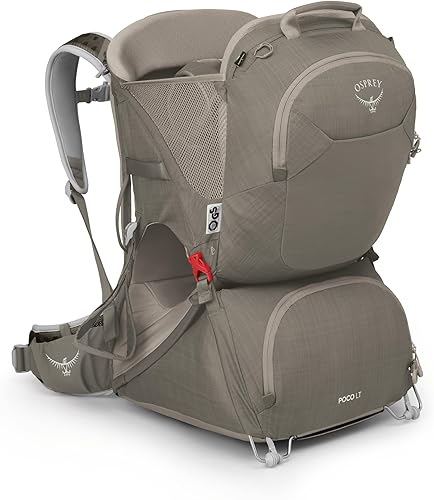
The Osprey Poco LT is the lightest and most compact carrier in Osprey’s Poco line. It is the best pick for families who fly, drive to trailheads or need a carrier that works in shops as well as on trails.
The folding frame is what makes the Poco LT stand out. It collapses flat, so it fits in a car trunk next to a stroller or slides into an airline checked-bag line without a fight. Osprey designed it with travel and everyday use in mind.
At 5.1 lbs, it is about 2 lbs lighter than the Thule Sapling and Kelty Journey Elite. GearJunkie testers ran a side-by-side test against Osprey’s heavier Poco Plus, and the mothers in the group said they would choose the LT for comfort and ease of putting it on.
The back panel adjusts with a hook-and-loop system across 6 inches of torso length. Swapping between parents takes about 30 seconds and works on the trail, which matters when one parent’s shoulders need a break halfway up a hill.
The Poco LT carries TÜV GS certification, a German safety standard, and works with the universal Poco rain cover and carry case. Both accessories are sold separately, so budget for the rain cover if you hike in wet regions.
Families who travel often and want a premium carrier that packs small.
Parents who need maximum storage for long days on remote trails.
The besrey Toddler Hiking Backpack Carrier is a foldable frame carrier with a 3-height seat, sunshade and rain cover. It is the best value on this list because it includes accessories that premium brands sell separately.
The included rain cover is the besrey’s quiet advantage. Osprey, Deuter and Kelty all sell rain covers as add-ons, so the besrey’s real price gap against those carriers is even wider than the sticker suggests.
The 3-height seat moves your child up as they grow. A 10-month-old sits low and secure, while a 2-year-old can sit higher and look over your shoulder. Some reviewers use the same carrier for two children of different ages.
At 5.5 lbs, it weighs less than the Thule, Kelty and Chicco. For a budget carrier, that is a meaningful number, since cheaper carriers often use heavier steel frames to save cost.
Read the weight rating carefully. besrey states the 16 to 40-lb range covers child, gear and carrier combined. That leaves less room for your child than the 40-lb child limit on premium carriers, so heavier toddlers may outgrow it sooner.
Budget-minded parents of babies and young toddlers who want everything in one box.
Parents of heavier toddlers near 35 lbs or more.
The Jeep Trail Rated Toddler Hiking Backpack Carrier is made by Delta Children under the Jeep brand. It suits parents who want a hydration-ready, weather-resistant carrier with plenty of pockets at a mid-range price.
The Jeep carrier is the only budget-friendly option here built around a 2-liter hydration reservoir. Drinking through a tube without stopping keeps your pace steady and lets your child stay asleep in the seat.
Storage is generous for the price. You get a large zippered lower compartment, two side zip pockets, a zippered belt pocket and an adjustable bottle or sippy cup holder. The canopy tucks into its own pocket when the sun goes behind the clouds.
The 600D Oxford fabric resists light rain, and reflective trim adds visibility near roads. The whistle on the chest buckle is a small safety extra that most hikers forget to pack separately.
The 14-lb minimum is the lowest on this list. Even so, your child must still sit up without help before using any framed carrier. Weight alone does not mean a baby is ready.
Parents who hike in hot weather and want built-in hydration support.
Parents who count every ounce on steep climbs.
The Kelty Journey PerfectFIT Elite is Kelty’s top child carrier, with an aluminum frame, zippered pockets and an integrated sunshade. It is the best pick for full-day hikes where you need to carry gear for the whole family.
Storage is the Elite’s biggest strength. At 26 liters, it holds more than any other carrier on this list, enough for diapers, a change of clothes, lunch, rain jackets and a first aid kit. A lined lower pocket keeps messy items away from clean gear.
The PerfectFIT system lets you adjust torso length while wearing the pack. CleverHiker named it the easiest carrier to adjust after testing it with a 7-month-old and a 3-year-old on Colorado trails and everyday errands (CleverHiker, accessed 2026).
The fit range is wide. Torso lengths from 15.5 to 21 inches and hip sizes from 33 to 51.5 inches cover most adults, so tall and short parents can both carry comfortably (REI, 2026).
BabyGearLab testers praised the thick, stiff waistband for weight distribution. Smaller testers did note the waistband felt slightly droopy at the back (BabyGearLab, accessed 2026), so shorter parents should try it on if possible.
Families planning full-day hikes who need to carry gear for everyone.
Parents who want a compact, travel-friendly carrier.
The Luvdbaby Hiking Baby Carrier Backpack is a budget framed carrier with a diaper change pad, insulated bottle pocket and sun and rain hood. It suits parents of younger toddlers who still need bottles and frequent changes on the trail.
The insulated bottle pocket is rare on hiking carriers. It keeps milk or formula cool on warm days, which means fewer worries about spoilage on a three-hour loop. Most premium carriers leave you to pack a separate cooler bag.
The included diaper change pad is another practical detail. Changing a diaper on a rocky trail is hard, and a clean pad gives you a flat, washable surface without packing extra gear.
The hood works for both sun and rain. That covers two accessories that Deuter and Osprey sell separately, which keeps the total cost low for parents just starting out.
The waterproof ripstop polyester resists tears from branches and brush. Ripstop fabric has a grid pattern woven in, so a small snag stays small instead of running into a long tear.
Parents of younger toddlers who still need bottles and diaper changes on hikes.
Parents who want detailed fit specs before buying.
The Deuter Kid Comfort Active is a stripped-down, ventilated child carrier from a German pack maker. It suits parents who hike at a steady pace and want a light, close-fitting carrier.
The Kid Comfort Active is built for movement. Its compact frame and hip fins keep the child’s weight close to your center, so the carrier sways less on uneven ground. REI reviewers describe it as easy to adjust and comfortable on longer outings.
The Lite Aircontact back panel leaves gaps for air to move. Picture the difference between a foam pad and a mesh chair back on a hot day. That airflow helps on summer hikes and steep sections where you sweat most.
Deuter gives clear load limits: 40 lbs for the child and 8 lbs for gear (Deuter, 2026). Clear numbers help you avoid overloading the pack, which is easy to do once snacks, water and layers pile up.
Note the 2025 recall. CPSC announced that kickstand hinges could crack on some Kid Comfort Active units in teal with production codes ending in 0423 or 1223 (CPSC, 2025). The Forest color linked here is not on that list, but check the code if you buy used.
Active parents who hike at a steady pace and pack light.
Parents who need lots of storage or an included sunshade.
A baby hiking backpack is safe when your child can sit upright without support, stays within the weight limit, and rides with the harness snug. Thule’s instructions say a child must sit upright unassisted and weigh at least 16 lbs before using the Sapling (Thule Sapling instructions, 2021).
Most babies are ready when they can sit alone and hold their head steady, which Deuter places at about 8 months (Deuter, 2026). Weight minimums vary from 14 to 18 lbs across this list, but sitting ability comes first.
Always open and lock the kickstand on flat ground before placing your child inside. Thule's instructions say never to set a carrier on counters or tables, since it can tip over (Thule Sapling instructions, 2021).
Search the brand and model on CPSC.gov before you buy secondhand. The 2025 Deuter recall covered about 5,080 carriers with cracking kickstand hinges (CPSC, 2025).
Thule recommends frequent breaks because children in carriers can tire and are exposed to the weather (Thule Sapling instructions, 2021). Stop to check your child's hands and feet for cold, heat or numbness.
The besrey Toddler Hiking Backpack is the best starting point for most new hiking parents. It costs $139.99 at list price, weighs 5.5 lbs, and includes a sunshade and rain cover, so you do not need to buy extras (besrey, 2026).
A baby can ride in a framed hiking backpack once they sit upright without help, usually around 6 to 9 months. Deuter suggests about 8 months, and Thule requires a minimum of 16 lbs (Deuter, 2026; Thule Sapling instructions, 2021).
Most baby hiking backpacks hold a child up to 40 lbs. Total load limits for child plus gear range from about 40 lbs on budget carriers to 48.5 lbs on the Thule Sapling and Osprey Poco LT (REI, 2026).
The Osprey Poco LT is lighter at 5.1 lbs and folds flat for travel. The Thule Sapling weighs 7 lbs but gives your child full under-leg support and a machine-washable seat (REI, 2026).
Budget carriers can be safe if they list a tested weight limit, a 5-point harness and a locking kickstand. Look for third-party testing such as TÜV or ASTM in the listing, and check CPSC.gov for recalls before buying.
Start with how long you hike and how you travel. Choose a light, foldable carrier like the Osprey Poco LT for travel, a high-storage carrier like the Kelty Journey PerfectFIT Elite for all-day trips, and a budget carrier like the besrey for occasional weekend walks.
A sunshade protects your child’s face and arms on exposed trails, and a rain cover keeps them dry in sudden showers. The Thule Sapling, Osprey Poco LT and Kelty Elite include a sunshade, while the besrey and Luvdbaby include both shade and rain protection.
Only specific Kid Comfort Active units in teal with production codes ending in 0423 or 1223 were recalled in May 2025 (CPSC, 2025). Check the production code on the tag inside the bottom storage pocket, and contact Deuter for a free replacement if yours matches.
The Thule Sapling is the best baby hiking backpack for most families because its under-leg seat support and washable seat keep children comfortable on long hikes. If you travel often or want to save weight, the Osprey Poco LT is the runner-up at 5.1 lbs with a fold-flat frame. On a budget, the besrey gives you a sunshade, rain cover and 3-height seat for under $140.