
#1 · Best overall for newborns
Type
Digital stick (rectal only)
Read Time
10 seconds
OK for Under 3 Months?
Yes
Approx. Price
$10 to $17

As an Amazon Associate, Parents Love Best earns from qualifying purchases. Learn more
The best thermometer for a newborn is a digital rectal thermometer. Here are six picks, plus when forehead and ear models make sense.
The Frida Baby Quick-Read is a digital rectal thermometer made only for babies.
The table below sums up each pick. Prices are approximate and change often on Amazon, so check the current price before buying.



The best thermometer for a newborn (birth to 3 months) is a digital stick thermometer used in the bottom. A rectal reading measures core body temperature, which matters because a fever in a young baby can be a sign of a serious infection. Mayo Clinic advises a regular digital thermometer used rectally for this age group (Mayo Clinic, 2025).
Think of it like checking a roast. A probe in the center tells you the real temperature, while a hand on the oven door only tells you the outside is warm. A rectal thermometer is the probe. A no-touch forehead thermometer is the hand on the door.
Forehead thermometers come in two kinds. A temporal artery thermometer (also called a forehead touch thermometer) is swiped across the skin, and Mayo Clinic notes that new research suggests it may give accurate readings in newborns (Mayo Clinic, 2025). A no-touch thermometer reads skin surface heat from a short distance, and the FDA warns its accuracy depends on using it exactly as directed (FDA, 2025).
forehead temperature strips, which HonorHealth describes as poor indicators of true body temperature in infants (HonorHealth, accessed 2026), and glass mercury thermometers, which can break and expose a child to mercury (KidsHealth from Nemours, accessed 2026).
The right method changes as your baby grows. KidsHealth gives this age-based guidance (KidsHealth from Nemours, accessed 2026):
| Baby’s Age | Best Method | Acceptable Backup |
|---|---|---|
| Birth to 3 months | Rectal (digital stick) | None for decisions; confirm any other reading rectally |
| 3 to 6 months | Rectal | Temporal artery (forehead) or underarm |
| 6 months to 3 years | Rectal | Temporal artery, ear, or underarm |
| 4 years and older | Oral, if the child can hold it under the tongue | Rectal, temporal artery, ear, or underarm |
For a full list of what to buy before your due date, see our newborn essentials checklist.
A good newborn thermometer reads rectally, gives a result in seconds, and has a flexible tip that limits how far it goes in. After those basics, look at the display, memory, and cleaning. Here are the criteria we used to rank each pick in this guide.
Rectal use is the standard for babies under 3 months, so the thermometer must be labeled for rectal use.
Ear models are not accurate before 6 months, so check the minimum age on the box.
Look for a stated accuracy such as ±0.2°F so you know how close the reading should be.
A 8 to 10 second read means less time holding a squirming baby still.
A soft, bendable tip is gentler and moves with your baby instead of poking.
A stopper limits depth, which helps nervous first-time parents avoid inserting too far.
Night checks are easier when you can read the screen without turning on a bright light.
Green, yellow, and red screens help you understand a number at 3 a.m.
A fever for a newborn can be normal for a toddler, so age settings help on multi-age models.
Stored readings let you report a clear timeline to your pediatrician.
A water-resistant body can be washed with soap and water after every rectal use.
Vibration or muted beeps let you check a sleeping baby without waking them.
Disposable covers or lens caps reduce cross-contamination between family members.
A case keeps the tip clean and makes it easy to tell a rectal thermometer apart from an oral one.
Clearance shows the device meets U.S. requirements for a clinical thermometer.
Most rectal thermometers cost under $20, and many are FSA/HSA eligible.
Each pick below is ranked by how well it fits a baby under 3 months first, then by how useful it stays as your baby grows into a toddler.
The Frida Baby Quick-Read is a digital rectal thermometer made only for babies. It is our top pick because it uses the method doctors trust most for newborns and adds a stopper that makes the process less stressful.
The stopper is the reason most parents choose this one. Pediatric guides recommend inserting a rectal thermometer only about half an inch to 1 inch (Michigan Medicine, accessed 2026). The Frida tip widens at that point, so you feel resistance before going too far.
A 10-second read is short enough to hold a fussy baby still without a struggle. The backlit screen means you can read the number in a dark nursery, which helps when your baby feels warm at 2 a.m. and you do not want to flip on the overhead light.
The 10-reading memory is more useful than it sounds. When you call the pediatrician, the nurse will ask what the temperature was and when. Scrolling back through recent readings gives you a timeline instead of a guess from a tired memory.
Because it is rectal-only, there is no risk of someone grabbing it for an oral reading. KidsHealth advises labeling a thermometer for rectal use so it never goes in a mouth (KidsHealth from Nemours, accessed 2026). The Frida design does that job for you.
Parents of babies from birth to 3 months who want the most trusted method with a safety stopper.
Families who want one thermometer for every family member and every age.
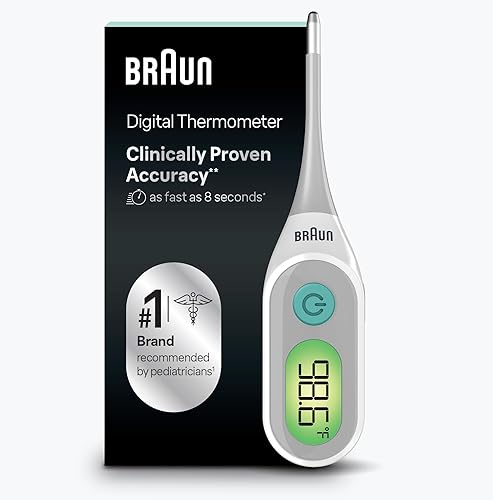
The Braun Digital Thermometer is a stick thermometer for rectal, oral, or underarm use. It earns a spot because it covers a newborn rectally today and the whole family later, with color-coded fever guidance on the screen.
At 8 seconds, it is a little faster than the Frida rectal model. For a newborn who hates having their legs held, those two seconds make a difference. The flexible tip moves with your baby rather than staying rigid.
Braun’s Age Precision version (model PRT2000) lets you set your child’s age group: 0 to 3 months, 3 to 36 months, or 36 months and up. This matters because a temperature that is normal for a 4-year-old can be a fever in a newborn.
Read the manual before relying on the screen colors. Braun states the color-coded display is designed for underarm mode only, and for rectal or oral readings you should use the number and the temperature tables in the manual (Braun PRT2000 manual, accessed 2026). For a newborn, that means trusting the number, not the color.
The included probe covers let you use one thermometer for more than one site. Many parents still prefer two thermometers, one labeled for rectal use, so there is never any doubt about which end has been where.
Parents who want a single stick thermometer that works rectally now and orally when their child turns 4.
Nervous first-time parents who want a physical stopper on the tip.
The Vicks SpeedRead is a low-cost digital stick thermometer for rectal, oral, or underarm use. It is our budget pick because it is cheap enough to buy two, one labeled for rectal use and one for everything else.
The Vicks SpeedRead has been sold for over a decade, and its simple design is the appeal. You press one button, insert, and wait for the beep. There are no modes to learn when you are half asleep and worried.
The low price makes the two-thermometer method easy. Michigan Medicine advises against using a thermometer orally after it has been used rectally unless you have disposable covers (Michigan Medicine, accessed 2026). Two Vicks thermometers cost about the same as one premium model.
Be realistic about speed. Vicks notes that 8 seconds is typical but clinical results ranged from 7 to 38 seconds depending on the person and method (Vicks, accessed 2026). Rectal readings on a newborn usually land on the fast end, but plan for an occasional longer wait.
The water-resistant body can be washed with soap and water after rectal use, which matters for hygiene. The automatic shut-off also stops you from coming back to a dead battery in the middle of the night.
Budget-minded parents and anyone who wants a separate thermometer for each measurement site.
Parents who want a tip shaped specifically for newborn rectal use.
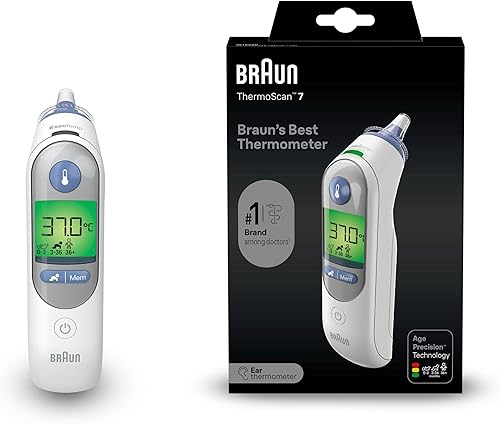
The Braun ThermoScan 7 is an infrared ear thermometer with age-based fever guidance. We include it because many parents register for it, but ear readings are not accurate before 6 months, so treat it as a second thermometer for later.
Braun says the ThermoScan 7 is as accurate as rectal measurement in newborns, and it includes a 0 to 3 month setting. Pediatric guidance disagrees on ear use this young: Seattle Children’s states ear temperatures are not accurate before 6 months (Seattle Children’s Hospital, 2023). We follow the pediatric guidance.
From 6 months on, it is one of the most praised thermometers for families. Mother&Baby and Mumsnet both named it their best overall baby thermometer in 2026 (Mother&Baby, 2026; Mumsnet, 2026). An ear reading takes seconds, which is a relief with a wriggly toddler.
The pre-warmed tip and ExacTemp guide fix the two main causes of bad ear readings: a cold probe and poor positioning. Mayo Clinic notes that earwax or a small, curved ear canal can also throw off ear readings (Mayo Clinic, 2025), so take two readings if the first seems off.
Disposable hygiene caps go over the tip for each reading, so siblings and parents can share it without spreading germs. You will need to buy replacement caps over time, which adds a small ongoing cost.
Parents who want a fast, family-wide thermometer for babies 6 months and older.
Your only thermometer during the newborn months.
The Frida Baby 3-in-1 is an infrared thermometer with ear, forehead, and touchless modes. It earns a spot for families who want one device for quick checks, bottle temperatures, and room temperatures once their baby is older.
In independent testing, TechGearLab named the Frida Baby 3-in-1 its best thermometer for babies and kids and called it the most accurate infrared model it tested (TechGearLab, 2026). It scored 75 out of 100 and ranked second of 10 thermometers overall.
The touchless mode is the extra that parents use most. You can check a bottle or bath water without touching it, which is handy in the newborn months even before you use the ear mode on your baby.
Customer reviews are more mixed than lab tests. On Babylist, the thermometer averages about 3.4 out of 5 stars, and about 36% of reviewers left 1 star, with many citing readings that seemed off (Babylist, 2026). Confirm any worrying reading with a rectal thermometer.
TechGearLab gave it a 6 out of 10 for ease of use, noting the controls take time to learn (TechGearLab, 2026). Practice switching modes while your baby is healthy so you are not figuring out the buttons during a fever.
Families with a baby over 6 months who want one device for body, bottle, and room temperatures.
Making fever decisions for a baby under 3 months.
The iHealth PT3 is a no-touch forehead thermometer that vibrates instead of beeping. It is on this list as a quiet screening tool for a sleeping baby, not as a replacement for a rectal reading in the first 3 months.
The vibration feedback is the reason to own one. You can check a sleeping newborn’s forehead without a beep, and if the reading looks normal, you can leave them asleep. If it looks high, take a rectal reading to confirm.
The distance check solves the most common no-touch mistake. Many cheap no-touch thermometers give a low reading when held too far away. The PT3 will not take a reading beyond 1.18 inches, so you are less likely to get a falsely reassuring number.
The ambient sensor adjusts for room temperature, but conditions still matter. The FDA advises using no-touch thermometers in a draft-free room away from direct sunlight, after the thermometer has adjusted to the room (FDA, 2025).
The AAP’s HealthyChildren site says no-touch infrared thermometers are safe but raises concerns about how accurate they are, and stresses correct use (American Academy of Pediatrics, accessed 2026). For a newborn, use the PT3 to decide whether to check, not what to do.
Parents who want a quick, silent first check before deciding whether to take a rectal temperature.
Confirming a fever in a baby under 3 months.
Taking a newborn’s rectal temperature takes about a minute: lubricate the tip, insert it half an inch to 1 inch, hold it steady, and wait for the beep. KidsHealth calls it a simple and safe process when done gently (KidsHealth from Nemours, accessed 2026). Follow these steps:
Wait 20 to 30 minutes if your baby just had a bath or has been swaddled or under blankets, since this can raise the reading (KidsHealth from Nemours, accessed 2026).
Wash the tip of the thermometer with soap and water, then rinse it.
Put a small amount of petroleum jelly on the tip so it slides in easily.
Lay your baby on their back with knees bent toward the chest, or face down across your lap.
Insert the tip gently about half an inch to 1 inch, and stop if you feel resistance (Michigan Medicine, accessed 2026).
Hold the thermometer steady between two fingers while cupping your hand against your baby’s bottom.
Remove it after the beep, then write down the number and the time.
Wash the thermometer with soap and water and store it in its case, labeled for rectal use.
Never leave your baby alone while the thermometer is in place, even for a few seconds (HonorHealth, accessed 2026).
For a baby under 3 months, a rectal temperature of 100.4°F (38°C) or higher means you should contact your doctor right away (Mayo Clinic, 2025). KidsHealth goes further and advises going to the ER for a baby this age with that reading, or with a rectal temperature of 97°F (36.1°C) or lower (KidsHealth from Nemours, accessed 2026).
A low temperature in a newborn can be as worrying as a high one, so do not ignore a reading at or below 97°F. Newborns cannot regulate body heat well, and a low reading can also be a sign of illness.
Do not give acetaminophen (Tylenol) to a baby under 3 months until a doctor has seen them (Mayo Clinic, 2025). Medicine can lower the number without treating the cause, which can hide important information from the doctor.
For reference, HonorHealth lists the AAP's normal ranges for babies as 97.5°F to 99.3°F (36.5°C to 37.4°C) under the arm and 100.2°F (37.9°C) or less rectally (HonorHealth, accessed 2026).
For babies 3 to 6 months old, Mayo Clinic advises calling the doctor if the temperature is up to 101°F (38.3°C) and your baby seems unusually irritable, sleepy, or uncomfortable, or if the temperature is higher than 101°F (Mayo Clinic, 2025).
Most bad readings come from the method, not the thermometer. These are the mistakes that cause the most confusion for new parents:
A newborn's ear canal is too small and curved for a reliable infrared reading, so use a rectal thermometer instead.
A normal forehead scan on a newborn who seems unwell is not a reason to skip a rectal reading.
Warm water and tight blankets raise skin and body temperature, so wait 20 to 30 minutes.
Label a rectal thermometer and keep it separate, or use disposable probe covers.
Some color displays, like Braun's Age Precision, are designed for underarm mode, so rely on the number for rectal readings.
Strips are unreliable for infants, and glass thermometers can break and expose your baby to mercury.
Building your registry? Add a rectal thermometer to your baby registry checklist so it is ready before you bring your baby home.
A digital stick thermometer used rectally is the most accurate option for a newborn. It measures core body temperature instead of skin temperature. Mayo Clinic recommends this method from birth to 3 months (Mayo Clinic, 2025).
Forehead thermometers are less reliable than rectal readings for newborns. Temporal artery models that touch the skin may be accurate in newborns based on newer research (Mayo Clinic, 2025), while no-touch models depend heavily on correct use. Confirm any concerning forehead reading with a rectal thermometer.
No, ear thermometers are not recommended before 6 months of age. Seattle Children’s Hospital states ear temperatures are not accurate in babies younger than that (Seattle Children’s Hospital, 2023). Save an ear thermometer like the Braun ThermoScan 7 for later.
A rectal temperature of 100.4°F (38°C) or higher is a fever in a newborn. For a baby under 3 months, this reading means you should contact your doctor right away (Mayo Clinic, 2025). A rectal reading of 97°F (36.1°C) or lower also needs urgent care (KidsHealth from Nemours, accessed 2026).
Most digital rectal thermometers give a reading in 8 to 10 seconds. The Frida Baby Quick-Read takes about 10 seconds, and the Braun Digital Thermometer and Vicks SpeedRead take about 8 seconds. Wait for the beep before removing it.
Yes, taking a rectal temperature is safe when you use a digital thermometer, lubricate the tip, and insert it only half an inch to 1 inch. Hold the thermometer steady and never leave your baby alone during the reading. A thermometer with a stopper, like the Frida Baby Quick-Read, adds a physical depth limit.
Most families do well with two thermometers. Use a digital rectal thermometer for the newborn months and to confirm fevers, and add an ear or forehead model once your baby is 6 months old for quick checks. Label the rectal one so it is never used orally.
The best thermometer for a newborn is the Frida Baby Quick-Read Digital Rectal Thermometer, because it uses the method pediatric sources trust most for babies under 3 months and adds a stopper that makes rectal checks easier for nervous parents. If you want to spend less, the Vicks SpeedRead V912US gives similar rectal readings at a lower price. Once your baby turns 6 months, add the Braun ThermoScan 7 for fast ear readings.