
How to Get a Restless Baby to Sleep: A Step by Step Guide
- Published October 11, 2026
- Updated November 1, 2026
- 9 min read
A restless baby is most often responding to overstimulation, an off sleep schedule, or an unmet physical need – fix the environment first before trying techniques
Rule out hunger, temperature, gas and overtiredness, darken the room, use low white noise and follow the same bedtime routine every night. Put your baby down drowsy but awake.
TL;DR: The Quick Answer
- A restless baby is most often responding to overstimulation, an off sleep schedule, or an unmet physical need – fix the environment first before trying techniques
- The most reliable method is a consistent bedtime routine done in the same order every night
- White noise, swaddling, and feeding to drowsy (not asleep) are the three techniques with the strongest evidence base
- Most babies need 14-17 hours of sleep per 24 hours at 0-3 months, dropping to 12-16 hours at 4-11 months (Sleep Foundation)
- If your baby has been difficult to settle for more than two weeks and isn’t gaining weight normally, see a pediatrician
- What You Need Before You Start
- Step 1: Rule Out the Four Physical Triggers
- Step 2: Set Up the Sleep Environment
- Step 3: Follow the Same Bedtime Routine
- Step 4: Use Swaddling Correctly if Your Baby
- Step 5: Try the 5 S's Method for Acute
- Step 6: Handle Night Wakings Without Fully
- Common Problems and How to Fix Them
- FAQ
- Key Takeaways
How to Get a Restless Baby to Sleep at a Glance
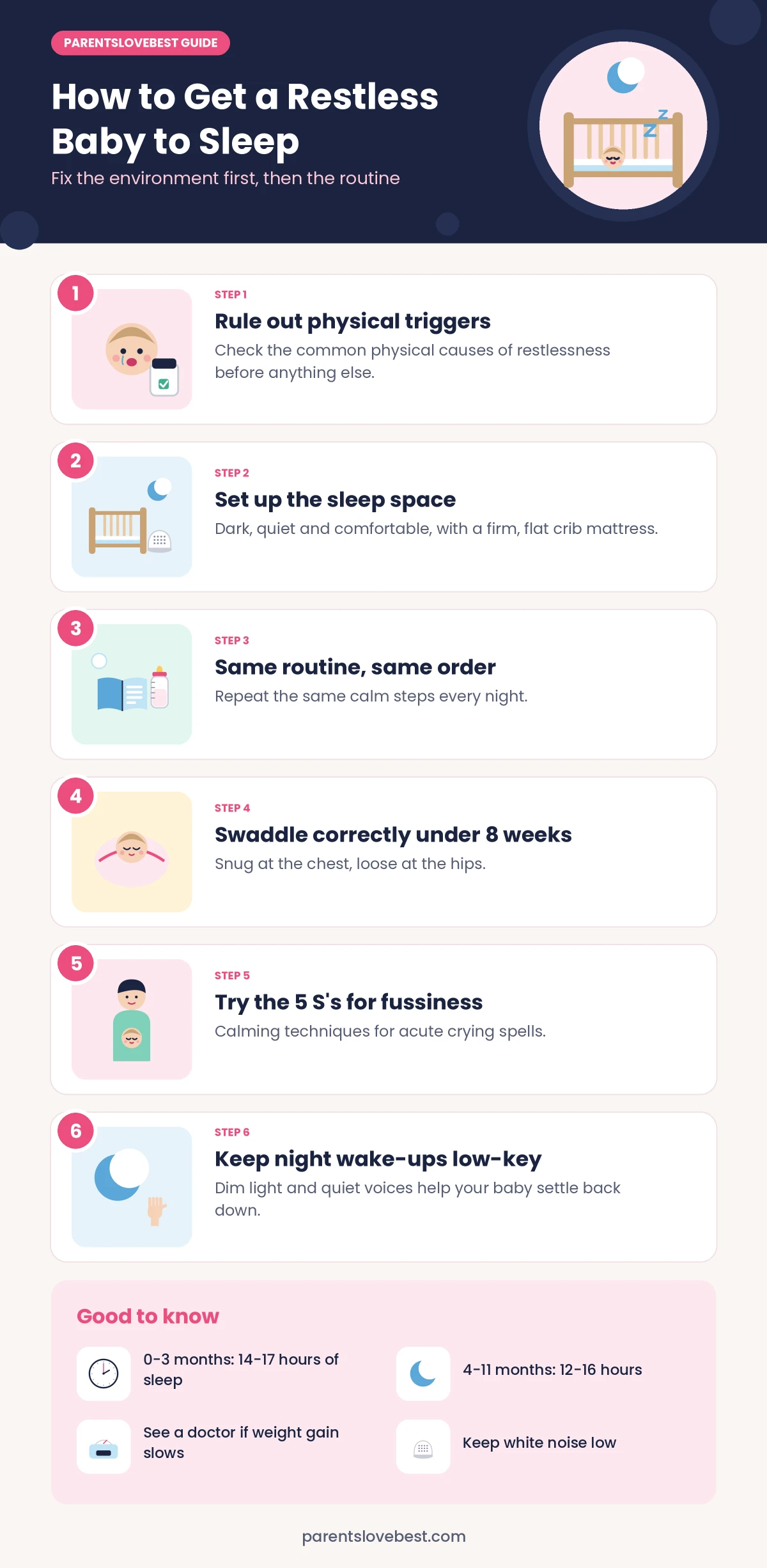
What You Need Before You Start
A darkened room with blackout curtains
Never drape a cover over the bassinet - it can block airflow.
A white noise machine or free white noise app, kept at a low volume and well away from the sleep space
A swaddle blanket if your baby is under 8 weeks and not yet rolling
A consistent start time - pick a bedtime and stick within 30 minutes of it every night
Step 1: Rule Out the Four Physical Triggers First
Before any sleep technique will work, check that your baby isn’t restless because of a physical need. A baby who is hungry, in pain, too hot, or overtired will fight sleep regardless of what method you use.
Run through this checklist in order:
Hunger
Feed your baby before starting the sleep routine, not after they're already wound up.
Temperature
The ideal room temperature for infant sleep is 68-72°F (20-22°C). Feel the back of their neck - cool and dry is correct.
Gas or reflux
Hold them upright for 10-15 minutes after a feed. If they arch their back and cry during feeds, mention this to your pediatrician.
Overtiredness
A baby who has been awake too long produces cortisol, which makes them harder, not easier, to settle. Watch for the first yawn or eye rub and start the wind-down immediately.
Good to know
If all four are clear, move to Step 2.
Step 2: Set Up the Sleep Environment
A sleep-ready room removes two of the biggest barriers to falling asleep: light and noise. Babies don’t naturally tune out stimulation the way adults can.
Do this at least 15 minutes before the sleep routine starts:
Close blackout curtains to darken the room
Keep the bassinet itself uncovered and bare, as the AAP safe sleep guidance recommends.
Turn on white noise before you bring the baby into the room
White noise works by masking sudden sounds - a door closing, a dog barking - that trigger the startle reflex. Set it to a constant, steady sound, not music or nature sounds with pauses.
Lower your own voice
Talking in a normal volume signals "awake time" to a baby.
Step 3: Follow the Same Bedtime Routine in the Same Order
A fixed bedtime routine is the single most effective habit you can build for long-term sleep. Studies show that babies with a consistent routine fall asleep faster, wake less often at night, and sleep longer overall (Mindell, J.A., SLEEP Journal, 2015).
The routine doesn’t need to be long. A 15-20 minute sequence is enough. A reliable order is:
Warm bath (optional but effective – the drop in body temperature after a bath triggers sleepiness)
Fresh diaper and sleep clothes
Feed (breast or bottle)
2-3 minutes of quiet holding or gentle rocking
Place in the crib drowsy but awake
Good to know
Step 5 is the hardest for most parents to follow through on. Placing the baby drowsy but not fully asleep teaches them to finish falling asleep on their own - which is what prevents the 2 a.m. wakeups where they need you to recreate the exact conditions they fell asleep in.
Step 4: Use Swaddling Correctly if Your Baby Is Under 8 Weeks
Swaddling reduces the Moro reflex (also called the startle reflex) – the involuntary arm-fling that wakes babies up during light sleep. A firm, correctly done swaddle mimics the feeling of being held.
How to swaddle safely:
Use a thin, stretchy muslin blanket - not a thick one that traps heat.
Keep the hips loose. The legs should be able to bend and spread
Tight hip swaddling is linked to hip dysplasia - see the International Hip Dysplasia Institute's hip-healthy swaddling guide.
The arms go straight down at the sides, not bent up near the face.
Stop swaddling as soon as your baby shows any sign of rolling, usually between 8-12 weeks.
Good to know
Pre-made swaddle wraps with velcro closures (such as the Halo SleepSack Swaddle or Love to Dream) are easier to get consistently snug than a flat blanket.
Step 5: Try the 5 S's Method for Acute Fussiness
If your baby is crying and already overtired, a gentle routine won’t break through immediately. Dr. Harvey Karp’s 5 S’s method (Karp, H., “The Happiest Baby on the Block,” 2002) is the most widely cited approach for calming an actively fussy newborn.
Do all five at once, in this order:
Swaddle – wrap firmly as described in Step 4
Side or stomach position – hold them on their side or stomach across your arm (never put them to sleep in this position, only use it to calm them)
Shush – make a loud “shhhh” sound directly near their ear, matching the volume of their cry
Swing – small, fast jiggling motions – about 1 inch back and forth, not slow rocking
Suck – offer a pacifier or your clean finger
Good to know
Once they calm down, transition to the crib drowsy but awake. Don't wait until they're in a deep sleep to transfer them.
Step 6: Handle Night Wakings Without Fully Waking the Baby
Babies naturally cycle between light and deep sleep every 45-60 minutes. A restless baby at night is often in a light sleep phase, not fully awake. Your response in the first 60 seconds determines whether they go back down or fully wake.
When you hear stirring:
Wait 60 seconds before going in
Many babies settle on their own in this window.
If you go in, keep the room dark
Don't turn on lights.
Use a hand on the chest and a quiet "shhhh" before picking up
Picking up immediately as the first response trains them to need it every time.
If they need a feed, feed in the dark with minimal talking and eye contact.
Common Problems and How to Fix Them
| Problem | Likely Cause | Solution |
|---|---|---|
| Baby falls asleep feeding every time | Feed-to-sleep association | Move the feed earlier in the routine, not last |
| Baby wakes 45 minutes after going down | Light sleep cycle waking | Don’t intervene immediately – wait 60 seconds first |
| Baby fights the swaddle | Arms being pinned wrong | Try a swaddle with arms up (Love to Dream style) |
| Baby sleeps fine in arms but wakes in crib | Temperature difference | Warm the sheet briefly with your hand – never put a heating pad or hot water bottle in the crib |
| Baby is calm but won’t close eyes | Undertired, not overtired | Push bedtime 20-30 minutes later and try again |
Frequently Asked Questions About Getting a Restless Baby to Sleep
Why does my baby fall asleep feeding but wake up the minute I put them down?
This is a sleep association problem. The baby fell fully asleep at the breast or bottle and then woke up in an unfamiliar place – the crib – without the thing that put them to sleep. The fix is to place them in the crib while still drowsy but not fully asleep, so the crib becomes part of the falling-asleep experience.
How long should I let my baby cry before going in?
For newborns under 4 months, most pediatric sleep specialists don’t recommend any form of cry-it-out because babies at this age can’t self-regulate. A 60-second wait before responding is reasonable. After 4-6 months, graduated methods like Ferber (Ferber, R., “Solve Your Child’s Sleep Problems,” 2006) have strong evidence for safety and effectiveness.
What is a wake window and why does it matter for baby sleep?
A wake window is the amount of time a baby can comfortably stay awake between sleeps before becoming overtired. Newborns have a wake window of about 45-60 minutes. At 3 months, it stretches to 60-90 minutes. Putting a baby down for a nap or bedtime within their wake window – before they show strong tired signs – is one of the fastest ways to reduce sleep resistance.
Is white noise safe to use every night for my baby?
Yes, when used correctly. Keep the volume low and the machine more than 2 meters (about 7 feet) from the baby: a study in Pediatrics found many infant sleep machines can exceed safe noise levels at close range, as the Children’s Hospital of Philadelphia reports. Don’t place the machine inside the crib or directly next to the sleeping surface.
When should I see a doctor about my baby's sleep problems?
See a pediatrician if your baby: isn’t gaining weight and seems to wake from hunger constantly, shows signs of pain during or after feeds (possible reflux), snores or has labored breathing during sleep, or has been impossible to settle for more than two to three weeks without improvement.
How do I transition a baby who can only sleep being held?
Start by shortening the hold time before transfer – put them down progressively earlier in the drowsy stage over five to seven nights. Warm the sheet briefly with your hand (never with a heating pad), maintain white noise, and keep your hand on their chest for two to three minutes after placing. Expect three to five difficult nights before the association breaks.
Key Takeaways
- Check physical needs first – hunger, temperature, gas, and overtiredness all block sleep before any technique can help
- A fixed bedtime routine in a dark, white-noise room is more effective long-term than any single technique
- Place your baby in the crib drowsy but awake – this is the one habit that prevents most recurring night waking
- The 5 S’s (swaddle, side, shush, swing, suck) work best during acute fussiness in babies under 3 months
- Wait 60 seconds before responding to night stirring – many babies resettle without help