
Benefits of a Stroller Fan: 8 Real Ways It Helps Your Baby
- Published October 29, 2020
- Updated October 17, 2026
- 9 min read
A stroller fan clips onto your stroller and pushes fresh air through the seat. The benefits of a stroller fan come down to a cooler, less sweaty baby on warm walks. Here are eight real benefits, plus the heat limits where a fan stops helping.
A stroller fan moves the still, warm air that collects under a stroller canopy, so your baby stays cooler and sweats less on warm days.
TL;DR: The Quick Answer
- A stroller fan moves the still, warm air that collects under a stroller canopy, so your baby stays cooler and sweats less on warm days.
- Draping a thin blanket over a stroller raised the inside temperature from about 72°F to 93°F in 30 minutes in a Swedish newspaper test, and a fan plus an open canopy is the safer way to shade and cool (Svenska Dagbladet, 2014).
- Fans stop protecting against heat illness once temperatures reach the high 90s °F, so on those days the answer is shade, air conditioning and shorter outings (CDC, 2001).
- The best stroller fans for babies have finger-safe grills, foam blades or a bladeless design, plus a flexible arm and a battery that lasts a full outing.
- A stroller fan is a low-cost comfort item for warm days, and it works alongside shade, light clothing and frequent feeds, not in place of them.
What Is a Stroller Fan?
A stroller fan is a small, battery-powered or USB-rechargeable fan that clips or wraps onto a stroller frame and blows air toward the seat. Most have a bendable arm (also called a tripod or octopus leg) so you can aim the airflow at your baby without the fan sitting in reach.
Stroller fans come in three main designs
Caged fans hide plastic blades behind a fine grill, foam-blade fans use soft blades that stop on contact, and bladeless fans push air through a ring with no visible blades at all.
Parents mainly use them during spring and summer walks, at theme parks and zoos, and in the car seat on hot drives. If you want product picks, see our guide to the best stroller fans.
Why Babies Need Extra Airflow in a Stroller
Babies need extra airflow because they heat up faster than adults and cool down more slowly. Young infants do not sweat the way adults do, which makes it harder for their bodies to release heat (FDA, 2012).
A stroller makes this worse in one specific way
The canopy blocks the sun, which is good, but it also traps air around your baby. On a calm day that air barely moves, so the seat slowly warms up from your baby's own body heat and the heat around them.
Think of it like sitting in a parked car with the windows cracked
You are in the shade, but the air is stale and warm. A stroller fan works like rolling the window down: the temperature outside does not change, yet the air around you feels cooler because it keeps moving.
8 Benefits of a Stroller Fan for Babies and Parents
The main benefits of a stroller fan are cooler, fresher air in the seat, a safer way to shade your baby, and calmer outings on warm days. Each benefit below explains what the fan actually does and where its limits are.
1. It Moves Trapped Warm Air Out of the Stroller Seat
A stroller fan keeps air circulating under the canopy so warm air does not pool around your baby. Moving air carries heat away from the skin and helps sweat evaporate, which is how bodies cool down.
This matters most in strollers with deep canopies, bassinet attachments or padded seat liners. These designs give good shade, yet they also cut off natural breezes. A fan aimed across the seat replaces that missing breeze.
A stroller fan lets you shade and cool your baby without covering the stroller opening. Many parents drape a muslin cloth over the front to block the sun, but that cloth traps heat.
In a test by the Swedish newspaper Svenska Dagbladet, an uncovered stroller left outside measured about 72°F (22°C) inside. With a thin cloth over the opening, it reached 93°F (34°C) in 30 minutes and roughly 100°F (37°C to 38°C) after an hour (Svenska Dagbladet, 2014). Stockholm pediatrician Svante Norgren compared the covered stroller to a thermos.
The safer setup is the stroller’s own canopy, a clip-on umbrella or a mesh sun shade, with a fan clipped to the handlebar or bumper bar to keep air moving. You can also see your baby clearly, which a cloth cover blocks.
2. It Gives You a Safer Alternative to Draping a Blanket Over the Stroller
3. It Reduces Sweat and Heat Rash Flare-Ups
A stroller fan helps keep your baby's skin drier, which lowers the chance of heat rash. Heat rash (also called prickly heat or miliaria) is a red, bumpy rash that appears when sweat gets trapped in blocked sweat glands.
Babies often get it on the back, neck and diaper area, the exact spots pressed against a padded stroller seat. Steady airflow lets sweat dry before it builds up. Pair the fan with breathable cotton clothing and a light seat liner for the best results.
4. It Helps Babies Nap More Comfortably on the Go
A stroller fan can help your baby settle and nap during walks because a cooler, less sweaty baby is usually a less fussy baby. Many fans also give off a soft, steady hum that works like mild white noise and masks street sounds.
The fan does not guarantee sleep, and it is no substitute for safe sleep practices at home. Babies should still finish long naps flat on their backs in a crib, bassinet or play yard. For short naps on a walk, though, steady airflow makes a warm afternoon easier for everyone.
5. It Makes Warm-Weather Outings Last Longer
A stroller fan lets you stay out longer on warm, but not extreme, days. A walk at the park, a morning at the farmers market or a long airport layover all become easier when your baby is not overheated and cranky after 20 minutes.
The word "warm" is doing real work here. The American Academy of Pediatrics (AAP) warns that a heat index at or above 90°F poses a significant health risk to babies and young children (AAP, HealthyChildren.org). On those days, plan outings for early morning or evening and keep them short, fan or no fan.
6. It Works in the Car Seat, Play Yard and for Parents Too
A stroller fan is useful beyond the stroller because the clip or flexible arm attaches to almost any frame or handle. Parents commonly use the same fan:
- On an infant car seat handle during hot drives, while the car's air conditioning catches up.
- On the outside rail of a play yard at the beach or a backyard party, aimed in but kept out of reach.
- On a baby carrier strap or diaper bag when you are babywearing, since two warm bodies pressed together heat up fast.
- On the stroller handlebar facing you, so the parent pushing the stroller stays cooler too.
Wherever you clip it, mount the fan outside your baby's reach and never place it inside a crib or bassinet.
7. It Is Lightweight, Rechargeable and Easy to Pack
A stroller fan weighs very little and runs for hours on one charge, so it fits easily in a diaper bag or stroller organizer. Most models charge by USB, which means you can top them up from a car port or power bank.
Battery life varies a lot by model and speed setting. The Skip Hop Stroll & Connect bladeless fan runs up to six hours on low speed (Skip Hop, 2026). The Momcozy portable stroller fan uses an 8,000mAh battery rated for up to 27 hours on a single charge (The Bump, 2026). Check the low-speed and high-speed runtimes before you buy, since high speed drains the battery much faster.
8. It Is a Low-Cost Way to Improve Summer Comfort
A stroller fan costs far less than most summer baby gear. For rainy days, see our guide to the best stroller weather shield picks. Many popular models sell for roughly $15 to $40, for example the Skip Hop bladeless fan listed at $19.99 (Babylist, 2026).
Compared with a new stroller that has better ventilation, a fan is an easy upgrade for the stroller you already own. If you are shopping for a new stroller anyway, look for a large canopy with a mesh peek-a-boo window or a removable back panel, as covered in our guide to the best baby strollers.
When a Stroller Fan Is Not Enough: Heat Limits Every Parent Should Know
A stroller fan stops being protective once the air is close to or above body temperature. At that point the fan only blows hot air across your baby’s skin, and it can make the body gain heat instead of lose it.
The CDC states that electric fans may provide comfort but will not prevent heat-related illness when the temperature is in the high 90s °F (CDC, 2001). The AAP gives the same advice and says fans should not be relied on in extreme heat because they do not cool the air (AAP, HealthyChildren.org).
A fan also does nothing about sunlight
The FDA and AAP recommend keeping babies younger than 6 months out of direct sun and in the shade, especially between 10 a.m. and 2 p.m. (FDA, 2012). A fan clipped to an uncovered stroller in full sun is still a baby in full sun.
On very hot days, move indoors to air conditioning, offer breast milk or formula more often, and watch for signs of overheating:
Flushed or red skin, a hot chest or neck, or a damp, sweaty head.
More fussing or crying than usual, or refusing to feed.
Fewer wet diapers than normal.
Unusual sleepiness, limpness or difficulty waking, which needs medical care right away.
Stroller Fan Safety at a Glance
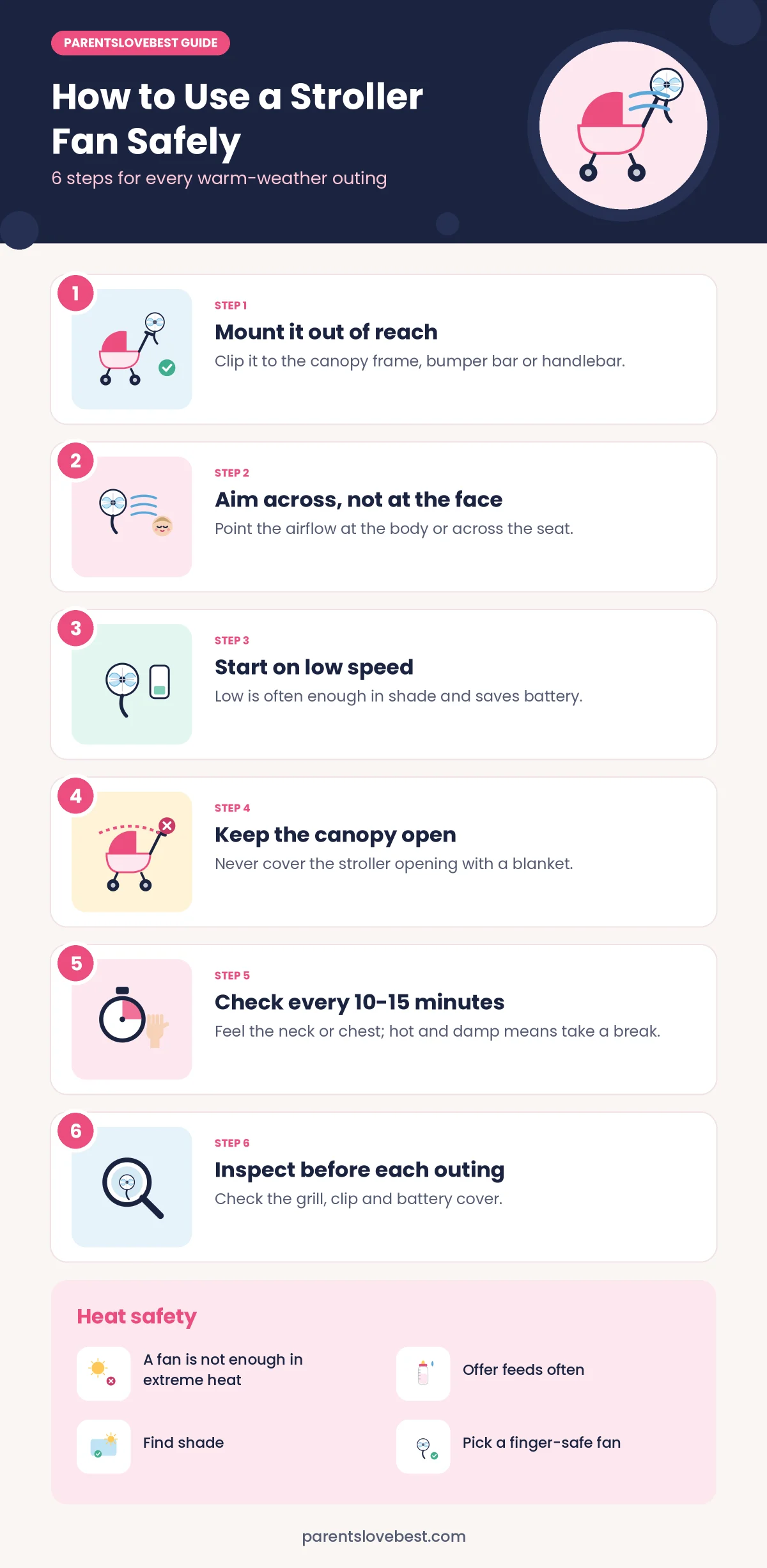
How to Use a Stroller Fan Safely: 6 Steps
You use a stroller fan safely by mounting it securely out of reach, aiming it across your baby rather than straight at the face, and checking on your baby often. Follow these steps every time:
Mount it out of reach. Clip or wrap the fan on the canopy frame, bumper bar or handlebar where your baby cannot grab the fan, cord or arm.
Aim across, not into the face. Point the airflow at the body or across the seat. A strong breeze straight into a baby’s face can dry the eyes and startle them.
Start on low speed. Low speed is often enough in shade and also gives the longest battery life.
Keep the canopy open to the front. Never cover the stroller opening with a blanket, even with a fan running.
Check your baby every 10 to 15 minutes. Feel the back of the neck or chest. Damp and hot means your baby needs shade, a feed or a break indoors.
Inspect the fan before each outing. Check that the grill is not cracked, the clip holds firmly and the battery cover is screwed shut.
How to Choose a Stroller Fan: Features Compared
The best stroller fan for a baby has a finger-safe design, a flexible mount and a battery that outlasts your typical outing. This table compares the three main fan types so you can match one to your child.
| Fan type | How it works | Finger safety | Airflow | Best for |
|---|---|---|---|---|
| Caged blade fan | Plastic blades behind a fine grill | Good if the grill gaps are small | Strongest of the three | Older babies, very warm and humid days |
| Foam blade fan | Soft foam blades that stop on contact | Good, blades are soft | Light to moderate | Newborns and curious grabbers |
| Bladeless fan | Air pushed through an open ring | Best, no blades to touch | Often the weakest | Toddlers who grab everything |
Beyond the fan type, check these features before you buy:
A flexible, grippy arm that holds its angle while the stroller bumps over sidewalks.
At least three speed settings, so you can turn it down for a sleeping baby.
A realistic runtime of six hours or more on low speed.
USB-C charging, so you can share a cable with your phone.
A quiet motor, since a whiny fan can wake a napping baby.
Good to know
Ready to compare models? Our best stroller fan reviews test the top options, or you can browse a popular clip-on stroller fan on Amazon.
Common Mistakes to Avoid With a Stroller Fan
The most common stroller fan mistakes are trusting the fan in extreme heat and mounting it where a baby can reach it. Avoid these:
Covering the stroller and adding a fan.
A fan cannot fix a fully covered stroller, so keep the front open and use the canopy or a mesh shade instead.
Relying on the fan during a heat wave.
Once temperatures hit the high 90s °F, go indoors to air conditioning rather than turning the fan up.
Leaving the fan within reach.
Even foam-blade fans have small parts, cords and batteries, so mount the fan where small hands cannot get it.
Forgetting sun protection.
A fan does not block ultraviolet (UV) rays, so keep using shade, a baby sun hat and light long sleeves.
Skipping feeds on hot days.
Babies under 6 months get their fluids from breast milk or formula, so offer feeds more often in warm weather.
Main Takeaways: Stroller Fan Benefits at a Glance
A stroller fan keeps air moving under the canopy, which keeps your baby cooler, drier and calmer on warm walks.
Use a fan with the canopy open, never with a blanket draped over the stroller.
Fans stop protecting against heat illness in the high 90s °F, so move indoors on those days.
Pick a finger-safe design, mount it out of reach and check on your baby every 10 to 15 minutes.
Frequently Asked Questions About Stroller Fans
What are the benefits of a stroller fan?
The benefits of a stroller fan are cooler, fresher air in the stroller seat, less sweating and heat rash, and calmer naps on warm walks. It also gives parents a safer way to keep a baby comfortable than draping a blanket over the stroller.
Are stroller fans safe for newborns?
Stroller fans are safe for newborns when you choose a finger-safe design, mount it out of reach and aim it across the body instead of straight at the face. Newborns also need shade and frequent feeds on warm days, so the fan is one part of keeping them cool.
Does a stroller fan actually cool a baby down?
A stroller fan cools a baby by moving air across the skin, which carries heat away and helps sweat evaporate. It does not lower the air temperature, so once the air is in the high 90s °F, a fan will not prevent heat-related illness (CDC, 2001).
Is it safe to cover a stroller with a blanket if a fan is running?
It is not safe to cover the stroller opening with a blanket, even with a fan running. A thin cloth raised the inside of a stroller to 93°F within 30 minutes in a Swedish test, and it also stops you from seeing your baby (Svenska Dagbladet, 2014).
Can a stroller fan reduce the risk of SIDS?
No study has looked at stroller fans and sudden infant death syndrome (SIDS). One California case-control study found that a fan running in the baby’s sleep room was linked to a 72% lower SIDS risk, but it studied home sleep, not strollers, and other researchers have questioned its methods (Coleman-Phox et al., 2008). Safe sleep on the back in a bare crib is still the main SIDS protection.
How long does a stroller fan battery last?
A stroller fan battery usually lasts between 2 and 27 hours, depending on the battery size and speed setting. For example, the Skip Hop bladeless fan runs up to six hours on low (Skip Hop, 2026), while the Momcozy 8,000mAh model is rated for up to 27 hours (The Bump, 2026).
Which is better: a bladeless or a bladed stroller fan?
A bladeless stroller fan is better for finger safety, while a caged or foam-blade fan usually moves more air. Choose bladeless for a toddler who grabs everything, and a caged or foam-blade fan for a younger baby on hot, humid days.