
#1 · Extended rear-facing
Type
Convertible
Child Weight Range
4-65 lb
Price
About $240-$260

As an Amazon Associate, Parents Love Best earns from qualifying purchases. Learn more
We compared 10 of the best car seats on limits, fit, installation and price so you can match the right seat to your child’s age and your car.
The Graco Extend2Fit is a convertible car seat built to keep your child rear-facing up to 50 lb.
This table compares all 10 car seats by type, weight range and starting price. Prices are list or recent retail prices and change often, so check the current price before you buy.



The best car seat for your family is the one that fits your child’s current size, installs tightly in your vehicle, and is easy enough that you use it correctly every ride. These are the criteria we used to judge each seat on this list.
All car seats sold in the U.S. must meet the same federal crash test standard (FMVSS 213). Extra features make a seat easier to use correctly, which matters because 46% of car seats and boosters were found to have at least one misuse (NHTSA, 2015).
A higher limit (40-50 lb) lets your child ride rear-facing longer, which the AAP recommends.
Many kids outgrow a seat by height before weight, so check the inches, too.
A 65 lb harness keeps preschoolers in a 5-point harness instead of moving to a booster early.
All-in-one seats with a booster mode can replace a second purchase later.
2-in-1, 3-in-1, 4-in-1 and 5-in-1 seats cover different age spans.
Seats near 17-18.5 inches wide make three-across setups possible in many cars.
Lighter seats (under 20 lb) are easier to move between cars or carry through airports.
Tensioning systems and level indicators reduce the chance of a loose install.
Raising the headrest also raises the harness, so you skip rethreading straps by hand.
More recline settings help you hit the correct angle in sloped vehicle seats.
Check for seats tested to the federal side impact standard (FMVSS 213a).
FAA-approved seats can be used on planes in harness mode.
Covers that come off without uninstalling the seat save time after spills.
Some seats use flame retardant-free or GREENGUARD Gold certified fabrics.
Most seats last 6-10 years from the date of manufacture.
A higher price buys convenience features, not a pass/fail safety difference.
Your child needs a rear-facing seat from birth, a forward-facing harness seat once they outgrow rear-facing limits, and a booster until the adult seat belt fits. Each seat type below covers one or more of those stages.
A rear-facing-only seat that clicks into a base and often into a stroller. Most fit babies up to about 30 lb.
A seat that installs rear-facing first, then turns forward-facing with a harness. It does not become a booster.
A convertible seat that also becomes a belt-positioning booster for older kids.
A seat that raises a child so the vehicle's lap and shoulder belt crosses the hips and chest correctly. It has no harness.
Two terms come up in every review below. LATCH (Lower Anchors and Tethers for Children) is the set of metal anchors built into your car’s seat crease that a car seat clips onto. A top tether is a strap from the top of the seat to an anchor behind the vehicle seat, and it limits how far the seat moves forward in a crash.
A child should stay rear-facing as long as possible, until they reach the top rear-facing weight or height limit of their seat. The American Academy of Pediatrics (AAP) dropped its old "until age 2" milestone in 2018 and now uses the seat's limits instead (AAP, 2018).
Rear-facing works like a catcher's mitt. In a frontal crash, the seat shell cradles the head, neck and spine together, spreading crash forces across the whole back instead of the neck.
A child should move to a booster only after outgrowing the forward-facing harness limits of their seat. They should stay in the booster until the lap and shoulder belt fits, which is often at 4 feet 9 inches tall and 8 to 12 years old (AAP, 2018).
Below, each car seat gets a full review covering who it suits, what makes it different, and where it falls short. Specs come from manufacturer pages and verified retailer listings.
The Graco Extend2Fit is a convertible car seat built to keep your child rear-facing up to 50 lb. It earns the top spot because it pairs a high rear-facing limit with a leg-room panel and a price well under premium rotating seats.
The extension panel is the reason to buy this seat. Toddlers usually outgrow rear-facing comfort before weight, because their legs bunch against the vehicle seat. Sliding the panel out up to 5 inches gives them room, so a 3- or 4-year-old can stay rear-facing without complaining.
The 50 lb rear-facing limit is high for a seat in this price range. Many convertible seats stop at 40 lb rear-facing, including the Chicco Fit360 Zip, which costs roughly twice as much. For parents following the AAP advice to rear-face as long as possible, that extra 10 lb can mean another year rear-facing.
At 19 lb, the Extend2Fit is light enough to move between two cars without a struggle (Graco, 2026). The harness storage pockets hold the straps out of the way while you lift your child in, which helps on rainy days when you want the door closed fast.
It has a 4.5 out of 5 rating from more than 2,100 reviews on Graco’s own site (Graco, 2026). Reviewers often mention the clear level indicator and how easy the LATCH install is, which is helpful given how common loose installs are.
Parents who want to keep a toddler rear-facing to 50 lb without paying for a premium seat.
Families who want one seat that becomes a booster, or anyone fitting three seats across.
The Baby Trend Journey is a 4-in-1 all-in-one car seat that covers children from 4 lb to 100 lb. It is on this list because it gives you four modes and a slim 18.25-inch width for about half the price of most all-in-one seats.
Price is the main reason to choose the Journey. At $119.99 on sale, you get a seat that runs from the hospital ride home to the booster years. Buying a separate infant seat, convertible seat and booster usually costs two to three times that.
The Zero Radius Recline is a smart design for small cars. The seat reclines within its own footprint instead of sliding forward, so the front passenger keeps more leg room. The flip foot under the base adds a second way to fine-tune the angle in sloped vehicle seats.
The seat weighs 16.24 lb, which is light for a 4-in-1 (Baby Trend, 2026). That makes it a realistic option for grandparents or a second car. The Comfort Cabin padding and two built-in cup holders keep older kids happy on longer drives.
The no-twist harness indicator is a small detail that helps with daily use. Twisted straps spread crash forces poorly, and checking them by feel is easy to skip when you are rushing. A visual cue makes the check part of the routine.
Budget-minded parents who want one seat from birth to booster.
Parents set on rear-facing past 40 lb.
The Evenflo Symphony Extend Breeze is a 3-in-1 all-in-one seat with breathable FreeFlow fabrics and a 50 lb rear-facing limit. It stands out for families in warm climates who want extended rear-facing and a seat that lasts up to 10 years.
Heat is a real comfort problem in rear-facing seats, where kids sit against padded walls with little airflow. The FreeFlow fabric is designed to breathe, which helps on long summer drives. Families in hot, humid places may find fewer sweaty, fussy kids at the end of a ride.
The 50 lb rear-facing limit matches the Graco Extend2Fit, and this seat also adds a booster mode. Safe in the Seat, a team of certified Child Passenger Safety Technicians, notes the highest harness slot sits at 19 inches, one of the tallest available (Safe in the Seat, 2026).
At 17 lb and 18.5 inches wide, it is light for an all-in-one seat (Safe in the Seat, 2026). It is also certified for aircraft use, so it can double as a travel seat when you fly with a toddler in harness mode.
The seat pad has built-in access to the belt path, so you route the vehicle belt without peeling back fabric. That matters because a loose installation was the most common misuse NHTSA found in its field study (NHTSA, 2015).
Families in warm climates who want extended rear-facing in an all-in-one seat.
Shoppers on a tight budget or those who want a backless booster stage.
The Chicco Fit360 Zip is a rotating convertible car seat that turns 360 degrees to face you during loading. It earns its place for parents with back pain, tight parking spaces, or squirmy toddlers who need to be buckled in fast.
Rotation is the whole point of this seat. You swing it toward the open door, buckle your child while facing them, then rotate back until the indicator turns green. Parents recovering from a C-section, grandparents, and anyone with a bad back often find this far easier than leaning in.
The LeverLock system makes a tight install simpler. You open a door on the base, route the seat belt, and close it, and the lever applies the tension for you. The base can stay installed the same way for both rear- and forward-facing use.
The Zip version adds a zip-off cover, so cleanup after a car-sick ride takes minutes. The included mirror attaches at the correct angle with no fiddling, and Chicco states it is crash-test approved for this specific seat (Chicco, 2026).
Side impact protection uses a steel-reinforced shell and EPP energy-absorbing foam. Chicco says the seat is engineered to meet FMVSS 213a, the federal side impact standard (Chicco, 2026). A removable newborn insert supports babies from 4 to 11 lb.
Parents who want the easiest daily loading and can leave the seat in one car.
Families who switch the seat between vehicles or fly with it.
The Evenflo Monarch Travel System pairs a full-size stroller with the LiteMax NXT infant car seat, which fits babies from 3 lb. It is here for parents of premature or small newborns who want a car seat and stroller that click together from day one.
The 3 lb minimum weight is the main reason to pick this system. Most infant seats start at 4 lb, and most convertible seats start at 4 or 5 lb. If your baby is expected early or measures small, a seat rated for 3 lb gives a correct harness fit from the hospital ride home.
A travel system means the car seat clicks straight from the base onto the stroller. You can move a sleeping baby from car to stroller without unbuckling them. Evenflo launched the Monarch in September 2026, so it is one of the newest systems on the market (Evenflo, 2026).
The stroller’s toddler seat handles children up to 55 lb and 45 inches, so the stroller stays useful long after the infant seat is outgrown. It folds with the toddler seat attached in either direction, which saves a step when you load the trunk.
SensorySoothe is a lights-and-sounds feature built into the infant seat. It can help calm a fussy baby in the car or on a walk. Treat it as a comfort extra; the safety value comes from the seat’s harness and installation.
Parents expecting a premature or small baby who want a matched car seat and stroller.
Parents who only need a car seat, or who want one seat to use for years.
The Diono Radian 3R Max is a slim all-in-one car seat built on a steel frame, designed to fit three across in many back seats. It belongs on this list for families with two or three kids in car seats who need every inch of width.
Width is why parents buy a Radian. The Radian line is known as the original three-across all-in-one seat, and earlier Radian 3R models measure close to 17 inches wide (Safe Beginnings, 2024). That slim profile can let you fit three seats in a midsize car instead of buying a bigger vehicle.
The steel frame gives the seat a solid core that holds up over 10 years of use. The Radian 3R line carries a 10-year lifespan from the date of manufacture, covering rear-facing through the booster years (Safe Beginnings, 2024).
The 50 lb rear-facing limit matches the best on this list, and the 120 lb booster limit is the highest of any all-in-one here except the Graco 4Ever DLX Grad. One seat can carry a child from birth into the tween years.
The seat folds flat, which is rare in an all-in-one car seat. That makes it easier to pack for a trip or store in a closet. It is also FAA approved, so you can use it on the plane in harness mode.
Families fitting three car seats across one row.
Parents who want the quickest, simplest adjustments.
The Safety 1st Simple-Click Canopy is a 3-in-1 all-in-one car seat with a removable sun canopy for rear-facing babies. It made the list because it combines sun protection, a slim fit and a booster mode for under $180.
The canopy solves a common complaint. Sun through the side and rear windows hits rear-facing babies right in the eyes, and window shades rarely cover the whole gap. The built-in canopy shades your baby without clip-on accessories, which can become loose objects in a crash.
The seat is dryer-safe as well as machine-washable. Many car seat covers must air-dry, which can leave you without a seat for a day. Being able to wash and dry the pad in one go is a real help for families with one car.
With the canopy off, the slim design fits three seats across in most vehicles (Safety 1st, 2026). That gives growing families flexibility as a second or third child arrives.
The seat is certified for aircraft use. If you fly with a baby or toddler, you can bring the seat onboard and use it in harness mode, then install it in a rental car at your destination.
Parents who want sun protection for a rear-facing baby in an affordable all-in-one seat.
Parents of very small newborns under 5 lb.
The Cosco Kids ShadeVenture is a lightweight 2-in-1 convertible car seat with a removable canopy and a slim shell. It is the pick for travel, grandparents’ cars, or a backup seat at the lowest price on this list.
Light weight is the reason to buy this seat. Carrying a 30 lb car seat through an airport is miserable, and the ShadeVenture is built to be portable. It is certified for aircraft use, so you can use it on the plane and in the rental car.
At $119.99, it is a sensible second seat. Many families keep their main seat in one car and use a lighter, cheaper seat for grandparents, a babysitter or a nanny. Using a dedicated second seat also avoids reinstalling your main seat over and over.
The canopy gives rear-facing babies shade from the sun, similar to the Safety 1st Simple-Click. That is a useful extra at this price, where most seats are bare-bones.
The forward-facing harness tops out at 50 lb and 44 inches, lower than the 65 lb limit on most seats here. For a travel or backup seat, that trade-off is reasonable, but it should not be your only seat for a large preschooler.
Travel, grandparents' cars, or a backup seat.
Families who want one main seat to last into the booster years.
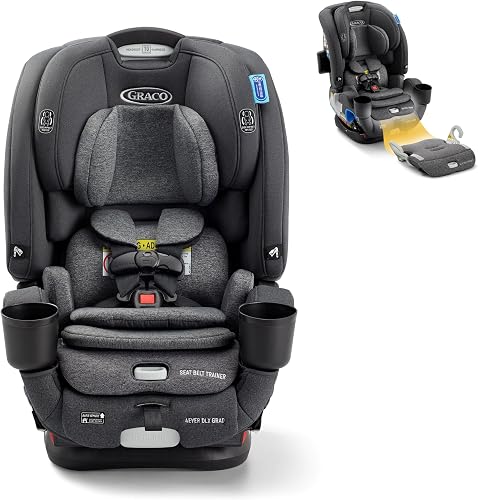
The Graco 4Ever DLX Grad is a 5-in-1 all-in-one car seat designed to fit children from infancy to 12 years old. It is the best choice if you want to buy one car seat and be done for a decade.
The seat belt trainer is what makes this seat different. Graco calls it the first car seat with five modes (Graco, 2026). After the booster stage, the trainer helps position the adult seat belt correctly on a child who has nearly outgrown boosters, covering the gap the AAP describes before kids reach 4 feet 9 inches.
Because the trainer is removable, two children can use the seat parts at the same time. A younger sibling rides in the harness seat while the older one uses the trainer. That can save you buying a separate booster when your second child arrives.
SnugLock is Graco’s seat belt tensioning system. You open a panel, route the belt, and close it, and the lock-off holds the belt tight. Graco says most parents can install the seat in under a minute, which helps fight the loose-install problem.
The seat is rated for 10 years from its date of manufacture (Graco, 2026). Spread over that time, the cost per year is lower than buying separate convertible and booster seats. At 23.5 lb, it is heavy, so plan to leave it in one car.
Parents who want one seat from the hospital to the tween years.
Parents set on rear-facing past 40 lb, or who fly often with a car seat.
The Britax Skyline is a 2-stage booster seat that converts from a high-back booster to a backless booster. It is the pick for children who have outgrown their harness seat and need a booster until the adult seat belt fits.
The 120 lb and 63-inch limits are the reason to choose this booster. The AAP says kids should use a booster until the seat belt fits, often at 4 feet 9 inches (57 inches) and 8 to 12 years old (AAP, 2018). A booster that fits up to 63 inches covers taller kids who still need it.
The lower connectors clip the booster to your car’s LATCH anchors. A booster normally relies on the vehicle seat belt to hold the child, but an empty, unattached booster can fly around in a crash. The connectors keep it in place even when no one is sitting in it.
Color-coded belt guides show exactly where the lap and shoulder belt should go. Booster misuse is less common than harness seat misuse, but NHTSA still found misuse in 16% of high-back boosters in its field study (NHTSA, 2015). Clear guides make correct belt routing easier for kids buckling themselves.
At about 11-12 lb, the Skyline is light enough for carpools (Britax, 2026). The backless mode is handy for older kids who feel too big for a high-back seat, though high-back mode gives more head support in side crashes.
Big kids who have outgrown a 5-point harness but are under 4 feet 9 inches.
Children under 40 lb or kids who still fit a forward-facing harness.
A car seat is installed correctly when it moves less than 1 inch side to side at the belt path, sits at the right recline angle, and uses either LATCH or the seat belt as the manual directs. Installation matters because NHTSA found a loose installation in 17% of the car seats it inspected (NHTSA, 2015).
Read both manuals. Your car seat manual and your vehicle owner’s manual each list approved seating positions and LATCH weight limits.
Choose LATCH or the seat belt. Use one method unless your seat’s manual says both are allowed.
Check the recline angle. Rear-facing seats have a level indicator, so adjust until it shows the correct range for your child’s weight.
Tighten and test. Press down on the seat and pull the belt or LATCH strap tight, then test at the belt path for less than 1 inch of movement.
Use the top tether when forward-facing. NHTSA recommends a tether for every forward-facing harness seat (NHTSA, 2015).
Get a free check. Certified Child Passenger Safety Technicians at many fire stations and hospitals will inspect your install.
Register your car seat with the manufacturer after you buy it. Registration is how you get recall notices.
Most car seat mistakes come from rushing or moving a child to the next stage too early. Fixing these takes minutes and makes a real difference in a crash.
Keep your child rear-facing until they hit the seat's rear-facing weight or height limit, not a birthday.
If you can pinch a fold of strap at the shoulder, tighten the harness until you can't.
The chest clip should sit at armpit level, not over the belly.
Thick coats compress in a crash and leave the harness loose, so buckle your child in and lay the coat over them.
Children 4 to 7 years old were moved to seat belts too early about 25.8% of the time in NHTSA's 2015 data (NHTSA, 2015).
Check the expiration date on the label and replace a seat after a moderate or severe crash.
The best car seat overall is the Graco Extend2Fit 2-in-1 Convertible Car Seat. It has a 50 lb rear-facing limit, a leg-room extension panel and a mid-range price. If you want a seat that also becomes a booster, the Graco 4Ever DLX Grad 5-in-1 is the better long-term pick.
The best car seat for a newborn depends on your baby’s size. For premature or small babies, the Evenflo Monarch Travel System‘s LiteMax NXT infant seat fits from 3 lb. For full-term babies, convertible seats starting at 4 lb, like the Graco Extend2Fit or Chicco Fit360 Zip, work from day one.
A convertible car seat goes from rear-facing to forward-facing with a harness, then stops. An all-in-one car seat does the same and also becomes a booster seat for older kids. All-in-one seats cost more upfront but can replace a separate booster purchase.
A child should ride rear-facing as long as possible, until they reach the highest rear-facing weight or height their seat allows. The AAP removed its “until age 2” milestone in 2018 (AAP, 2018). Seats with 50 lb rear-facing limits let many children rear-face past age 3.
Your child can use a booster seat after outgrowing the forward-facing harness limits of their car seat, and when they are mature enough to sit still for the whole ride. Most boosters start at 40 lb. Keep them in a booster until the adult seat belt fits, often at 4 feet 9 inches tall.
Rotating car seats are not automatically safer, since all car seats sold in the U.S. must pass the same federal crash standard. Their benefit is easier loading, which can make correct buckling more likely. They are also heavier and more expensive than most fixed seats.
Yes, car seats expire, usually 6 to 10 years after the date of manufacture. Plastics weaken over time, and safety standards change. The Graco 4Ever DLX Grad and Diono Radian 3R line, for example, are rated for 10 years. Check the label on your seat for its exact date.
You can use many car seats on an airplane if they carry an FAA approval label. On this list, the Evenflo Symphony Extend Breeze, Diono Radian 3R Max, Safety 1st Simple-Click Canopy, and Cosco ShadeVenture are certified for aircraft use. Booster seats cannot be used on planes because planes have lap belts only.
The Graco Extend2Fit 2-in-1 is our top pick, because its 50 lb rear-facing limit and leg-room panel keep kids rear-facing longer for a fair price. If you want one seat to last until age 12, the Graco 4Ever DLX Grad 5-in-1 is the runner-up for long-term value.
On a budget, the Baby Trend Journey 4-in-1 covers birth to booster for about $120. For easy daily loading, the Chicco Fit360 Zip is worth its higher price. For a premature or small newborn, start with the Evenflo Monarch Travel System.