
#1 · Overall pick
Bag System
Any 13-gal bag
Capacity
55 newborn diapers
Typical Price
About $70 to $90

As an Amazon Associate, Parents Love Best earns from qualifying purchases. Learn more
Ten diaper pails compared on the three things that decide the purchase: odor sealing, what the bags cost you monthly, and capacity.
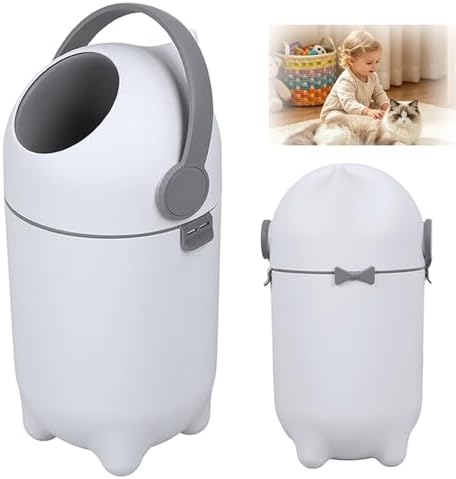
The Ubbi is a powder-coated steel pail with a sliding lid and rubber gaskets that takes any standard 13-gallon trash bag.
Prices move often on Amazon. The Diaper Genie Complete alone has ranged from $30.49 to $69.06 on the same listing (camelcamelcamel, 2026), so check the live price before you commit.


Pick a diaper pail on bag type first, odor seal second, and capacity third. Bag type sets your ongoing cost for the next two to three years. Odor seal decides whether the nursery smells. Capacity decides how many trips you make to the outdoor bin each week.
Proprietary refill packs run about $7 to $48 depending on brand and count; standard trash bags cost pennies per change
A gasket or trap door keeps smell inside between changes
Many pails leak smell only in the two seconds the lid is open
Newborn counts range from 16 to 60 diapers across these 10 models
A foot pedal lets you hold the baby and dispose of a diaper at once
Sliding or push-top lids work when your other hand is busy
Steel and closed-cell ABS plastic resist odor absorption better than soft plastic
Toddlers open unlocked pails, and some locks cover the chute but not the main lid
Some systems take 20 seconds; sealed-clamp systems take longer
Taller pails reduce bending; shorter pails fit under a changing table
Oval and slim pails fit beside a dresser in a small nursery
Rotating chambers and trap doors are harder to deep clean when soiled
Carbon filters need replacing every 30 to 90 days depending on brand
Cloth needs a wide opening and a pail that can be washed out
Pails that convert to a trash can stay useful after potty training
Coverage ranges from 1 year to 3 years on these models
Budget for the bags, not the pail. Infants go through up to 12 diapers a day, at $80 to $100 or more per month for the diapers alone (National Diaper Bank Network, 2022). On top of that, a refill-based pail adds its own liner cost, and that number is often higher than the pail itself.
One Munchkin refill ring holds up to 272 newborn diapers and an 8-pack sells for $47.99 (Munchkin, 2026). A baby using 10 diapers a day works through roughly 3,650 diapers a year, so plan on 13 to 14 rings, or about $80 per year in liners.
A standard-bag pail replaces that line item with 13-gallon kitchen bags you already buy. Over two years, that difference is often larger than the price gap between a $30 pail and an $80 pail.
The EPA put disposable diaper waste at 4.1 million tons in 2018, about 1.4 percent of all municipal solid waste that year (EPA, 2018). Pails that let you empty partial loads without wasting a full liner cut some of that down.
Each review below covers the bag system, odor seal, and real capacity, then pros and cons and who the pail suits.
The Ubbi is a powder-coated steel pail with a sliding lid and rubber gaskets that takes any standard 13-gallon trash bag. It is the pick for parents who want strong odor containment without a subscription to proprietary refills.
Steel is the reason to buy it. Plastic pails absorb odor molecules over months of use and start to smell even when empty. The Ubbi’s powder-coated steel body does not, which means the pail you use at month 24 performs like the one you unboxed (Ubbi, 2026).
The sliding lid is the second design decision that matters. Instead of swinging open and pushing a pocket of air out at you, it slides across the top, so less air moves during disposal (Ubbi, 2026). Three rubber gaskets seal the perimeter when it is closed.
Capacity is 55 newborn diapers in a 13-gallon body measuring 19.5 by 8.4 by 11.4 inches (Ubbi, 2026). Forbes Vetted measured real-world loads at roughly 40 newborn or 20 toddler diapers, which still beat most pails in that review (Forbes Vetted, 2026).
Two honest limits. There is no foot pedal, so you slide the lid with a free hand, and a full bag can grip the inside walls on removal. The child lock covers the sliding door, not the main lid, so a determined toddler can still lift the top.
Parents who want one pail for the full diapering period and refuse to buy proprietary liners.
Anyone who wants true hands-free, foot-pedal operation.
The Munchkin STEP pairs a foot pedal with a self-sealing lid and a baking soda cartridge, and it is the strongest sealed system here. The trade is cost: it runs on Arm & Hammer refill rings or Snap, Seal & Toss bags.
The odor system has three parts working at once. A self-sealing lid closes the chute after each diaper, the PUCK baking soda cartridge sits in the lid, and the seven-layer refill film blocks smell from the bag side (Munchkin, 2026). You smell the pail mainly during the drop itself.
The foot pedal is the daily-use win. You hold the baby, step, drop, and walk away without touching a surface. The pail is 13 gallons with the same 272-diaper refill-ring capacity used across Munchkin’s pails (Munchkin, 2026).
Run the numbers before buying. Refill rings sell for $47.99 per 8-pack and Snap, Seal & Toss bags for $21.99 per 20-pack, which holds up to 600 newborn diapers (Munchkin, 2026). Today’s Parent estimated total refill and cartridge spend near $365 across three years for one child (Today’s Parent, 2017).
The bundle on this listing includes one Snap, Seal & Toss bag, one starter refill ring, and one PUCK cartridge, so plan a refill order in the first month. The pail itself lists at $74.99 direct (Munchkin, 2026).
Parents with a sensitive nose, or a nursery where the pail sits close to the crib.
Budget-focused households that want to use kitchen bags.
The Momcozy uses a rotating disposal chamber to block odor at three points while still taking ordinary 13-gallon trash bags. It is the closest thing here to sealed-system odor control without the refill bill.
The triple-seal system works in stages. A rotating ball seals the top opening as the diaper drops through, seals the bag below between changes, and a clamp holds the bag mouth shut while you lift the lid to remove it (Momcozy, 2026). You never touch a soiled part.
Mommyhood101 ran about two weeks of hands-on testing and rated odor containment, one-handed operation, and standard-bag compatibility as its strengths, while flagging that bag installation is finicky and the rotating chamber is hard to deep clean if soiled (Mommyhood101, 2026).
Capacity is 22 liters, holding up to 60 newborn diapers or 24 large diapers, with a transparent window so you can see the fill level (Momcozy, 2026). At 28.86 inches tall, it is built for disposal without bending.
Price sits at $76.49 on sale against a $89.99 list, with a child safety lock and 15 starter bags included (Momcozy, 2026). It is newer than the other names here, so the long-term durability record is thin.
Parents who want sealed-system odor performance and refuse to buy refills.
Small nurseries where a 28.86-inch pail is too tall for the space available.
The Dekor Plus is the largest pail in this comparison and the most flexible on diaper type. Step on the pedal, drop the diaper through a trap door, and the continuous liner seals it below.
The continuous liner is what separates it from refill-ring pails. There is no preset bag length, so you cut what you need with the child-proof cutter inside the access door. Empty three diapers or 60 without wasting a full bag (Dekor, 2026).
Capacity runs to 60 newborn diapers in the pail and up to 580 newborn diapers per liner roll (Dekor, 2026). The Plus measures about 13.5 by 9.5 by 22.75 inches, which makes it a single-pail solution for twins or a household that empties less often.
Cloth diaper users get a wide opening and a body made from closed-cell ABS plastic that resists odor absorption, rust, and yellowing, and wipes clean with household cleaners (Dekor, 2026). The EKO version is made with 70 percent GRS-certified post-consumer recycled material.
It still needs Dekor refills, so factor that cost in. A four-count liner refill runs about $31.50 and a nine-liner Classic pack about $36.99 depending on retailer (Dekor retail listings, 2026). Bag changes take around 20 seconds once you know the cutter.
Twins, heavy users, and parents rotating between cloth and disposable diapers.
Anyone set on using standard trash bags.
The Diaper Genie Complete is the most widely stocked refill pail in the US, with double Air-Tite clamps, a carbon filter, and a foot pedal. It is the safe default if refill availability matters more than running cost.
The odor system stacks three layers: the double Air-Tite clamps press the bag closed, the multi-layer refill film blocks smell from inside, and an activated carbon filter in the lid absorbs what escapes during the drop (Diaper Genie, 2026).
Capacity is where buyers get confused. The pail body holds up to 36 newborn diapers at a time, while the included round refill holds up to 270 newborn diapers across multiple bag changes (Diaper Genie, 2026). The pail figure is the one that decides how often you empty.
Refills are the cheapest and easiest to find in this comparison, stocked at nearly every grocery and big-box store. Munchkin’s Arm & Hammer rings are also sold as a guaranteed fit for the Complete, which gives you a second supplier (Munchkin, 2026).
Two maintenance notes. The carbon filter needs replacing every 30 days for full effect, at about $7 for a 4-pack (Diaper Genie, 2026). Amazon pricing on the pail has swung between $30 and $69 historically, so watch the listing (camelcamelcamel, 2026).
First-time parents who want a familiar system with refills available locally.
Households trying to avoid proprietary refills entirely.
This is a 13.2-gallon step pail built for adult incontinence products and high-volume nursery use, and it takes ordinary kitchen bags. It holds 40-plus adult diapers, far more than the 7 to 11-gallon pails usually sold for this job.
The odor approach is different from sealed-refill pails. An AbsorbX activated carbon filter runs continuously to absorb odor rather than mask it with fragrance, which suits caregivers who react to scented liners (iTouchless, 2026).
Build quality is aimed at long-term care settings. The body is non-porous PP/ABS with a matte, fingerprint-proof, rust-free finish, and the lid closes slowly and quietly, which matters in a bedroom at night (iTouchless, 2026). The listing is ADA compliant for care facility use.
Capacity is the practical argument. At 50 liters, caregivers empty it far less often than with a small bedside pail, and it fits standard 13-gallon kitchen bags with no refills to reorder (iTouchless, 2026).
Pricing on the plastic 13.2-gallon SoftStep model runs $79.96 against a $114.95 list on the manufacturer’s own store, so compare that with the Amazon listing before ordering (iTouchless, 2026). The pedal footprint is elongated, so measure your space.
Caregivers handling adult incontinence products, and households diapering two or more children.
Small nurseries with limited floor space.
The L.A. Baby Magic is a narrow 9.3-gallon pail with a patented odor-blocking system, a child-safe lock, and no refill requirement. It is the one to pick when floor space is tight.
Size drives the decision. At 9.5 by 9.5 by 18 inches and 3.6 pounds, it fits in a corner, beside a toilet, or in a childcare changing station without crowding the room (L.A. Baby, 2026). It holds around 25 diapers between changes.
The odor system is a dual-seal design that L.A. Baby markets as 100 percent odor free, backed by a child-proof lock on one-handed operation (L.A. Baby, 2026). Childcare suppliers stock it for exactly that lock plus wipe-clean plastic.
Bags are the money saver. It takes any standard bag of similar size, with 15 multi-layer bags included to start, and the manufacturer positions the no-refill design as the main saving versus cartridge pails (L.A. Baby, 2026).
Retail sits around $69.99 to $79.99 depending on the seller, with a 1-year limited warranty (L.A. Baby retail listings, 2026). The lid is removable so the pail converts to an open bin later.
Small nurseries, bathrooms, grandparents' homes, and childcare rooms.
Families who want to empty the pail twice a week rather than daily.
The Easy Saver is the cheapest way to get a lidded, deodorized diaper pail that uses ordinary trash bags. It has one-hand operation, a pop-open seal top, and a replaceable deodorizer disc.
Cost is the whole argument. It uses standard plastic bags with no cartridges, and reviewers repeatedly cite that as the reason they bought it a second time (Walmart customer reviews, 2026). Retail sits near $29.99 through baby specialty sellers (ANB Baby, 2026).
Odor performance is mid-pack and the reviews say so plainly. Parents rate it 4.2 out of 5 across 141 Walmart ratings, with praise for capacity and cost and criticism of a flimsy lid on some units (Walmart, 2026).
Its second use is worth knowing. Owners commonly move it to pet waste, kitty litter, or adult incontinence duty after potty training, since it is just a sealed bin with a deodorizer slot.
Replacement deodorizer discs are sold separately under part 23900, so order a set with the pail (Safety 1st, 2026). Skipping them is the most common reason owners say the odor performance drops.
Second pails, tight budgets, and grandparents' houses.
Nurseries where the pail sits in the same room where the baby sleeps.
This 7-gallon pail is built specifically for cloth diapers, with a wide opening, a clamp-down lid, and a replaceable charcoal filter that lets air move without letting odor out. It holds one to two days of cloth.
Cloth needs airflow, and that is the design difference. Sealed pails trap moisture against cloth and encourage mildew, while the Busch pail’s vented lid and activated charcoal filter release moisture and hold odor (Busch Systems, 2026).
The dimensions suit a laundry room or bathroom: 11.38 by 11.38 by 14.25 inches at 3.8 pounds, made from recycled plastic and recyclable at end of life (Busch Systems, 2026). Two side handles clamp the lid down and double as a child deterrent.
Owner feedback matches the design intent. It holds roughly two to three days of cloth diapers and keeps odor contained, rating 4.2 out of 5 across about 240 Amazon reviews (Amazon listing data, 2026). Pail liners from cloth brands fit it.
Filter replacements are the only consumable, and owners report single filters lasting many months. Busch sells replacements directly and cloth retailers stock generic equivalents.
Cloth diapering families and daycare or maternity rooms running a wet pail.
Disposable-only households wanting a nursery centerpiece.
The SaftSpzre is a 15-liter plastic pail with an airtight baffle lid, one-handed operation, and no refill requirement. It is a sensible second pail for a bathroom, bedroom, or car-seat-area changing spot.
Size sets expectations. It holds up to 16 diapers at once and measures 10.63 by 10.63 by 19.69 inches, which is roughly two days for a newborn and about one day at peak (SaftSpzre, 2026).
The odor design is a sealing baffle plus an airtight lid rather than a refill cartridge or carbon filter. It fits any standard 4 to 8-gallon trash bag, so running cost stays near zero (SaftSpzre, 2026).
It is a marketplace brand rather than an established name, so treat durability and review volume with more caution than the Ubbi or Diaper Genie listings. The upside is the price band, which sits well under the sealed systems.
The listing covers both disposable and cloth use, and the non-porous plastic wipes clean quickly. For a primary nursery pail, the capacity is too small; as a bathroom backup, it is sized correctly.
A second pail in a bathroom, bedroom, or grandparent's house.
Use as the only pail for a newborn.
Cloth diapers need airflow and a washable pail, which rules out most sealed refill systems. A sealed pail holds moisture against wet cloth and grows mildew between wash days, so cloth users want a vented lid with a carbon filter, or a large pail they can line with a washable pail liner.
Two picks here fit. The Busch Systems pail is built for cloth, with a vented lid and a wide opening sized for pail liners (Busch Systems, 2026). The Diaper Dekor Plus suits households running cloth and disposables together, since its washable ABS body handles both (Dekor, 2026).
Most cloth users run a load every two to three days, which means a 7-gallon pail is usually the right size, not a 13-gallon one.
Most odor complaints come from maintenance, not the pail. Filters have service lives, gaskets collect residue, and an overfilled bag breaks the seal it depends on. Fix these four things before blaming the product.
Diaper Genie recommends a new carbon filter every 30 days (Diaper Genie, 2026), and Munchkin's PUCK cartridge is a separate consumable (Munchkin, 2026).
A bag stuffed above the clamp or gasket stops the lid from closing flush, and the pail leaks odor from the rim.
Wipe the gaskets, chute, and trap door monthly with a household cleaner, which is why ABS and steel bodies are easier to live with than soft plastic.
Heat speeds bacterial growth inside the bag. Keep the pail away from radiators and direct sun.
The Munchkin STEP Diaper Pail has the strongest odor system in this comparison, combining a self-sealing lid, seven-layer refill film, and an Arm & Hammer baking soda cartridge (Munchkin, 2026). If you want similar sealing without refill costs, the Momcozy Triple-Seal blocks odor at three points and still uses standard 13-gallon bags (Momcozy, 2026).
No. Ubbi, Momcozy, iTouchless, L.A. Baby, Safety 1st, Busch Systems, and SaftSpzre all take ordinary trash bags. Munchkin, Diaper Genie, and Diaper Dekor use proprietary refills, which improves sealing but adds roughly $80 or more per year in liners based on manufacturer pricing (Munchkin, 2026).
Every two to three days for most families, sooner in hot weather. Infants use up to 12 diapers a day (National Diaper Bank Network, 2022), so a 25-diaper pail such as the L.A. Baby Magic fills in about two days, while a 60-diaper pail such as the Diaper Dekor Plus or Momcozy stretches to four or five.
A diaper pail adds a secondary seal between the diaper and the room: a gasket, trap door, rotating chamber, or clamped liner, usually with a carbon filter or deodorizer. A kitchen trash can has a single lid, so odor escapes every time it opens and the plastic absorbs smell over time.
Steel does not absorb odor molecules the way soft plastic does, so a steel pail such as the Ubbi still performs at month 24 (Ubbi, 2026). Closed-cell ABS plastic, used in the Diaper Dekor, resists absorption in the same way without the rust or dent risk of steel (Dekor, 2026).
A standard-bag pail costs the price of 13-gallon kitchen bags, usually under $30 a year. A refill system costs roughly $80 or more per year based on Munchkin’s 8-pack refill pricing and typical usage (Munchkin, 2026), and Today’s Parent put three-year refill and cartridge spend near $365 for one child (Today’s Parent, 2017).
Yes, and two models here are sized for it. The iTouchless 13.2-gallon STEP pail is built for adult products with 40-plus capacity and ADA-compliant operation (iTouchless, 2026), and Ubbi sells a 13-gallon adult version of its steel pail.
The Ubbi Stainless Steel Diaper Pail is the top pick. It holds 55 newborn diapers, seals odor with steel and rubber gaskets rather than a cartridge, and takes the kitchen bags you already buy, which saves the refill cost that outlasts the pail itself.
Buy the Munchkin STEP instead if odor is your single priority and the refill cost is acceptable. Choose the Momcozy Triple-Seal if you want sealed-system performance with standard bags, the Diaper Dekor Plus for cloth or twins, and the Safety 1st Easy Saver as a $30 second pail.