
#1 · Overall stash
Type
Pocket
Approx. Price Each
$21.95
Fit Range
8-35 lb
Closure
Snaps or hook-and-loop

As an Amazon Associate, Parents Love Best earns from qualifying purchases. Learn more
The best cloth diapers balance three things: how much they hold, how fast they dry, and how hard they are for a tired adult to fasten at 3 a.m. This guide compares 7 systems on those terms, with real prices and stash math.
The bumGenius Original 5.0 is the default recommendation for a first full stash.
The table below compares all 7 picks side by side. Prices change often, so treat them as a guide and check the current Amazon listing before you buy.


Absorbency, fit at the legs, and drying time decide whether a cloth diaper works for your household. Price per diaper matters less than most parents expect, because a diaper that leaks gets used twice and then abandoned. Here is the full criteria set used to rank the 7 picks below.
Prices in this guide were checked in September 2026 and move often. Confirm current pricing before buying.
Determines how long a baby can stay in one diaper before leaking. Hemp and bamboo hold the most liquid, microfiber absorbs fastest (Mom Loves Best, 2026).
Double gussets around the legs catch runny newborn stool. Single-gusset diapers leak more during the first 3 months.
One-size diapers use snap rows to fit 8 to 35 lb. More snap rows means a better fit at each stage.
Snaps last longer and resist toddler removal. Hook-and-loop closes faster and fits better on tiny newborns.
Pockets and covers dry in a few hours. All-in-ones with sewn-in layers can take a full day or need a dryer cycle.
Microfiber is cheap and fast but must never touch skin. Bamboo is soft and trim. Hemp is the thinnest option for overnight.
Suedecloth or athletic wicking jersey pulls moisture off the skin, which lowers rash risk between changes.
Daycare staff and relatives need a diaper that works without instructions. All-in-ones win here.
Premium US brands run $20 to $25 each. Budget pocket brands run $5 to $9 each in multi-packs.
A diaper that survives one child saves money. One that survives three changes the math entirely.
Premium brands hold 40 to 60 percent of their price on secondhand cloth diaper groups. Budget brands hold almost none.
Sold-out sizes and discontinued lines make it hard to match a stash later.
Cloth diapers come in 6 formats, and the format matters more than the brand. An all-in-one (AIO) is the simplest and slowest to dry. A prefold is the cheapest and needs the most technique. Everything else sits between those two poles.
| Type | How It Works | Drying Speed | Best For |
|---|---|---|---|
| All-in-one (AIO) | Absorbent layers sewn into the waterproof shell. Put on and take off like a disposable. | Slowest | Daycare, relatives, anyone new to cloth |
| A shell with an opening you stuff with loose inserts. Unstuff before washing. | Fast | Customising absorbency, overnight use | |
| Hybrid / all-in-two (AI2) | A reusable shell plus snap-in or lay-in soaker pads. Reuse the shell 3 to 4 times per day. | Fast | Cutting cost per change and laundry volume |
| Fitted | A fully absorbent shaped diaper with no waterproof layer. Needs a separate cover. | Slow | Overnight and heavy wetters |
| Prefold | A rectangular multi-layer cotton pad folded into a cover or fastened with a Snappi. | Fast | Lowest cost per diaper, newborn stage |
| Flat | A single large square of cotton birdseye, folded to fit. | Fastest | Bulk value, hand washing, hot climates |
Most families end up with a mix. A common setup is pockets for daytime, a fitted plus wool or PUL cover for overnight, and prefolds as backup when everything else is in the wash.
Each review below covers fit range, insert setup, drying behaviour and the specific baby it suits. Picks span $5 to $25 per diaper.
The bumGenius Original 5.0 is the default recommendation for a first full stash. It is a one-size pocket diaper with a 3×3 snap grid, a suedecloth stay-dry lining and a wide pocket opening that takes any insert you want.
Cotton Babies introduced this pocket in 2005 and it became the best-selling cloth diaper in North America, now in its 5.0 revision (Cotton Babies, 2026). Longevity matters here because parts, inserts and replacement elastic are easy to source years later.
The 3×3 rise and waist adjustment gives 9 fit combinations rather than the usual 3. That range is what lets one diaper cover birth through potty training on most babies without gapping at the thigh.
It ships with a microfiber insert plus a smaller newborn doubler. The pocket design means you can swap in bamboo or hemp for overnight without buying a different diaper, which is the practical advantage over sewn-in all-in-ones.
Price sits around $21.95 direct, with retail listings between $20.99 and $22.99 (Cotton Babies, 2026). A full 24-diaper stash lands near $480 at list price, and these resell well when you are done.
Parents building one stash to last from birth to potty training.
Anyone who wants to test cloth cheaply before committing.
The Thirsties One Size All-in-One removes every step that confuses other caregivers. Absorbent layers are sewn in, so there is nothing to stuff, snap or fold. It fits roughly 8 to 40 lb and lists around $22.99.
Thirsties builds this with a hemp and cotton blend soaker rather than microfiber. That blend holds more liquid per layer and stays functional longer, at the cost of a slower dry.
The soaker layers are attached at one end and flip open, which is what keeps drying time reasonable for an all-in-one. A fully sewn-down all-in-one can take more than a day on a line.
Double leg gussets sit inside the outer elastic. On runny newborn stool this is the feature that decides whether you change a diaper or change an outfit.
Testers rate the Thirsties Duo line among the top performers for absorbency across the category (BabyGearLab, 2025). The one-size version trades a little of that precision fit for a longer usable range.
Families whose baby is in daycare or regularly with other caregivers.
Households without a dryer in a humid climate.
The GroVia Hybrid is a reusable shell with snap-in soaker pads. You change the soaker and reuse the shell 3 to 4 times, which cuts the number of waterproof shells you need to about 6 to 8 instead of 24.
Cost per complete diaper runs around $23, roughly a dollar under the bumGenius Freetime (Mommyhood101, 2026). The real saving is structural: shells are the expensive part and you buy far fewer of them.
The snap-in soakers are cotton and hemp with a stay-dry option. Because they detach, they dry at pocket speed rather than all-in-one speed, and you can add a booster for overnight.
The trade-off is fit. Babies with slimmer thighs sometimes show gaps at the legs, and crawlers can open those gaps further (Mommyhood101, 2026). Check the fit at the thigh crease before committing to a large stash.
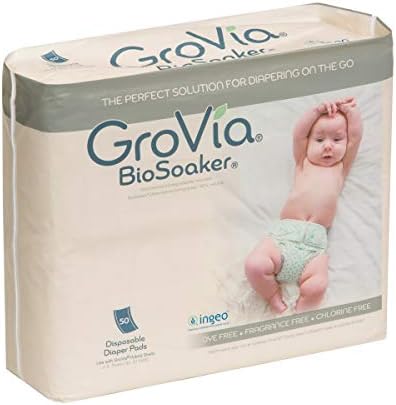
GroVia also sells disposable biosoakers that snap into the same shell. That gives a workable travel option without packing a second diapering system.
Parents who want lower total spend without dropping to budget brands.
Babies with very slim legs, where gapping causes leaks.
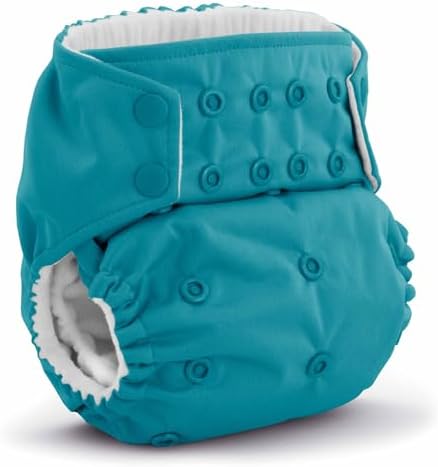
The Rumparooz G3 is the pick when leaks are the problem. It uses a double inner gusset design and ships with a 2-part microfiber insert, and it rates among the top absorbency performers tested in the category (BabyGearLab, 2025).
Pricing sits near $25 per diaper, at the top of the premium tier (Mommyhood101, 2026). Kanga Care positions it against bumGenius and GroVia rather than against budget pocket brands.
The included insert is a contoured main soaker with a snap-in doubler. Both pieces adjust by snaps, so the same insert set works at the newborn rise and the toddler rise without bunching.
One-size fit runs roughly 6 to 35 lb, which starts lower than most one-size diapers. For a newborn under 8 lb that difference is the gap between usable and pointless.
The double gusset is the specific reason to choose this over cheaper pockets. Inner gussets sit against the thigh and catch liquid stool before it reaches the outer elastic.
Heavy wetters, frequent blowouts, and small newborns.
Budget-first stashes where per-diaper cost drives the decision.
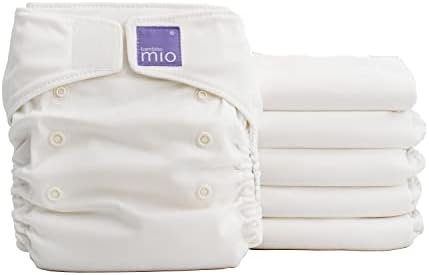
The Miosolo is a one-size all-in-one with hook-and-loop tabs, and it is the easiest diaper on this list for a caregiver who has never used cloth. Testers rank it among the strongest performers for absorbency in the category (BabyGearLab, 2025).
Per-diaper cost typically lands around $16 to $20 depending on pack size, below the US premium brands and above the budget pockets.
The soaker is a wide tongue-style insert attached at the back. It flips out flat, which means it dries far faster than a folded sewn-in soaker and gives you somewhere to lay a booster.
Hook-and-loop tabs are the real argument for this diaper. On a 7 lb newborn, snaps often cannot pull tight enough at the waist, while hook-and-loop closes to any width.
The cost of that convenience is lifespan. Hook-and-loop collects lint, loses grip over 18 to 24 months of washing, and toddlers learn to open it. Replacement tab strips are available but require sewing.
Newborns, daycare, and anyone who wants zero learning curve.
Families planning to reuse the same diapers for a second child.
Mama Koala sells one-size pocket diapers in 6-packs with inserts, which brings the cost to roughly $7 to $9 per diaper. The 2.0 version holds a 4.7-star average across more than 5,800 Amazon ratings (Amazon, 2026).
The athletic wicking jersey (AWJ) lining is the draw at this price. AWJ pulls moisture off the skin faster than plain suedecloth and it rinses clean easily, which matters when you are washing every other day.
Independent testing of the earlier 2.0 version flagged weak absorbency and a poor gusset design, ranking it near the bottom of a 12-diaper test group (BabyGearLab, 2022). The 3.0 revision changed the fit and gusset construction, and it has not been tested to the same standard.
Treat the included inserts as a starting point. Swapping the stock insert for a bamboo or hemp one closes most of the absorbency gap against premium brands and still leaves you well under $15 per diaper.
Shells alone run $6.75 to $7.75, which makes Mama Koala a cheap way to add covers to a prefold or fitted stash (Cloth Diapers for Beginners, 2023).
Testing cloth diapering, or building a large stash on a fixed budget.
Overnight, heavy wetters, or long-term multi-child stashes.
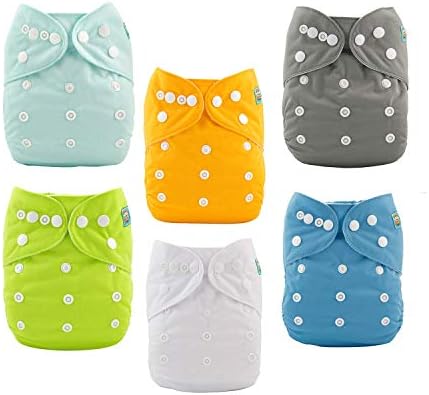
ALVABABY is the cheapest credible entry point, sold in 6-packs with 12 microfiber inserts at under $6 per diaper. It is a conventional one-size pocket with snaps, a fit range of roughly 6 to 33 lb, and a large print catalogue.
Performance sits close to other budget Chinese-manufactured pockets. Direct comparison puts ALVABABY and Nora’s Nursery at similar performance levels, with ALVABABY running slightly smaller in the rise and offering more prints (The Black and White Blog, 2026).
The PUL outer layer is noticeably thinner than premium shells. These hold up through one child in most reports but are unlikely to survive a second the way bumGenius or Thirsties shells do (The Black and White Blog, 2026).
Microfiber inserts are the weak point. They absorb fast but hold less than hemp or bamboo, they cannot touch the skin directly, and they hold odour if not dried fully.
At this price the sensible use is a trial set of 6 before committing, or bulk daytime diapers paired with better overnight diapers from another brand.
First-time trials and high-volume daytime use.
Overnight, heavy wetters, or long-term multi-child stashes.
Most families need 24 to 36 cloth diapers if they wash every 2 to 3 days (Kanga Care, 2026). The formula is simple: multiply daily changes by days between washes, then add 4 as a buffer. A 6-month-old needing 8 changes a day with laundry every 2 days needs about 20 diapers (Bayrli, 2026).
Newborns drive the largest stash because they need 10 to 12 changes per day. Guidance across manufacturers converges on 24 to 30 diapers for a newborn washing every other day, dropping to 16 to 20 for a toddler (Bayrli, 2026).
| Wash Frequency | Newborn | Infant | Toddler |
|---|---|---|---|
| Every day | 14-18 | 12-14 | 10-12 |
| Every 2 days | 24-30 | 20-24 | 16-20 |
| Every 3 days | 34-40 | 28-32 | 22-26 |
Bacteria and ammonia build up in soiled diapers, and that buildup is hard to wash out and damages the fabric over time (Kanga Care, 2026).
Many families begin with 12 to 18 diapers and add more once they know which style works on their baby (Kanga Care, 2026). A trial set of 3 to 5 diapers across different types costs less than a month of disposables.
Cloth diapering costs roughly $900 to $1,550 per child including laundry, against $2,200 to $3,000 for disposables over the same period (Bayrli, 2026). A full Esembly stash runs about $800 compared with $2,500 to $3,500 for disposables from birth to potty training (Esembly, 2023).
Disposables run $0.22 to $0.33 each, and parents buy around 3,000 per year, which puts annual spend at $960 to $1,200 (SoFi, 2026).
Savings multiply with a second child because the diapers are already bought. Cost for two children lands near $1,100 to $1,800 for cloth against $4,400 to $6,000 or more for disposables (Bayrli, 2026).
water and electricity for 2 to 3 extra wash loads per week, detergent, and the replacement inserts you will buy once the originals lose capacity. Budget $450 to $750 in ongoing costs over three years (Bayrli, 2026).
| Cost Item | Disposable (one child) | Cloth (one child) |
|---|---|---|
| Diapers | $1,960-$2,800 | $400-$700 one-time |
| Wipes | $250-$400 | $20-$40 one-time |
| Accessories | $50-$150 | $50-$100 one-time |
| Ongoing laundry and replacement | Included above | $450-$750 over 3 years |
| Total | $2,200-$3,000+ | $900-$1,550 |
Source: Bayrli cost breakdown (Bayrli, 2026)
Cloth diapers carry a lower lifetime environmental cost than disposables when washed sensibly, but the margin depends almost entirely on laundry habits. The most cited study, the UK Environment Agency lifecycle assessment published in 2005 and updated in 2008, found the two systems had broadly similar total impact under average use, with disposables dominating on waste and cloth dominating on water and energy from washing (UK Environment Agency, 2008).
A 2021 meta-analysis by the United Nations Environment Programme found single-use diapers have the highest climate impact, driven by greenhouse gas emissions from landfill, particularly unlined landfill (UNEP, 2021).
Washing at 60C, line drying where possible, using a sensible detergent dose and reusing diapers for a second child pushes the cloth advantage to roughly 40 percent or more across the lifecycle (Bayrli, 2026).
The US Environmental Protection Agency attributes more than 4.1 million tons of annual waste to disposable diapers, most of it landfilled with materials that do not break down readily (EPA, cited in SoFi, 2026).
A working wash routine is two cycles: a short warm prewash to remove soil, then a long hot main wash with a full dose of detergent. Skipping the prewash is the most common cause of ammonia smell and persistent stains.
Breastfed newborn stool is water-soluble and goes straight into the wash, but anything formed needs to come off before the diaper goes into the pail.
Use a full dose of mainstream detergent, not a quarter dose of a "cloth-safe" boutique product. Underdosing leaves soil in the fabric, and that residue is what causes rash and odour that gets blamed on the diaper.
Softener coats fibres and destroys absorbency. Routine bleach shortens PUL and elastic life. A monthly bleach soak is a repair tool, not maintenance.
Dry inserts fully. Microfiber in particular holds odour when it is put away slightly damp. Shells and covers last longer on a line or a low dryer setting, since high heat degrades the waterproof laminate and the leg elastic.
Thigh shape varies more than weight. Buy 3 to 5 diapers across two or three types and test them for a week first.
Microfiber pulls moisture out of skin and causes dryness and rash. It belongs inside a pocket or under a stay-dry layer, never against the baby.
Most leaks blamed on absorbency are fit problems. The rise should sit at the belly button with elastic tucked into the thigh crease.
Ammonia and bacteria set into the fabric and become hard to remove (Kanga Care, 2026).
Petroleum and zinc creams coat fibres and block absorbency permanently. Use a disposable liner when cream is needed.
Nights fail first. Plan hemp or bamboo boosters at the same time you buy the stash, not after three weeks of leaking.
All-in-one diapers are the easiest starting point because everything is sewn together and they work like a disposable. The Bambino Mio Miosolo and the Thirsties One Size All-in-One both require no stuffing or folding. Buy 3 to 5 diapers of two different types before committing to a full stash.
Yes. Cloth costs about $900 to $1,550 per child including laundry, against $2,200 to $3,000 for disposables (Bayrli, 2026). Break-even usually arrives between 6 and 12 months. A second child raises the saving sharply because the diapers are already paid for.
A pocket diaper is a shell with an opening you stuff with loose inserts, so you control absorbency and it dries in a few hours. An all-in-one has the absorbent layers sewn in, so there is nothing to assemble but drying takes much longer and absorbency is fixed.
Plan on 24 to 36 for a newborn washing every 2 to 3 days, 20 to 24 for an infant, and 16 to 20 for a toddler (Bayrli, 2026). If you wash daily you can manage with 14 to 18, though that leaves no margin for a delayed laundry day.
No, provided they are washed properly and changed on schedule. Rash in cloth is usually caused by detergent underdosing, leftover ammonia, or leaving a wet diaper on too long. Change every 2 hours during the newborn stage and immediately after a bowel movement.
Hemp holds the most liquid and is the thinnest option for overnight. Bamboo is the softest and trimmest for daytime. Cotton is the most durable and easiest to deep clean. Microfiber absorbs fastest and costs least, but it must never sit against skin (Mom Loves Best, 2026).
Most centres accept cloth if you send all-in-ones and a wet bag, since staff cannot stuff pockets or fold prefolds. Send diapers ready to use, label the bag, and check your centre’s policy in writing before you build a stash around it.
The bumGenius Original 5.0 is the best cloth diaper for most families, with a 3×3 snap grid that fits a wider range of body shapes, fast drying, sourceable replacement parts, and strong resale value at about $21.95 each.
For daycare or relatives, the Bambino Mio Miosolo is the better choice, because hook-and-loop tabs and a sewn-in soaker leave nothing to get wrong. For heavy wetters and newborn blowouts, the Kanga Care Rumparooz G3 and its double inner gussets are worth the $25.
If the budget is fixed, buy Mama Koala 3.0 in 6-packs and spend the savings on bamboo or hemp inserts. That combination gets most of the performance of a premium stash at roughly a third of the price.