
Can a Newborn Sleep in a Crib? Yes - Here's How to Do It Safely in 2026
- Published July 13, 2025
- Updated October 17, 2026
- 9 min read
A newborn can sleep in a crib from the first night home. There is no minimum age. What keeps a baby safe is how the crib is set up and where it sits in your home, and this guide covers both.
Yes, a newborn can sleep in a full-size crib from birth, as long as the crib meets current Consumer Product Safety Commission (CPSC) standards and holds nothing but a firm mattress and a fitted sheet.
TL;DR: The Quick Answer
- Yes, a newborn can sleep in a full-size crib from birth, as long as the crib meets current Consumer Product Safety Commission (CPSC) standards and holds nothing but a firm mattress and a fitted sheet.
- The American Academy of Pediatrics (AAP) recommends back sleeping on a firm, flat, bare surface in the parents’ room, but not in the parents’ bed, for at least the first 6 months (AAP, 2022).
- Crib bumpers and inclined sleepers are now banned for sale in the U.S. under the Safe Sleep for Babies Act (U.S. Congress, 2022).
- A crib and a bassinet are equally safe for a newborn. The choice depends on bedroom space and budget, not on safety.
- About 3,400 babies in the U.S. die suddenly and unexpectedly each year, many in unsafe sleep settings, so the setup steps below matter (CDC, 2024).
- Can a Newborn Sleep in a Crib From Day One
- AAP's Safe Sleep Guidelines Say
- Crib vs. Bassinet for a Newborn
- How to Set Up a Crib Safely for a Newborn
- What Can and Can't Go in a Newborn's Crib
- Where to Put the Crib
- Why Some Newborns Wake Up in
- Is a Secondhand Crib Safe for a Newborn
- What You Need for a Safe Newborn Crib Setup
- Common Crib Safety Mistakes New Parents Make
- FAQ
- Summary
Can a Newborn Sleep in a Crib From Day One?
Yes. A newborn can sleep in a standard crib from their very first night, and neither the AAP nor the CPSC sets any minimum age for crib use. The safety rules that apply to a 6-month-old in a crib apply to a 3-day-old in the same way.
Many parents assume newborns "need" a bassinet first because cribs look big and empty. That empty space is fine. A bare crib with a tight-fitting, firm mattress is exactly the sleep surface the AAP describes as safest.
Three conditions make a crib safe for a newborn
The crib meets the current CPSC federal standard for full-size or non-full-size cribs, which in practice means it was made after June 28, 2011.
The mattress is firm, flat, and fits snugly with no gaps at the edges.
The crib holds nothing except the baby and one fitted sheet.
Good to know
If you are still choosing a crib, our guide to the best baby cribs covers models that meet the current standard.
What the AAP's Safe Sleep Guidelines Say About Cribs
The AAP’s safe sleep guidelines say a newborn should sleep on their back, on a firm and flat surface, in their own sleep space, in the parents’ room. A crib that meets CPSC standards qualifies as that sleep space (AAP, 2022).
The current guidance comes from the AAP's 2022 policy statement, Sleep-Related Infant Deaths: Updated 2022 Recommendations for Reducing Infant Deaths in the Sleep Environment. You can read the full AAP policy statement for every recommendation and its evidence rating.
The parts that apply directly to crib sleep
Back to sleep, every sleep.
This includes naps. Side sleeping is not considered safe.
Firm, flat, non-inclined surface.
No sleep surface tilted more than 10 degrees, and no soft mattress toppers.
Nothing soft in the sleep space.
No pillows, blankets, quilts, stuffed toys, positioners, or bumpers.
Room-sharing without bed-sharing.
The baby sleeps in the parents' room on a separate surface for at least the first 6 months.
Avoid overheating.
Dress the baby in no more than one layer beyond what an adult would wear, and skip hats indoors.
Good to know
These rules have a long track record. After the National Institute of Child Health and Human Development (NICHD) launched the Back to Sleep campaign with the AAP in 1994, the U.S. rate of Sudden Infant Death Syndrome (SIDS) dropped by more than 50% between 1994 and 1999 (NICHD, 2013).
Crib vs. Bassinet for a Newborn: Which Should You Use?
A crib and a bassinet are equally safe for a newborn when each meets its CPSC standard and is set up bare. The real difference is practical: a bassinet fits easily beside your bed for a few months, while a crib takes more floor space but lasts for years.
A bassinet is a small sleep surface for young infants. CPSC rules say it should not be used past about 5 months of age or once a baby can push up on hands and knees (CPSC, 2013). Most bassinets also carry a weight limit of 15 to 20 pounds. Rolling or pushing up ends bassinet use even if the baby is under the weight limit.
A crib works from birth into toddlerhood. If your bedroom has room for one, starting in the crib skips a second transition at 4 or 5 months, which is usually when babies start rolling and sleep is already shaky.
| Sleep Surface | Safe From Birth | Easy to Fit in Parents’ Room | Typical Use Period |
|---|---|---|---|
| Full-size crib | Yes | Only in larger bedrooms | Birth to toddler bed transition |
| Mini crib | Yes | Yes | Birth to about 2 years (check label) |
| Bassinet | Yes | Yes | Birth to about 5 months, or when baby pushes up |
| Bedside sleeper | Yes | Yes | Birth to about 5 months (check label) |
| Play yard (with bassinet insert) | Yes | Yes | Insert to about 5 months; play yard longer |
Good to know
If space is tight, a bassinet for the room-sharing months followed by a crib works well. See our guide on how to get a newborn to sleep in a bassinet. Our list of the best bassinets under $100 covers budget picks, and the best 4-in-1 convertible cribs under $150 covers cribs that later convert to toddler and full beds.
Safe Crib Setup at a Glance
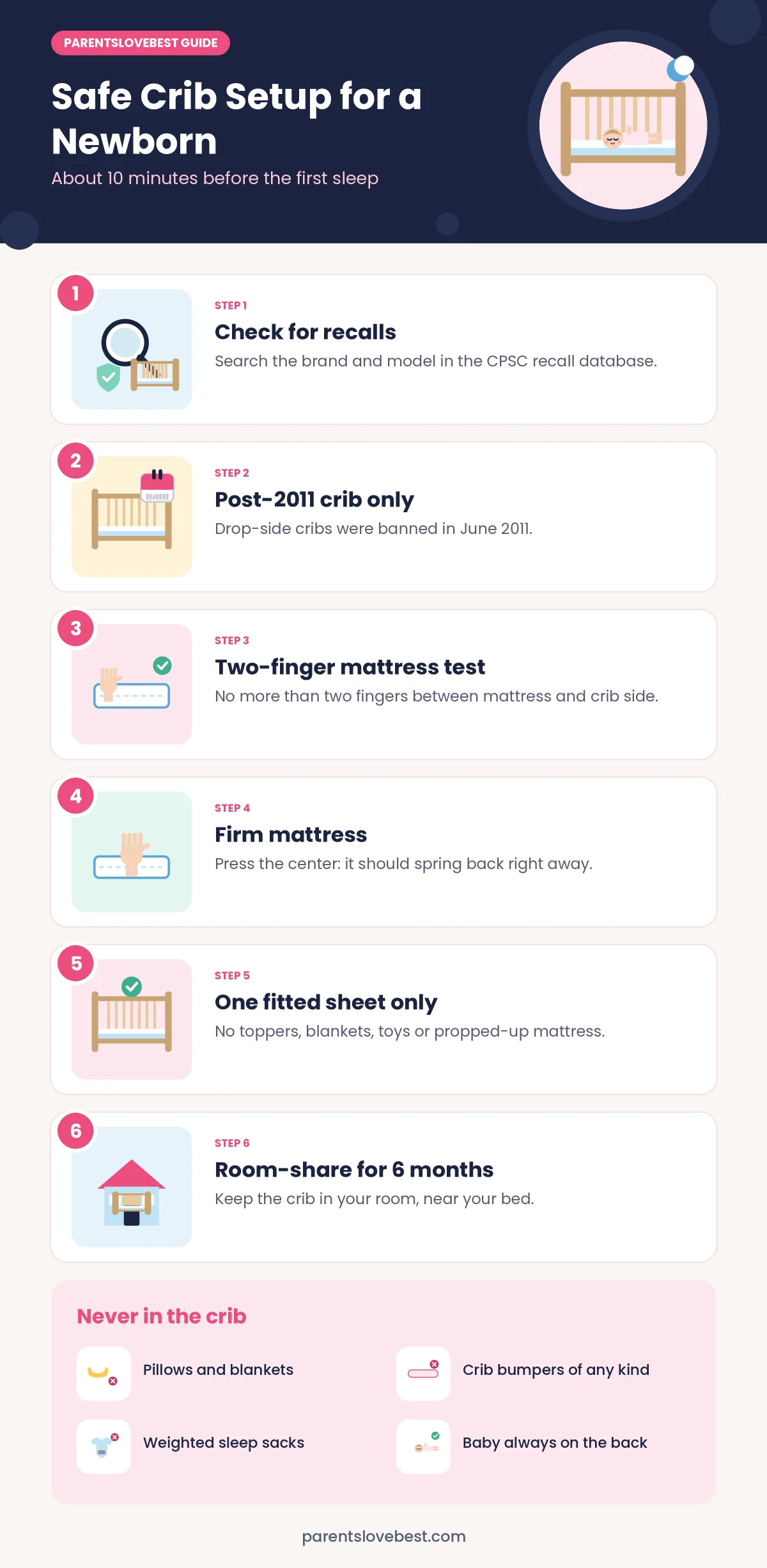
How to Set Up a Crib Safely for a Newborn: 7 Steps
A safe newborn crib setup takes about 10 minutes. Follow these steps before the first sleep, then recheck the crib whenever you change the sheet.
Check the crib for recalls. Search the brand and model on the CPSC recall database. Do not use a recalled crib, even if it looks fine.
Confirm it meets the post-2011 standard. The CPSC banned the manufacture and sale of drop-side cribs as of June 28, 2011. A crib made before that date likely does not meet today’s rules.
Do the two-finger mattress test. Press the mattress into one corner and try to slide your fingers between the mattress edge and the crib side. If more than two fingers fit, the mattress is too small for that crib and the pair should not be used (AAP, 2022).
Check mattress firmness. Press your palm flat into the center. A safe infant mattress springs back right away and does not hold the shape of your hand.
Add one fitted crib sheet, and nothing else. No mattress topper, no folded blanket underneath, no stuffed animal. Never prop up one end of the mattress.
Set the mattress at its highest position. This is fine for a newborn and saves your back. Lower it before your baby can sit up unassisted, and move it to the lowest position before your baby can pull to standing (AAP, 2022).
Place the baby on their back. Do this for every nap and every night, even if your baby later rolls onto their stomach on their own.
What Can and Can't Go in a Newborn's Crib
Only two things belong inside a newborn’s crib: a firm, snug mattress and one fitted sheet. Everything else, including products sold as “crib accessories,” adds risk without adding safety.
| Allowed in the Crib | Not Allowed in the Crib |
|---|---|
| Firm mattress that fits the crib snugly | Pillows, quilts, comforters, or loose blankets |
| One fitted sheet made for that mattress size | Crib bumpers of any kind, including mesh and vertical slat covers |
| Baby dressed in a non-weighted sleep sack or swaddle | Weighted sleep sacks, weighted swaddles, or weighted blankets |
| A pacifier with no strap or clip attached | Stuffed animals and soft toys |
| Sleep positioners, wedges, nests, or loungers | |
| Mattress toppers or extra padding |
Two of these rules changed in the last few years, so older advice may say otherwise:
Crib bumpers are now federally banned.
The Safe Sleep for Babies Act made padded bumpers, vinyl bumper guards, and vertical slat covers illegal to sell in the U.S., alongside inclined sleepers (U.S. Congress, 2022). The CPSC later finalized rules codifying both bans.
Weighted sleep products are not safe for infants.
The AAP, CPSC, CDC, and National Institutes of Health (NIH) all advise against weighted swaddles, sleep sacks, and blankets, citing evidence of lower oxygen levels in infants using them (CPSC, 2024).
Good to know
A regular, non-weighted sleep sack (a wearable blanket that zips around the baby) is the safe way to keep a newborn warm in a bare crib.
Where to Put the Crib: Room-Sharing in the First 6 Months
The crib should be in your bedroom for at least the first 6 months if your room can hold it. The AAP recommends room-sharing without bed-sharing for that period, and it reports that this arrangement can cut SIDS risk by as much as half (AAP, 2022).
Room-sharing means the baby's crib, bassinet, or play yard sits in the parents' room, close to the parents' bed. Bed-sharing means the baby sleeps on the adult bed, which the AAP advises against. The 2022 guidelines also note there is no evidence on when, before age 1, it becomes safe to move a baby to their own room.
When placing the crib in any room
Keep it away from windows, blind cords, and curtain cords, which are strangulation hazards.
Keep lamps, monitors, and their cords out of reach from inside the crib.
Mount any baby monitor on the wall or a shelf at least 3 feet from the crib, so the cord stays out of reach, as monitor makers' safety labels instruct.
Hang mobiles high enough that your baby cannot reach them, and remove them once your baby can push up on hands and knees.
Good to know
If your bedroom truly has no space for a full-size crib, a bassinet or mini crib in your room for the first 6 months, then the full crib in the nursery, follows the AAP guidance.
Why Some Newborns Wake Up in the Crib, and Safe Ways to Help
Many newborns wake the moment they are laid in a crib. This is normal and does not mean the crib is wrong for them. The usual causes are the startle reflex (also called the Moro reflex), the change from warm arms to a cooler sheet, and being moved during light sleep.
A simple comparison helps: after nine months in a snug, noisy, moving womb, a flat, still, quiet crib is a big change. The fixes below work by making the transfer gentler, not by adding anything to the crib.
Swaddle for the early weeks.
A snug, non-weighted swaddle calms the startle reflex. Stop swaddling as soon as your baby shows signs of trying to roll, which can start as early as 2 months (AAP, 2022).
Wait for deeper sleep before the transfer.
Newborns enter sleep in a light stage. Waiting 10 to 20 minutes after your baby's eyes close, until their arms go limp, improves your odds.
Lay them down feet first.
Lower the feet and bottom first, then the head, and keep a hand on their chest for a few seconds.
Use white noise.
A steady sound machine placed outside the crib, at a low volume, masks household noise.
Offer a pacifier at sleep time.
The AAP notes pacifier use at naps and bedtime is linked to lower SIDS risk. If it falls out after your baby is asleep, you do not need to put it back (AAP, 2022).
Good to know
Two "fixes" to skip: do not warm the mattress with a heating pad or hot water bottle, and do not let your baby finish the night in a swing, bouncer, or car seat. If your baby falls asleep in a sitting device, move them to the crib as soon as you can (AAP, 2022). Our baby swing guide covers safe, awake-time use of swings.
Is a Secondhand Crib Safe for a Newborn?
A secondhand crib can be safe for a newborn if it meets the current CPSC standard, has no recalls, and has every original part. Many older cribs fail at least one of those tests, so check each point before use.
Use this checklist on any hand-me-down crib, including the one at grandma’s house or daycare:
Manufacture date after June 28, 2011.
Look for the date label on the frame or headboard. No label, no use.
No drop side.
Traditional drop-side cribs can detach and trap a baby, which is why the CPSC banned them.
Slats no more than 2 3/8 inches apart.
That is about the width of a soda can. Wider gaps can trap a baby's body (CPSC).
No missing, cracked, or loose slats or hardware.
Only use replacement parts from the original manufacturer.
Corner posts no taller than 1/16 inch
above the end panels, unless they are part of a canopy, so clothing cannot catch on them.
No decorative cutouts
in the headboard or footboard where a head could get stuck.
No peeling paint
, since antique cribs may contain lead.
Not on the CPSC recall list.
Good to know
If you are buying a crib for a grandparent's home, see our picks for the best cribs for grandparents.
What You Need for a Safe Newborn Crib Setup
A safe newborn crib setup needs only a few items, and most “crib sets” sold online include things that should not go in a crib. Here is the short list of what to buy.
| Item | Why You Need It | What to Look For |
|---|---|---|
| CPSC-compliant crib | The sleep space itself | Made after June 2011, no drop side, JPMA certification is a plus |
| Firm crib mattress | Flat, firm surface | Fits your crib with no more than a two-finger gap; springs back when pressed |
| Fitted crib sheets (3 to 4) | Only fabric allowed in the crib | Sized to your mattress; no loose fabric or elastic gaps |
| Waterproof mattress protector | Keeps the mattress clean | Thin and fitted, not a padded topper |
| Non-weighted swaddles or sleep sacks | Keeps baby warm without a blanket | Sized by weight; no weights or beads sewn in |
| White noise machine | Helps with the crib transfer | Continuous sound, volume control, placed outside the crib |
Shop the items above:
Firm crib mattress: Check price on Amazon
Fitted crib sheets: Check price on Amazon
Waterproof mattress protector: Check price on Amazon
Non-weighted sleep sack: Check price on Amazon
White noise machine: Check price on Amazon
Good to know
Shorter parents may find a standard crib hard to reach into once the mattress is lowered. Our guide to the best cribs for short moms covers lower-rail options.
Common Crib Safety Mistakes New Parents Make
The most common crib mistakes come from adding comfort items that make a crib less safe. Each of the mistakes below is easy to avoid once you know it.
Using a blanket "just for the cold nights."
Use a non-weighted sleep sack instead. A loose blanket can cover a newborn's face.
Buying a bumper because the crib looks bare.
Bumpers of every type are now banned for sale. A bare crib is the goal, not a problem to fix.
Pairing any mattress with any crib.
Mattress sizes vary. Always run the two-finger test with your specific crib and mattress together.
Letting baby sleep overnight in a swing, bouncer, or car seat.
These are not sleep surfaces. Move your baby to the crib once they fall asleep.
Forgetting to lower the mattress.
Many parents leave the mattress high too long. Lower it before your baby can sit unassisted.
Placing the crib next to a window.
Blind and curtain cords are a strangulation risk. Move the crib to an inside wall if possible.
Trusting "safe sleep" marketing on weighted products.
The AAP and CPSC warn against weighted swaddles and sleep sacks regardless of how they are marketed.
Frequently Asked Questions About Newborns Sleeping in a Crib
Can a newborn sleep in a crib instead of a bassinet?
Yes. A bassinet is optional. A newborn can sleep in a full-size crib from birth as long as the crib meets the current CPSC standard, has a firm, snug mattress, and holds nothing but a fitted sheet.
What age can a baby start sleeping in a crib?
There is no minimum age for crib sleep. Babies can sleep in a crib from day one. The AAP and CPSC set setup rules for cribs, not age rules.
Is it safe for a newborn to sleep in a crib in a separate room?
The AAP recommends keeping the baby’s crib or bassinet in the parents’ room for at least the first 6 months (AAP, 2022). If a full-size crib won’t fit, use a bassinet or mini crib in your room for those months and move to the nursery crib afterward.
Is a crib or bassinet safer for a newborn?
Neither is safer. Both are safe when they meet CPSC standards and are kept bare. A bassinet is easier to fit beside your bed, while a crib lasts years longer and avoids a transition at 4 to 5 months.
Can a newborn sleep in a crib with a blanket?
No. The AAP advises no loose blankets in the crib during infancy because they can cover the baby’s face. Use a fitted, non-weighted sleep sack or swaddle to keep your baby warm instead.
How firm should a crib mattress be for a newborn?
A crib mattress should be firm enough to spring back immediately when you press your palm into it. It should not hold the shape of your hand. Soft, plush, or memory foam surfaces are not safe for infant sleep.
Are mesh crib bumpers safe for newborns?
No. Mesh bumpers fall under the U.S. ban on crib bumpers in the Safe Sleep for Babies Act (U.S. Congress, 2022), and the AAP advises against all bumpers. Leave the crib sides bare.
When should I lower my baby's crib mattress?
Lower the mattress before your baby can sit up unassisted, which often happens around 5 to 6 months. Move it to the lowest setting before your baby can pull to standing (AAP, 2022).
Can a newborn sleep in a crib without being swaddled?
Yes. Swaddling is optional. It can help a newborn settle by calming the startle reflex, but a baby who sleeps well unswaddled on their back does not need it. Stop swaddling once your baby shows any sign of rolling.
Summary: What to Remember About Newborns and Cribs
- A newborn can sleep in a crib from the first night home. There is no minimum age.
- The crib should be made after June 28, 2011, free of recalls, and fitted with a firm, snug mattress that passes the two-finger test.
- Keep the crib bare: one fitted sheet, no bumpers, blankets, pillows, toys, or weighted products.
- Place your baby on their back for every sleep, in your room, on their own surface, for at least the first 6 months (AAP, 2022).
- Crib versus bassinet is a space and budget decision. Both are safe when used correctly.