
How to Get Newborn to Sleep in Bassinet: A Step by Step Guide for 2026
- Published June 25, 2025
- Updated October 17, 2026
- 10 min read
Most newborns fight the bassinet because it feels cold, flat, and quiet compared to your arms. This guide shows you how to get a newborn to sleep in a bassinet safely, in eight repeatable steps.
To get a newborn to sleep in a bassinet, warm the sheet, swaddle snugly, run low white noise across the room, and lay your baby down drowsy or in deep sleep with a slow, flat transfer.
TL;DR: The Quick Answer
- To get a newborn to sleep in a bassinet, warm the sheet, swaddle snugly, run low white noise across the room, and lay your baby down drowsy or in deep sleep with a slow, flat transfer.
- The bassinet must hold only a firm, flat mattress and a fitted sheet, because about 3,700 US babies died suddenly and unexpectedly in 2022, mostly during sleep (CDC, 2022).
- Keep the bassinet in your room, next to your bed: room-sharing without bed-sharing can cut SIDS risk by up to 50% (AAP, 2016).
- Keep white noise at or below 50 dB at the bassinet, because all 14 infant sleep machines tested in one study went over that limit at full volume (Hugh et al., Pediatrics, 2014).
- Give one routine 7-10 days before you judge it, and change only one thing at a time.
- What You Need Before You Start
- Why Newborns Refuse the Bassinet
- Is a Bassinet Safe for Newborn Sleep
- Step 1: Set Up the Room Before Bedtime
- Step 2: Warm the Bassinet Sheet
- Step 3: Swaddle Snugly to Calm
- Step 4: Run White Noise at a Safe Volume
- Step 5: Feed, Burp, and Hold
- Step 6: Lay Your Baby Down Drowsy
- Step 7: Use a Slow, Flat Transfer
- Step 8: Repeat the Same Routine for 7-10 Days
- Common Problems and How to Fix Them
- Quick Recap
- FAQ
What You Need Before You Start
You need five things to get a newborn to sleep in a bassinet: a safe bassinet, a fitted sheet, a swaddle or sleep sack, a sound source, and a dim room. Everything else is optional.
A bassinet with a firm, flat mattress that fits the frame with no gaps. If you are still shopping, see our list of the best bassinets under $100.
A fitted sheet made for that exact mattress size, and nothing else inside the bassinet.
A thin muslin swaddle for the early weeks, plus a non-weighted sleep sack for when your baby starts to roll.
A white noise machine, fan, or air purifier that you can place across the room.
Blackout curtains or a dim night light for night feeds.
Good to know
A baby monitor helps for daytime naps when you leave the room, but it does not replace room-sharing at night.
Why Newborns Refuse the Bassinet
Newborns refuse the bassinet because it is the opposite of the womb and your arms. In your arms, your baby feels warmth, a heartbeat, constant motion, and pressure on all sides. In a bassinet, they get a cool sheet, silence, stillness, and open space.
Three body-based reasons cause most refusals:
The Moro reflex
(also called the startle reflex) makes a baby fling their arms out when they sense falling. Lowering them into a bassinet often triggers it. The reflex weakens around 3-4 months and is usually gone by 6 months (Queensland Health, 2024).
Temperature change
from your warm chest to a cool sheet wakes many babies within seconds of the transfer.
Light sleep
is normal for newborns. They spend more time in active sleep, so a small bump or noise can wake them.
Good to know
None of these mean your baby "hates" the bassinet. Each one has a direct fix, and the steps below cover them in order.
Is a Bassinet Safe for Newborn Sleep?
Yes, a bassinet is a safe place for newborn sleep when it meets current federal safety standards and holds nothing but a firm mattress and fitted sheet. The American Academy of Pediatrics (AAP) lists cribs, bassinets, play yards, and bedside sleepers as approved infant sleep surfaces (AAP, 2022).
The AAP’s 2022 safe sleep policy sets the ground rules every step in this guide follows:
Place your baby on their back for every sleep, naps included.
Use a firm, flat surface
Products inclined more than 10 degrees are not safe for sleep.
Keep out pillows, blankets, bumpers, positioners, and stuffed toys.
Share a room, not a bed, for at least the first 6 months.
Good to know
The Safe Sleep for Babies Act of 2022 also banned the sale of crib bumpers and inclined sleepers in the US. Moving to a crib later? Read can a newborn sleep in a crib. If a product promises to help your baby sleep by tilting, wedging, or weighting them, skip it.
The Bassinet Routine at a Glance
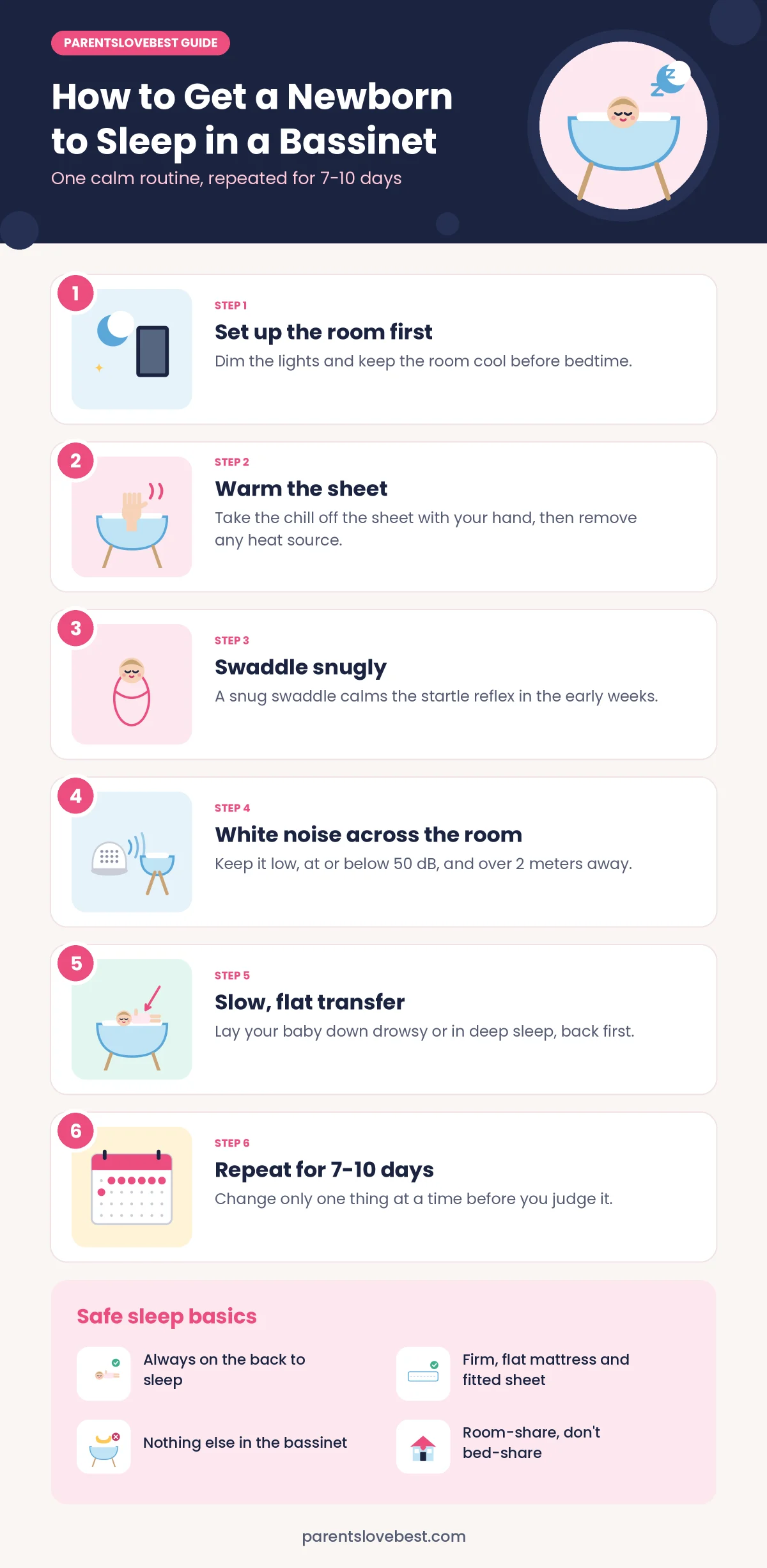
Step 1: Set Up the Room Before Bedtime
Set up the room first so the bassinet is ready before your baby gets sleepy. A prepared room means you are not hunting for a swaddle or switching on lights while a tired newborn is in your arms.
Place the bassinet beside your bed, within arm's reach
Dim the lights 15-20 minutes before sleep, and keep night feeds in low light so your baby starts learning that night is for sleeping.
Dress your baby for the room, not for winter
University of Utah Health (2025) advises that if the room feels comfortable to you, it is likely comfortable for your baby. Check the back of the neck: sweaty means too warm, and cool hands alone are normal.
Step 2: Warm the Bassinet Sheet Before the Transfer
Warm the sheet before you lay your baby down so the move from your body to the bassinet does not feel like a cold shock. A cool sheet is one of the most common reasons a newborn wakes the moment their back touches the mattress.
Place a warm water bottle or heating pad on the sheet for 5-10 minutes while you feed or rock. Remove it completely before your baby goes in, and test the sheet with your inner wrist. It should feel slightly warm, never hot.
Never leave any heat source in the bassinet with your baby
If that rule feels hard to keep at 3 a.m., use a simpler method: lay your hand flat on the sheet for a minute, or put the fitted sheet against your own body before a feed.
Step 3: Swaddle Snugly to Calm the Startle Reflex
Swaddle your newborn before each sleep to keep the Moro reflex from jolting them awake. A good swaddle is snug around the chest with room for two fingers, and loose at the hips so the legs can bend up and out.
Use a thin muslin wrap or a zippered swaddle with arms in
Swaddling can make babies overheat, so use one light layer and keep the room comfortable.
Stop swaddling as soon as your baby shows any sign of trying to roll
Some babies start working on rolling as early as 2 months (HealthyChildren.org, AAP, 2023). At that point, move to an arms-free sleep sack. Never use a weighted swaddle or weighted sleep sack, which the AAP warns can press on a baby's chest.
Step 4: Run White Noise at a Safe Volume
Turn on white noise before the transfer, set low and placed across the room. The steady sound masks sudden noises like a door closing or a dog barking, which wake light-sleeping newborns.
Volume and distance matter more than the sound you pick
In a study of 14 infant sleep machines, every one exceeded 50 dB (the recommended noise limit for hospital nurseries) when measured at crib-rail distance at maximum volume, and three went above 85 dB (Hugh et al., Pediatrics, 2014).
Follow the study authors' advice
Place the machine more than 2 meters (about 7 feet) from the bassinet.
Never set it on the bassinet rail or inside the bassinet.
Use the lowest volume that covers household noise, and check it with a free decibel app held at the mattress.
Step 5: Feed, Burp, and Hold Upright Before Sleep
Feed and burp your baby, then hold them upright for 15-20 minutes before laying them down. Putting a newborn flat right after a full feed can cause gas or spit-up discomfort, which often wakes them a few minutes into the bassinet.
This upright time also lets you watch for sleep cues
Yawning, staring off, and slower movements tell you your baby is getting drowsy.
Breastfed newborns usually feed every 2-3 hours and bottle-fed babies every 3-4 hours (Akron Children's Hospital, 2024). Expect short sleep stretches in the first weeks. Newborns need 14-17 hours of total sleep a day, spread across day and night (National Sleep Foundation, 2015).
Step 6: Lay Your Baby Down Drowsy or in Deep Sleep
Lay your baby down when they are either drowsy but still awake, or fully in deep sleep. The worst time to transfer is the light, half-asleep stage in between, when any movement wakes them.
Drowsy but awake
means calm, heavy-eyed, and close to sleep. Practicing this once or twice a day teaches your baby that the bassinet is where sleep happens. Start with the first nap of the day, when babies tend to settle more easily.
Deep sleep
is the backup plan for nights when your baby falls asleep feeding. Wait 15-20 minutes after they nod off. Look for slow, even breathing, a slack jaw, and an arm that flops when you gently lift it. That is your window.
Step 7: Use a Slow, Flat Transfer
Lower your baby into the bassinet while keeping their body flat and parallel to the mattress the whole way down. Tipping a baby from upright to lying flat too fast feels like falling, and that sets off the startle reflex even in a sleeping baby.
Use this order:
Hold your baby close to your chest as you bend over the bassinet.
Set their bottom down first, then their back.
Slide your hand out from under their head last.
Keep one hand on their chest and one on their tummy for 20-30 seconds.
Lift one hand slowly, wait a few seconds, then lift the other.
Good to know
If your baby stirs, pause with your hands still in place. A gentle shush or light pat on the chest often settles them without a pickup.
Step 8: Repeat the Same Routine for 7-10 Days
Run the same routine in the same order at every sleep for at least 7-10 days before deciding it does not work. Newborns cannot read a clock, but they do learn from repeated cues, and a predictable sequence signals that sleep is next.
A simple routine for most families looks like this:
Dim the lights and warm the sheet.
Change the diaper.
Swaddle.
Feed, burp, and hold upright.
Start white noise.
Transfer to the bassinet.
Good to know
Keep the whole routine under 20-25 minutes so your baby does not get overtired. If something is not working, change one thing at a time, such as the swaddle style or the noise level, so you know which change made the difference.
Common Problems and How to Fix Them
Most bassinet problems trace back to temperature, the startle reflex, timing, or a sleep habit formed in another spot. The table below matches each problem with its likely cause and a fix.
| Problem | Likely Cause | Solution |
|---|---|---|
| Baby wakes within minutes of the transfer | Cool sheet or a fast, tilted transfer | Warm the sheet first and use the flat, bottom-first transfer from Step 7. |
| Baby only sleeps on your chest | Contact sleep is now the habit | Start with one bassinet nap a day, then add more once that nap goes well. |
| Baby grunts and squirms all night | Normal active sleep, not a wake-up | Wait 2-3 minutes before picking them up, since many babies resettle. |
| Baby arches and cries when laid flat | Possible reflux or gas | Hold upright 20-30 minutes after feeds, and talk to your pediatrician if it continues. |
| Swaddle comes loose by morning | Blanket wrap too loose or wrong size | Switch to a zippered swaddle sized for your baby’s weight. |
| Baby only sleeps in a swing or car seat | Motion habit has formed | Use the baby swing for awake soothing only, and move your baby to the bassinet once asleep. |
| Baby sleeps all day and wakes all night | Day-night confusion | Keep daytime feeds bright and social, and night feeds dark and quiet. |
Good to know
The AAP advises that sitting devices like swings, car seats, and strollers are not for routine sleep. If your baby falls asleep in one, move them to a flat bassinet as soon as you can (AAP, 2022).
Quick Recap: The Bassinet Routine That Works
Set up a safe bassinet beside your bed with only a firm mattress and fitted sheet, and place your baby on their back every time.
Warm the sheet, swaddle snugly, and run low white noise from across the room before each sleep.
Lay your baby down drowsy or in deep sleep, using a slow transfer that keeps their body flat.
Run the same routine for 7-10 days and change one thing at a time when something is off.
Stop swaddling at the first sign of rolling, and never use weighted, inclined, or padded sleep products.
Frequently Asked Questions About Getting a Newborn to Sleep in a Bassinet
Why does my newborn wake up every time I put them in the bassinet?
Your newborn most likely wakes because of the startle reflex, a cold sheet, or a transfer during light sleep. Warm the sheet for 5-10 minutes, swaddle snugly, and wait for deep sleep signs like a floppy arm before you lay them down with a slow, flat transfer.
How long does it take a newborn to get used to a bassinet?
Most babies start accepting the bassinet within 1-2 weeks of a consistent routine, though some take longer. Good nights and rough nights will mix together at first. That pattern is normal and is not a sign the routine is failing.
Is it okay to let my newborn sleep on me instead of the bassinet?
Contact naps are fine while you are awake and alert, but the AAP advises against sleeping with your baby on a bed, couch, or armchair (AAP, 2022). If you feel yourself getting drowsy, put your baby in the bassinet. A sofa is one of the most dangerous places to fall asleep with an infant.
Can I use a pacifier to help my newborn sleep in the bassinet?
Yes, the AAP recommends offering a pacifier at nap time and bedtime because it is linked to lower SIDS risk (AAP, 2022). If you are breastfeeding, wait until feeding is well established, usually around 3-4 weeks. You do not need to put the pacifier back in once your baby is asleep.
Is an inclined bassinet insert or wedge safe?
No, inclined inserts and wedges are not safe for infant sleep. The AAP says sleep surfaces angled more than 10 degrees are unsafe, and the Safe Sleep for Babies Act of 2022 banned inclined sleepers in the US. Your baby’s sleep surface must be firm and flat.
What is the safest bassinet setup for a newborn?
The safest setup is your baby on their back, on a firm, flat mattress with only a tight fitted sheet. Keep the bassinet in your room beside your bed for at least the first 6 months (AAP, 2022). Nothing else goes inside: no blankets, pillows, toys, or positioners.
When should I move my baby from the bassinet to a crib?
Move your baby to a crib when they reach the bassinet’s weight limit or start rolling, pushing up on hands and knees, or sitting up, whichever comes first. Most bassinets list weight limits between 15 and 20 pounds, so check your manual. Our guide to the best baby cribs covers safe next-step options.
Should I wake my newborn to feed if they finally sleep in the bassinet?
Yes, in the first couple of weeks you should wake your newborn every 3-4 hours to feed until they show good weight gain (Akron Children’s Hospital, 2024). After your pediatrician confirms steady weight gain, you can usually let your baby sleep longer stretches at night.