
How To Bathe a Baby: A Step by Step Guide for New Parents (2026)
- Published October 11, 2026
- Updated October 11, 2026
- 8 min read
Bathe your newborn 2-3 times per week with a sponge bath until the umbilical cord stump falls off, usually at 1-3 weeks (American Academy of Pediatrics).
Give sponge baths until the umbilical cord stump falls off, then switch to a baby tub. Keep the water at 37-38°C (98.6-100.4°F), gather everything first and never leave your baby alone in or near water.
TL;DR: The Quick Answer
- Bathe your newborn 2-3 times per week with a sponge bath until the umbilical cord stump falls off, usually at 1-3 weeks (American Academy of Pediatrics).
- Water temperature should be 37-38°C (98.6-100.4°F) – test it with your wrist or elbow, not your hand.
- Never leave a baby alone in or near water, even for a second.
- Use a baby specific, fragrance free wash to protect the skin barrier.
- Gather everything before you start soap, towel, clean diaper, change of clothes – so your hands never leave the baby.
Baby Bath Basics at a Glance
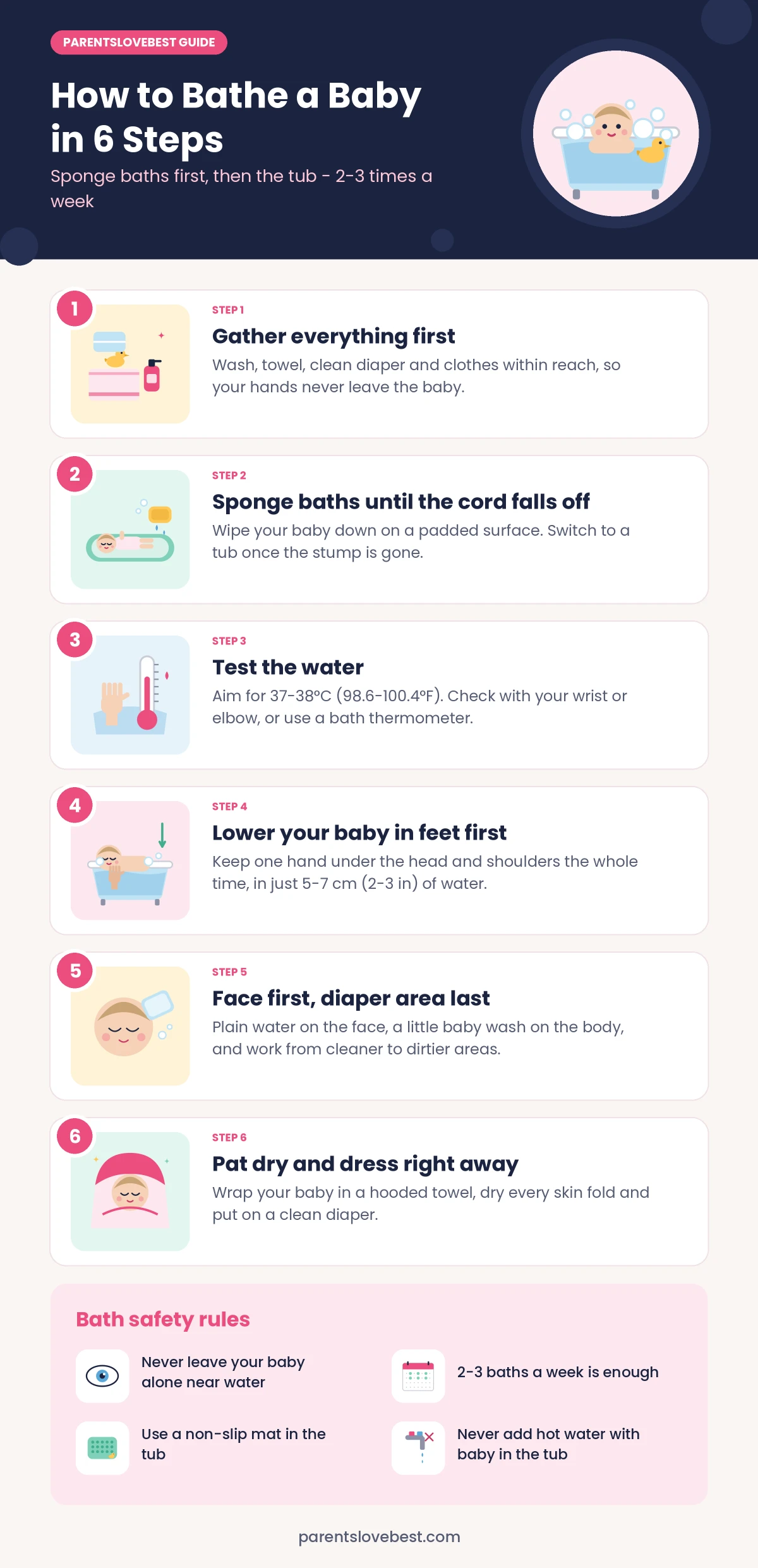
What You Need Before You Start Bathing Your Baby
Gather all supplies before you run the water. Once the bath starts, you cannot step away to grab something you forgot.
You will need:
A baby bathtub or a clean sink with a non-slip mat
A basin or cup for rinsing
Baby-specific, fragrance-free wash or shampoo
Two soft washcloths (one for the body, one for the face)
Good to know
Keep the room warm - around 24°C (75°F) - before undressing the baby. Newborns lose body heat fast, and a cold room turns bathtime into a stressful experience for both of you.
Sponge Bath vs. Tub Bath: Which Type Your Baby Needs
Use a sponge bath until the umbilical cord stump dries and falls off. Submerging a newborn with an attached stump raises the risk of infection. The stump typically falls off between 1 and 3 weeks after birth (American Academy of Pediatrics).
Once the stump is gone and, for boys, any circumcision site is fully healed, you can move to a baby tub bath.
What Is a Sponge Bath for a Baby?
A sponge bath means wiping the baby down with a damp cloth while they lie on a padded, flat surface. You never submerge the baby. Work section by section, keeping uncleaned parts covered with a dry towel to maintain warmth.
How to Give a Baby a Sponge Bath: Step by Step
A sponge bath takes about 5 minutes once you have the routine down.
Lay the baby on a clean, padded surface Place the baby on a changing mat, padded table, or a folded towel on the floor. Keep one hand on the baby at all times. Never leave them unattended on an elevated surface.
Undress the baby, but keep them covered Remove the baby’s clothes and diaper. Immediately wrap them loosely in a dry towel. You will expose one body area at a time to keep them warm.
Wipe the face first with plain water Dip a clean washcloth in warm water. Wring it so it is damp, not dripping. Wipe each eye gently from the inner corner outward. Use a fresh corner of the cloth for each eye to avoid spreading bacteria. Wipe the rest of the face, ears (outside only – never inside the ear canal), and neck folds.
Wash the body from top to bottom Uncover one section at a time. Apply a small amount of baby wash to the washcloth and clean the neck, chest, arms, hands, legs, and feet. Pay attention to skin folds – under the arms, behind the knees, between the fingers – where moisture and lint collect.
Clean the diaper area last Wipe front to back. For girls, always wipe from front to back to prevent bacteria from entering the urogenital area. For boys, clean around, not under, the foreskin if uncircumcised. Allow the circumcision site to heal fully before bathing if recently circumcised.
Dry and dress the baby immediately Pat (do not rub) the baby dry with a hooded towel, getting into all skin folds. Apply any prescribed creams if your pediatrician has recommended them. Put on a clean diaper and clothing right away. For sensitive skin, see our best diapers for sensitive skin and keep the changing area clean with one of our changing pad liner picks.
How to Give a Baby a Tub Bath: Step by Step
Once the umbilical cord stump is gone, you can move to a baby bathtub. The process is similar to a sponge bath but the baby sits in a few inches of water.
Fill the tub with 5-7 cm (2-3 inches) of warm water Run the water, then check the temperature with your wrist or elbow – the skin there is more sensitive than your palm. Aim for 37-38°C (98.6-100.4°F). A bath thermometer gives you an exact reading and removes the guesswork. Turn the hot water tap off first to avoid accidental scalding from any drips.
Lower the baby into the tub feet first Support the baby’s head and neck with one hand throughout the entire bath. Lower them slowly, feet first, talking calmly as you go. Keep your supporting hand under their head and shoulders the whole time.
Keep pouring warm water over the baby Babies lose heat fast in water. Use a cup to pour warm water over the baby’s body continuously, except over their face. This keeps them warm and calm.
Wash face, hair, and body in order Wash the face first with a damp cloth and plain water – no soap on the face. Shampoo the hair once or twice a week; daily shampooing strips natural oils from the scalp. Tilt the baby’s head back slightly and pour a small cup of water to rinse, shielding the eyes with your free hand. Wash the body with a tiny amount of baby wash on a cloth, again from cleaner to dirtier areas, finishing with the diaper area.
Lift the baby out and dry immediately Wet babies are slippery. Have the towel open and ready before you lift. Bring the baby to your chest, wrap the towel around them, and pat dry. Move to the changing surface to finish dressing.
How Often to Bathe a Baby
Bathe a newborn 2-3 times per week. Daily baths are not necessary and can dry out a newborn’s skin, which is thinner and more permeable than adult skin (American Academy of Dermatology).
Between baths, clean the face, neck folds, hands, and diaper area daily with a damp cloth. This is sometimes called a "top and tail" wash.
As babies become toddlers and start eating solid foods and crawling, daily baths become more practical
But for the first several months, less is more.
Bath Safety Rules Every Parent Needs to Know
Bath safety is non-negotiable. Drowning is the leading cause of accidental death in children aged 1-4 in the United States, and it can happen in as little as 2.5 cm (1 inch) of water (CDC).
Never leave the baby alone in or near water.
If the doorbell rings or a phone rings, take the baby with you or ignore it.
Always test water temperature before placing the baby in.
Scalds from hot water happen quickly and cause serious burns.
Use a non-slip mat
in the baby tub or sink to prevent sliding.
Never add more hot water while the baby is in the tub.
Turn the tap off, then add the baby, or remove the baby before adjusting the temperature.
Empty the tub immediately after the bath.
Curious toddlers can fall into a full tub left unattended.
Common Baby Bath Problems and How to Fix Them
| Problem | Likely Cause | Solution |
|---|---|---|
| Baby cries the entire time | Water temperature too cool, or startling drop in | Warm the room, check water temp, lower baby in slowly while talking |
| Dry or flaking skin after bath | Over-bathing or using adult soap | Reduce to 2-3 baths per week, switch to fragrance-free baby wash |
| Cradle cap (yellow, scaly scalp) | Normal seborrheic dermatitis in newborns | Massage a small amount of baby oil into the scalp before bathing, then wash out gently |
| Baby slips in the tub | No grip surface in tub | Add a non-slip mat; always keep one hand under the baby |
| Red or irritated skin folds | Moisture trapped between skin rolls | Dry folds thoroughly after every bath; consult a pediatrician if redness persists |
Frequently Asked Questions About Bathing a Baby
How often should I bathe a newborn?
Bathe a newborn 2-3 times per week. More frequent bathing dries out a newborn’s skin. Between baths, clean the face, neck, hands, and diaper area daily with a damp washcloth.
What water temperature is safe for a baby bath?
The water should be 37-38°C (98.6-100.4°F). Test it with your wrist or elbow before placing the baby in. A bath thermometer is the most reliable option.
When can I give my baby a tub bath instead of a sponge bath?
Switch from sponge baths to tub baths once the umbilical cord stump falls off and any circumcision site has fully healed. The stump usually falls off within 1-3 weeks of birth (American Academy of Pediatrics).
What soap should I use on a newborn?
Use a fragrance-free, hypoallergenic baby wash. Avoid adult soaps, which have a higher pH and strip the natural oils from a baby’s skin. For the first few weeks, plain water on the body is enough.
Can I bathe a baby right after feeding?
Wait at least 30 minutes after a feeding before bathing. A full stomach combined with handling and movement can cause the baby to spit up. A slightly hungry baby tends to be calmer in the bath.
How do I wash a baby's hair without getting water in the eyes?
Tilt the baby’s head back slightly and use a small cup to pour water over the scalp, moving from front to back. Shield the eyes with your free hand or a dry cloth. Baby shampoo formulas are tear-free, so small amounts reaching the eyes are not harmful, but minimizing it keeps the baby calm.
Key Steps to Remember
- Use sponge baths until the umbilical cord stump falls off, then move to a baby tub.
- Keep water at 37-38°C and always test it with your wrist before the baby goes in.
- Gather every supply before starting – soap, towel, diaper, clothes.
- Wash face first, diaper area last, and dry skin folds thoroughly.
- Never leave a baby alone near water, at any stage of the bath.