
#1 · Reactive and eczema-prone skin
Pulp Processing
Totally chlorine free
Third-Party Skin Certification
Asthma Allergy Nordic, OEKO-TEX, dermatologically tested
Approx. Price per Diaper
$0.40 to $0.55

As an Amazon Associate, Parents Love Best earns from qualifying purchases. Learn more
Babies with reactive skin need diapers without fragrance, lotion, or loose dyes. This guide compares 10 sensitive skin diapers on materials, third-party certifications, absorbency, and price per diaper, so you can pick one and stop guessing.
Bambo Nature is the only diaper in this guide certified by Asthma Allergy Nordic, a label awarded to products reviewed ingredient by ingredient for skin-allergy risk.
Prices vary by size, pack count, retailer, and subscription status. Check the live listing before buying.




Most diaper rash is irritant contact dermatitis caused by urine, stool, moisture, and friction against the skin, not by an allergy to the diaper itself. A smaller group of babies react to something in the diaper material, most often dyes or added fragrance. The two problems need different fixes, so it helps to know which one you are solving.
Diaper dermatitis prevalence estimates range from 7% to 35% in the general infant population, with the highest frequency between 9 and 12 months of age (Clinical, Cosmetic and Investigational Dermatology, 2023). A 2025 global review put incidence between 36% and 75% across home and hospital settings, with severe cases between 1% and 24% (Jaiyeoba and Visscher, 2025).
A case series in Pediatrics identified allergic contact dermatitis in five infants traced to the blue, pink, and green dyes in their diapers, and the treatment was switching to dye-free diapers (Alberta, Sweeney and Wiss, 2005).
If your baby's rash follows the shape of the printed design or the elastic bands, dye or elastic sensitivity is worth investigating with your pediatrician.
The American Academy of Pediatrics lists frequent changes, gentle cleaning with water or mild cleanser, a thick barrier ointment at every change, highly absorbent diapers, and a looser fit among its prevention steps (American Academy of Pediatrics, 2021). A diaper upgrade helps, but it works alongside those habits rather than replacing them.
The short answer: fragrance-free, lotion-free, dye-free where possible, chlorine-free pulp, and a real third-party certification instead of a marketing word. Below are the criteria used to evaluate every diaper in this guide.
Added fragrance is a common contact allergen and is listed on labels as a single word that can hide dozens of ingredients.
Shea butter, petrolatum, and aloe coatings sit against the skin and can trigger reactions in babies sensitive to emollients.
Disperse dyes leach onto skin under moisture and friction and are documented causes of diaper dermatitis (Alberta, Sweeney and Wiss, 2005).
Totally chlorine free (TCF) pulp uses no chlorine compounds; elemental chlorine free (ECF) uses chlorine dioxide. TCF is the stricter standard.
Natural rubber latex is a known sensitizer and appears in elastic components of some older diaper designs.
These are preservative and plasticizer classes many parents choose to avoid in products worn 24 hours a day.
Asthma Allergy Nordic reviews every ingredient for skin-allergy risk and bans perfume outright.
OEKO-TEX STANDARD 100 tests components against a list of more than 1,000 regulated and unregulated substances.
Screens against a published banned-ingredient list and requires ingredient disclosure.
Dermatest and similar seals mean patch testing was done on human volunteers by an outside lab.
Fast wicking keeps urine off the skin, which is the main driver of irritant dermatitis.
Higher capacity means fewer overnight leaks and less skin contact with wet pulp.
Air flow lowers humidity inside the diaper, which reduces yeast growth and skin maceration.
Tight elastic causes friction marks; stretchy cuffs contain stool without pressing into the thighs.
A full published component list lets you match a reaction to a specific material.
A newborn uses 8 to 10 diapers a day, so a $0.20 difference changes the monthly bill by roughly $50.
A diaper that stops at size 5 or sells out often forces a mid-rash brand switch.
Each diaper below was assessed on published material lists, third-party certifications, independent lab testing where it exists, and parent-reported performance. Prices are approximate and change often.
Bambo Nature is the only diaper in this guide certified by Asthma Allergy Nordic, a label awarded to products reviewed ingredient by ingredient for skin-allergy risk. If your baby has already reacted to two or three brands, start here.
Asthma Allergy Nordic certification bans perfume entirely and requires a specialist to examine every ingredient for sensitizing potential (Bambo Nature, 2025). That is a different claim from “hypoallergenic,” which any company can print without testing. The diaper also carries the Nordic Swan Ecolabel, FSC-certified pulp, and OEKO-TEX screening.
The absorbent core uses totally chlorine free (TCF) fluff pulp, so no chlorine compounds touch the pulp at any processing stage. There is no lotion and no perfume in the product, and the wetness indicator uses non-sensitizing pigments without heavy metals (Bambo Nature, 2025). Bambo Nature reports its diapers are free of 1,328 chemicals banned in the European Union.
Absorbency holds up against premium rivals. The size 4 datasheet lists 726 ml of capacity by the Rothwell method at 31.7 g diaper weight (Abena, 2025), which is high capacity in a thin build. The backsheet is fully breathable, and production runs on renewable energy at the Danish factory.
Two caveats matter. Size 0 carries the Nordic Swan and FSC marks but is not Asthma Allergy Nordic certified, and sizes 5 and 6 are CE-marked as medical devices under EU rules, which changes nothing about the material but does confuse some buyers.
Babies with confirmed skin reactions, eczema-prone infants, and parents who want certification instead of marketing language.
Families buying on the lowest price per diaper or who need in-store restocking at short notice.
Coterie absorbs more than any other diaper in this comparison, which keeps urine off the skin during 11 and 12 hour stretches. That is the single most useful property for a baby whose rash flares overnight.
Coterie reports that a size 4 diaper absorbs over 16 oz of liquid in lab testing and holds up to 12 hours of leak protection (Coterie, 2025). Independent testing supports the claim: one 2026 head-to-head found Coterie held roughly 25% to 30% more liquid than competing premium diapers before leaking (TeachToddler, 2026).
On materials, Coterie is made without added fragrance, lotion, latex, parabens, phthalates, or chlorine bleaching, and uses 25% plant-based materials from managed forests. It is OEKO-TEX STANDARD 100 certified and EWG Verified, meaning it is screened against more than 3,900 banned ingredients (The Bump, 2026).
Price is the obstacle. Consumer Reports lists $0.51 per diaper on a 198-count pack (Consumer Reports, 2026) and Forbes lists a typical $0.48 (Forbes, 2026), roughly double a mainstream diaper. Coterie sells direct by subscription at about $85 to $95 per bundle, with Amazon listings available for one-time buys.
Reviews are strong but not unanimous. Aggregated parent feedback praises softness and overnight dryness while flagging bulk, occasional fit issues in larger sizes, and a minority of rash reports (Thingtesting, 2026). Order a single pack before committing to a subscription.
Heavy wetters, overnight use, and babies whose rash worsens after long stretches of sleep.
Tight diaper budgets or parents who restock at a local store.
Pampers Pure Protection is the sensitive-skin diaper you can buy at almost any pharmacy, grocery store, or big-box retailer at 11pm. It is made without chlorine bleaching, fragrance, parabens, natural rubber latex, and the EU’s 26 listed allergens (Pampers, 2025).
The outer cover contains 15% cotton and the topsheet blends plant-based and polypropylene fibers (Pampers, 2025). Pampers states the diaper is clinically proven hypoallergenic and dermatologically tested, and the printed backsheet inks are made without disperse dyes, the dye class linked to diaper dye dermatitis.
One detail deserves attention. The Pure Protection liner is enriched with shea butter, which is an added emollient sitting against the skin. Most babies do not react to it, but if you are eliminating every topical variable during a rash investigation, a liner with no added ingredients is the cleaner test.
Chlorine processing is also worth checking against your priorities. Pampers markets the line as made with 0% chlorine bleaching, while independent reviewers classify the pulp as elemental chlorine free rather than totally chlorine free (New Modern Mom, 2026). ECF pulp uses chlorine dioxide instead of chlorine gas.
Value is the strongest argument. Pure Protection typically runs $0.31 to $0.47 per diaper depending on pack size and retailer, sizes 0 through 6, with a wetness indicator in every size. Absorbency ranked second behind Coterie in independent pour testing (TeachToddler, 2026).
Parents who want a fragrance-free diaper they can restock anywhere without paying premium prices.
Babies being tested for emollient or lotion sensitivity.
Huggies Special Delivery is the softest mainstream diaper for sensitive skin, with a 100% breathable outer cover that lowers humidity against the skin. Huggies describes it as clinically proven hypoallergenic and dermatologist tested.
The diaper is fragrance-free, paraben-free, lotion-free, and free of elemental chlorine bleach (Huggies, 2025). Plant-based materials including sugar cane make up 23% of the diaper by weight, and the fluff pulp is FSC certified. Skin Smart certification and dermatologist testing back the sensitive-skin positioning.
Performance centers on containment. The Leak Lock system holds moisture for up to 12 hours, the pocketed back waistband catches blowouts, and soft leg cuffs seal without digging into the thighs. Breathability matters here because air flow inside the diaper reduces the humidity that feeds yeast overgrowth.
Two recurring complaints show up in parent reviews. The soft outer fabric sheds fibers in some packs, and sizing runs small, so babies outgrow each size sooner than expected. Neither affects skin safety, but both affect the real cost per month.
Pricing sits between mainstream and premium at roughly $0.35 to $0.54 per diaper depending on size and retailer (TeachToddler, 2026; HuggleHive, 2026). Sizes run newborn through 6, and stock is reliable in major grocery and big-box chains.
Newborns and young infants who need softness plus blowout containment from an easy-to-find brand.
Parents who want TCF pulp or an allergy-specific certification.
Honest Comfort Dry diapers are OEKO-TEX STANDARD 100 certified, meaning components are tested for 350 harmful substances by an outside lab. That testing is the strongest reason to choose this diaper over a mainstream fragrance-free option.
The Honest Company relaunched the line on July 15, 2025, with prices from $12.99 to $49.99 depending on pack size (The Honest Company, 2025). The diaper is fragrance-free, hypoallergenic, dermatologist-tested, and made without elemental chlorine, parabens, or natural rubber latex, using FSC-certified fluff pulp.
The build uses a five-point leak system: a fast-absorbing core, leg cuffs, stretch wings, a plant-based inner liner, and channels that spread wetness to stop sagging. Newborn and size 1 include an umbilical cutout, and sizes 1 and 2 add double pockets for stool containment.
Absorbency is mid-pack rather than category-leading. In one 2026 four-brand pour test, Honest leaked earliest under compression, meaning when the baby lies or sits on the diaper (TeachToddler, 2026). For daytime changes every two hours that is a non-issue; for 12-hour nights it matters.
Availability and range are advantages. Sizes run newborn through 7, packs sell at Amazon, Target, and Walmart, and club boxes bring the price near $0.31 per diaper on promotions. The prints rotate seasonally, which is cosmetic rather than functional.
Parents who want outside lab screening of materials and a wide size range at retail.
Overnight use with a heavy wetter.
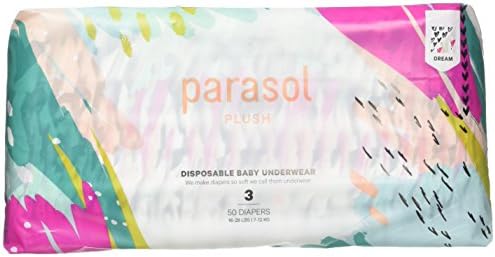
Parasol combines totally chlorine free pulp, water-based inks instead of dyes, and a Dermatest “Excellent” seal, which is the specific combination you want when a baby keeps rashing on other brands.
The material list excludes chlorine, dyes, fragrances, lotion, parabens, phthalates, preservatives, latex, and heavy metals (Parasol, 2026). The pulp is FSC certified, the spandex is OEKO-TEX certified, and the whole diaper is screened under OEKO-TEX STANDARD 100. Water-based inks avoid the disperse dye class tied to diaper dye dermatitis.
Independent lab results are unusually strong. BabyGearLab scored Parasol 95 out of 100 with a five-star rating, ranking it above 18 competing brands on absorption, leak protection, comfort, and durability (BabyGearLab, 2024). It was one of only two diapers in that test to score a perfect 10 for absorption.
The design uses an ultra-thin core with 3D embossed texture, a high-rise waist, and wider fabric coverage across the back, which helps with reflux-era blowouts. Latex-free closing tabs and soft nonwoven fabric keep friction low around the thighs.
Cost and access are the trade-offs. Parasol runs above $0.50 per diaper and sells mainly online and at Target rather than across every grocery chain, so plan restocking ahead rather than relying on a late-night run.
Babies with recurring rash where dyes or chlorine-processed pulp are suspects.
Parents who need a diaper stocked at every neighborhood store.
Seventh Generation is the cheapest way to get a fragrance-free, lotion-free, chlorine-free diaper from a regular supermarket shelf. It is dermatologist tested and built for sensitive skin without premium pricing.
The diapers are made with 0% fragrances, 0% lotions, and 0% chlorine bleaching, using FSC-certified sustainably sourced wood pulp under license C115279 (Seventh Generation, 2025). The published component list covers fluff pulp, sodium polyacrylate, polypropylene, polyethylene, polyolefins, polyurethane, spandex, adhesives, and inks.
The FreshAIR breathable layer releases humidity while pulling moisture away from the skin, and the absorbent core is rated for 12 hours of leak protection. Newborn sizes include an umbilical cord cutout, and the range covers newborn through size 6 plus a separate overnight line.
Absorbency is solid rather than exceptional, which suits daytime changes every two hours more than marathon nights. Parents managing a heavy wetter usually pair these for daytime with a higher-capacity diaper such as Coterie or Parasol after bedtime.
The certification gap is worth noting. Seventh Generation holds FSC certification for sourcing and states dermatologist testing, but it does not carry an allergy-specific mark like Asthma Allergy Nordic or a published OEKO-TEX STANDARD 100 listing for the diaper line.
Budget-conscious families who want a fragrance-free diaper they can grab with the weekly shop.
Babies with a confirmed dye or ink reaction.
Hello Bello delivers a plant-based, fragrance-free diaper at roughly $0.26 to $0.30 per diaper through Amazon Subscribe and Save or the brand’s bundle, which is close to mainstream pricing for a sensitive-skin build.
The diapers are made without chlorine processing, artificial fragrance, phthalates, parabens, latex, and lotion (Hello Bello, 2026). BabyGearLab lists the materials as TCF fluff pulp from managed forests, super absorbent polymer, polypropylene and polyethylene nonwovens, plant-derived PLA fiber, and spandex.
Independent testing rates the performance well. BabyGearLab gave Hello Bello Premium an Editors’ Choice award for absorbency, durability, and leak protection alongside its material profile, scoring it 84 out of 100 (BabyGearLab, 2024).
Buying method changes the value completely. Single packs off the shelf run as high as $0.78 per diaper, while the subscription bundle drops the price to a third of that (HuggleHive, 2026). Treat the bundle as the real price and the single pack as an emergency purchase.
Two practical notes. The rotating print designs use inks, so this is not the choice for a confirmed dye reaction, and parent reports on leak performance are mixed compared with Coterie and Parasol.
Families who will commit to a subscription and want clean materials at a normal price.
Occasional buyers who purchase one pack at a time.
DYPER uses bamboo viscose for the layers touching skin and ships with no inks or printed designs, which removes dye exposure from the equation entirely.
The topsheet and backsheet nonwovens are made from bamboo viscose, and the brand states the diapers are free of chlorine, latex, alcohol, perfumes, PVC, lotions, TBT, parabens, sulphates, and phthalates (DYPER, 2025). The product is OEKO-TEX certified and dermatologist tested.
The published component breakdown is unusually specific: 22% sodium polyacrylate, 35% elemental chlorine free wood pulp, 18% viscose, 9% polypropylene, 6% bioplastic, 4% paper, 3.7% elastane, and 2.3% adhesive (DYPER, 2025). The brand reports 55% USDA-certified biobased content.
Composting is the differentiator. The ReDyper program ships soiled diapers to an industrial composting partner rather than landfill, but it costs roughly $50 per month on top of the diaper subscription (Reviewed, 2022), and home composting is not an option.
Absorbency is the weak point. BabyGearLab scored DYPER 47 out of 100 and rated its absorption and leak protection poor, while crediting the softness and durability (BabyGearLab, 2024). The list price runs around $0.57 to $0.65 per diaper.
Babies with a suspected dye reaction and parents who want print-free diapers plus a composting route.
Heavy wetters or overnight stretches longer than eight hours.
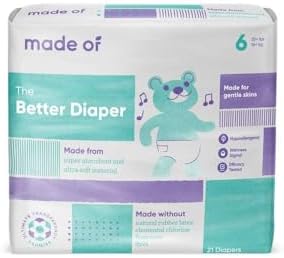
MADE OF builds its diaper around exclusions: latex-free, fragrance-free, bleach-free, and dye-free, with pediatrician and dermatologist testing behind the sensitive-skin claim.
The brand states the diapers contain no petrochemicals, phthalates, parabens, sulfates, soy, nuts, GMO ingredients, synthetic fragrances, or artificial ingredients, and lists EWG and NSF organic standard certification (MADE OF, 2025). Dye-free construction puts it in the same category as DYPER for babies reacting to printed designs.
Absorbency is rated at 10 hours by the manufacturer, and every size includes a wetness indicator. Sizes run newborn through 6 with pack counts from 36 to 176, and parent reviews on retail sites report good absorbency without rash across multi-month use.
The caution here is supply. Several Amazon and Walmart size listings have shown as unavailable or out of stock, so confirm the size you need is in stock before you build a routine around the brand.
Independent lab testing is also thin. Unlike Parasol, Coterie, and Hello Bello, MADE OF has not been through the major third-party diaper test panels, so the performance picture rests on manufacturer claims and parent reviews.
Parents who want a dye-free, minimal-ingredient diaper and are comfortable ordering ahead.
Anyone who needs guaranteed availability in a specific size every month.
Change one variable at a time and give each diaper five to seven days. Switching diaper, wipes, and barrier cream in the same week makes it impossible to identify what helped, and most irritant rashes improve within three days of better moisture control regardless of brand.
A 30-count pack costs a few dollars and tells you what a 198-count box cannot: whether your baby's skin reacts, whether the fit leaves marks, and whether the absorbency matches your change schedule.
Change every two hours during the day and as soon as stool appears, clean with water or a fragrance-free and alcohol-free wipe, pat dry, and apply a thick zinc oxide or petrolatum barrier at every change (American Academy of Pediatrics, 2021).
If the rash follows the shape of the printed design, the elastic bands, or the fastening tabs, that pattern points toward allergic contact dermatitis rather than simple irritation. Dye-free diapers are the standard avoidance step in that case (Alberta, Sweeney and Wiss, 2005), and a pediatrician can arrange patch testing.
Bambo Nature Classic is the strongest overall pick because it holds Asthma Allergy Nordic certification, uses totally chlorine free pulp, and contains no perfume or lotion. For babies whose rash is driven by overnight wetness rather than an ingredient reaction, Coterie’s higher absorbency is the better answer.
Not on its own. There are no federal standards or definitions governing the term in the United States, and manufacturers are not required to submit evidence to support the claim (FDA, 2022). Look instead for OEKO-TEX STANDARD 100, Dermatest, EWG Verified, or Asthma Allergy Nordic, which require outside testing.
Totally chlorine free (TCF) pulp is bleached without chlorine or any chlorine derivative. Elemental chlorine free (ECF) pulp is bleached with chlorine dioxide rather than chlorine gas. TCF is the stricter of the two. Bambo Nature, Parasol, and Hello Bello use TCF pulp; Pampers Pure, Huggies Special Delivery, and Honest use ECF.
Yes, though it is less common than irritant rash. A case series in Pediatrics documented allergic contact dermatitis in infants caused by the blue, pink, and green dyes in their diapers, and switching to dye-free diapers resolved it (Alberta, Sweeney and Wiss, 2005). Adhesives, elastics, and rubber components are other reported triggers.
Change every two hours during the day and immediately after stool. Prevention guidance from the American Academy of Pediatrics covers frequent changes, gentle cleaning, a thick barrier product at each change, highly absorbent diapers, and avoiding a tight fit (American Academy of Pediatrics, 2021). Change frequency affects rash risk more than brand choice for most babies.
No. Plant-based content and compostability measure environmental impact, not skin compatibility. A bamboo diaper with mediocre absorbency can leave skin wetter than a conventional fragrance-free diaper with a fast-wicking core. Check for a skin certification and absorbency testing separately from the sustainability claims.
Coterie absorbs the most, holding over 16 oz in size 4 lab testing (Coterie, 2025), with independent pour tests putting it 25% to 30% ahead of rivals (TeachToddler, 2026). Parasol is the runner-up, scoring a perfect 10 for absorption in BabyGearLab testing (BabyGearLab, 2024).
Bambo Nature Classic is the best diaper for sensitive skin because it is the only option here with an allergy-specific third-party certification, totally chlorine free pulp, and no perfume or lotion anywhere in the product.
Coterie is the pick for overnight and heavy wetters, where absorbency does more for the skin than ingredient purity. If price and availability decide it, Pampers Pure Protection is the fragrance-free diaper you can buy anywhere at a mid-range cost, provided your baby tolerates the shea butter liner.