
How to Pick a Stroller: A Step by Step Guide
- Published August 14, 2026
- Updated August 14, 2026
- 9 min read
The right stroller depends on your lifestyle first – where you walk, how often you travel, and whether you have more than one child matters more than brand.
The right stroller depends on your lifestyle first – where you walk, how often you travel, and whether you have more than one child matters more than brand.
TL;DR: The Quick Answer
- The right stroller depends on your lifestyle first – where you walk, how often you travel, and whether you have more than one child matters more than brand.
- Full-size strollers work best for everyday city or suburban use; lightweight and travel strollers are better for families who fly frequently.
- Check the weight limit, folded dimensions, and wheel type before buying – these three specs eliminate most mismatches.
- Stroller prices range from around $100 to over $1,500 (Consumer Reports, 2024), but a $300-500 mid-range model covers most parents’ needs.
- Test the fold mechanism in the store – if you can’t do it one-handed in under 10 seconds, it will frustrate you every day.
What to Know Before You Start Stroller Shopping
Before comparing specific models, you need to answer four questions about how you actually live. The stroller that works for a Manhattan apartment dweller who takes the subway daily is completely different from what works for a suburban parent who loads it into an SUV trunk.
The four questions are
Where will you use it most? How often do you travel by air? Do you plan to have more children? What is your storage situation at home?
Your answers will immediately rule out entire categories of strollers and save you from spending $800 on something you end up hating.
How to Pick a Stroller: The 5 Steps at a Glance
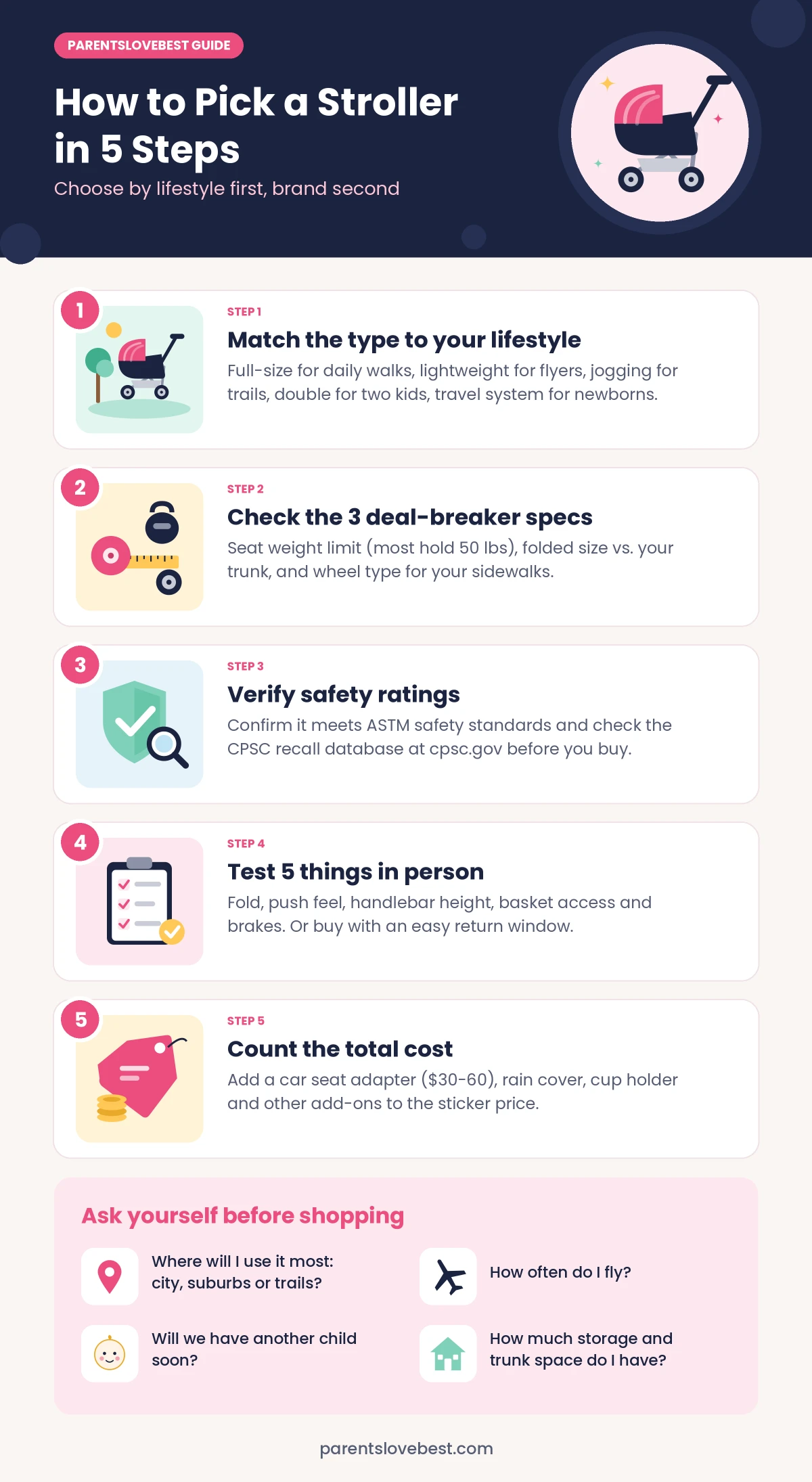
Step 1: Match the Stroller Type to Your Lifestyle
The five main stroller types each solve a different problem. Pick the type first, then compare models within that type.
Full-size strollers are the standard choice for everyday use. They have larger storage baskets, more recline positions, and wider seat widths - but they are heavier (typically 20-30 lbs) and have larger folded footprints. Good for parents who do not fly often and have room in a car trunk or entryway.
Lightweight strollers
(also called umbrella strollers) weigh between 11 and 17 lbs and fold into a compact shape. They sacrifice storage and recline depth in exchange for portability. Good for parents who travel by plane 3+ times per year or live in tight spaces.
Travel system strollers
include a stroller frame plus an infant car seat that clicks in directly. This lets you move a sleeping newborn from car to stroller without unbuckling them. Good for parents of newborns who drive frequently.
Jogging strollers have a fixed front wheel, three large air-filled tires, and a hand brake - designed for running at a pace faster than a brisk walk. The American Academy of Pediatrics recommends waiting until a baby is at least 6 months old before jogging with them in a stroller (AAP, 2023).
Double strollers carry two children and come in two layouts: side-by-side (wider, harder to fit through doorways) and tandem, also called inline (longer front-to-back, easier to maneuver). Good for twins or children within about 3 years of each other in age.
Step 2: Check the Three Specs That Eliminate Most Bad Purchases
Once you have narrowed down the stroller type, these three specifications will immediately tell you whether a specific model fits your life.
Weight limit.
Every stroller has a maximum weight rating for the seat. Most standard strollers support up to 50 lbs, which covers children through roughly age 4-5. Double strollers typically support 35-40 lbs per seat. If you expect to use the stroller past age 3, confirm the weight limit before buying.
Folded dimensions.
Look up the stroller's folded length and height in the product specs, then compare it to your car trunk or storage space at home. Many full-size strollers are 20-24 inches tall when folded, which will not fit in a compact car trunk alongside a diaper bag and groceries.
Wheel type.
Foam-filled or rubber wheels handle pavement, tile, and flat surfaces well. Air-filled (pneumatic) tires handle gravel, grass, and uneven terrain better but require occasional inflation. If you walk primarily on smooth surfaces, foam wheels are lower maintenance. If you walk on trails or rough sidewalks regularly, air tires are worth it.
Step 3: Verify the Safety Ratings for Any Stroller You Consider
All strollers sold in the United States must meet federal safety standards set by ASTM International and enforced by the Consumer Product Safety Commission (CPSC). But passing the minimum standard is not the same as being a top-rated stroller.
Check the CPSC recall database at cpsc.gov before finalizing any purchase. As of 2024, the CPSC has issued recalls on several stroller models for issues including faulty harness buckles and folding mechanism finger entrapment (CPSC, 2024).
For independent safety and durability ratings, Consumer Reports tests strollers for structural integrity, harness strength, and ease of use. Their 2024 testing found that stroller seat harnesses vary significantly in how difficult they are to buckle and unbuckle with one hand - a detail that matters when you are doing it 10 times a day.
Step 4: Test These Five Things In Person Before Buying
A stroller that looks good in photos can still be wrong for you. If at all possible, test the model in a store – or buy from a retailer with a no-hassle return window – and check these five things.
Fold mechanism. Open and close the stroller five times. Can you do it one-handed? Does it lock securely? A fold that requires two hands and a knee is a daily frustration.
Push feel. Push it around the store with some weight in the seat. Does it pull to one side? Do the wheels roll smoothly? A stroller that tracks straight is dramatically easier to push.
Brake. Engage and release the parking brake. It should click firmly into place and release without forcing it. A weak or stiff brake is a safety issue on any incline.
Canopy coverage. Open the canopy fully and check how much of the seat it shades. Some canopies cover only the top of the child’s head. Look for a canopy that extends to at least the child’s chest level.
Handlebar height. Stand behind the stroller in your natural posture and check that the handle sits at a comfortable height. For taller parents (above 6 feet), check the manufacturer’s handlebar measurement – many budget strollers top out at around 40 inches, which causes back strain on long walks.
Step 5: Factor in Total Cost, Not Just the Sticker Price
The purchase price is one part of the real cost of owning a stroller. Factor in accessories and compatibility before deciding your budget.
A car seat adapter lets you attach an infant car seat to a stroller that does not come as a travel system. Adapters typically cost $30-60 and are brand-specific - a Graco adapter will not fit a UPPAbaby frame.
A rain cover fits over the seat and canopy to keep a child dry in wet weather. Most are sold separately for $30-80. Some budget strollers do not have compatible aftermarket rain covers, so check before buying.
Cup holders and storage organizers for parents are rarely included at any price point below $500. Budget $20-40 for a universal organizer if you want a place to put your phone and coffee.
If you are buying a travel system, compare the total cost of buying the car seat and stroller together versus buying the stroller separately and adding a compatible adapter. Sometimes the bundle costs more than the parts purchased separately.
Common Stroller Buying Mistakes to Avoid
Buying for where you live now, not where you will use it. Many parents buy a rugged, heavy jogger for occasional trail walks and then hate it for the daily school pickup run. Match the stroller to your most frequent use case, not your ideal one.
Ignoring the weight until you own it. A 28-lb stroller sounds manageable until you are lifting it into a trunk 10 times a week for six months. If you drive frequently, weight matters more than almost any other spec.
Skipping the recline check for newborns. Newborns cannot support their heads and must lie flat or at a very slight incline. If you plan to use a stroller from birth, confirm that the seat reclines to fully flat - or buy a car seat compatible with a travel system frame.
Buying a double stroller before the second child is born. Double stroller needs vary depending on the age gap between children. A child born 4 years after a sibling will likely need the stroller for only a year or two. A convertible single stroller with a jump seat attachment may be more practical and cost less.
Overlooking resale value. Strollers from brands like UPPAbaby, Bugaboo, and Nuna hold 40-60% of their resale value on the secondhand market (Buy Buy Baby Resale Survey, 2023). A $900 stroller that resells for $400 costs you less long-term than a $350 stroller that resells for $40.
Frequently Asked Questions About Picking a Stroller
What is the best stroller for a newborn?
The best stroller for a newborn is either a travel system – which pairs a stroller frame with an infant car seat that clicks in flat – or a full-size stroller with a seat that reclines completely flat. Newborns must lie flat or nearly flat because they cannot hold their heads upright. Most strollers label this feature as a “lie-flat recline” or “bassinet mode.”
How do I pick a stroller if I live in an apartment?
If you live in an apartment, prioritize folded dimensions and weight above most other features. Measure your elevator (if applicable), hallway width, and the space where you will store the stroller. Lightweight umbrella strollers and compact fold full-size strollers – like the Babyzen YOYO2 or the GB Pockit – are designed specifically for tight urban spaces.
What is the difference between a travel system and a regular stroller?
A travel system is a bundle that includes a stroller frame plus an infant car seat designed to click onto that frame without an adapter. A regular stroller is sold as a stroller only. The main advantage of a travel system is moving a sleeping newborn from car to stroller without unbuckling them. The trade-off is that you are locked into one brand’s car seat, which may not be the best-rated seat for your vehicle.
When can a baby sit in a stroller without a car seat attachment?
Most stroller manufacturers recommend waiting until a baby can hold their head upright independently before using the stroller seat in a standard reclined position – typically around 3-6 months of age. Until then, the seat should recline flat or a compatible infant car seat should be used. Always follow the specific age and weight minimums listed in your stroller’s manual.
How long will a stroller last, and is it worth buying secondhand?
A well-made stroller from a reputable brand typically lasts through 2-3 children with normal use. Buying secondhand is worth considering for brands known for durability – but check the CPSC recall list first, inspect the harness buckle and frame for cracks, and confirm the model is not more than 5 years old. Avoid secondhand strollers that have been in a car accident or that are missing parts.
What is a good stroller budget for most families?
Most families find a reliable stroller in the $250-500 range. At that price point, you get a solid frame, an adequate canopy, a full harness system, and reasonable weight. Spending above $700 typically gets you a lighter fold, better wheel quality, and higher resale value – worth it if you use the stroller daily for 3+ years. Strollers below $150 tend to have weaker frames and shorter lifespans.
Summary: How to Pick the Right Stroller
- Identify your lifestyle needs first – daily environment, travel frequency, number of children – before looking at any specific models.
- Choose a stroller type (full-size, lightweight, travel system, jogging, or double) based on your most frequent use case.
- Check folded dimensions, weight limit, and wheel type to eliminate models that do not fit your practical constraints.
- Verify safety ratings on cpsc.gov and check for any active recalls before purchasing.
- Test the fold, push feel, brake, canopy, and handlebar height in person whenever possible.
- Calculate total cost including accessories, and factor in resale value when comparing price points.