
Essential Stroller Safety Features Every Parent Should Know
- Published October 11, 2026
- Updated October 11, 2026
- 8 min read
The most important stroller safety features are a five-point harness, a reliable braking system, and a stable frame with a low center of gravity.
Look for a five-point harness, a foot brake that locks both rear wheels and a wide, low frame. Check for JPMA certification, register the stroller for recalls and never hang bags on the handlebar.
TL;DR: The Quick Answer
- The most important stroller safety features are a five-point harness, a reliable braking system, and a stable frame with a low center of gravity.
- Strollers sold in the U.S. must meet ASTM International standard F833, which covers stability, restraint systems, and folding mechanisms.
- A five-point harness is safer than a three-point harness because it restrains the shoulders, hips, and crotch simultaneously, reducing ejection risk in tip-overs.
- Check for JPMA (Juvenile Products Manufacturers Association) certification on the label – it means the stroller passed independent third-party safety testing.
- Always register your stroller with the manufacturer so you receive recall alerts.
Stroller Safety Features That Matter Most at a Glance
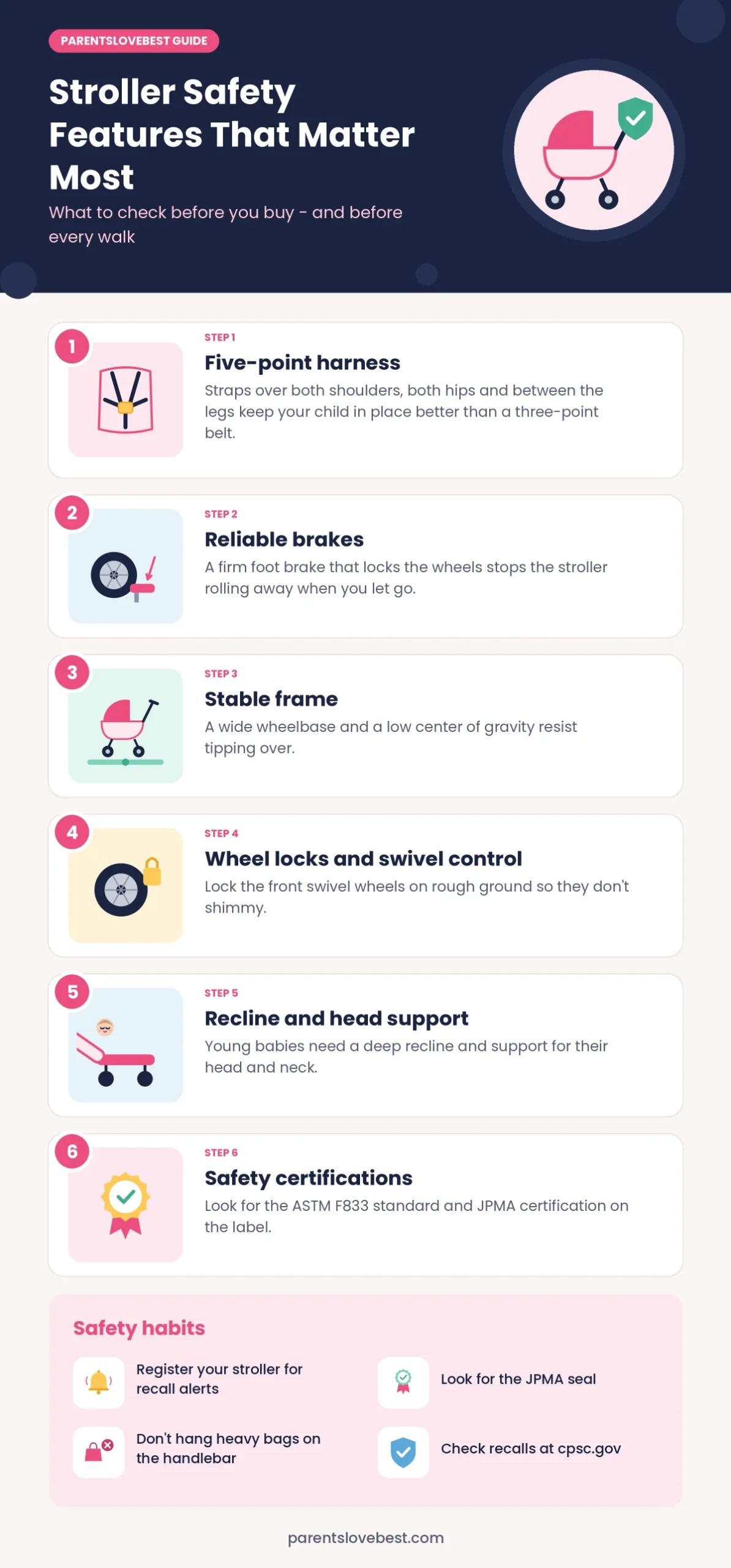
What Are Stroller Safety Features and Why Do They Matter?
Stroller safety features are the physical and structural elements of a stroller designed to prevent falls, tip-overs, ejections, and finger entrapment injuries. They matter because stroller- and carrier-related injuries send more than 17,000 children age 5 and under to U.S. emergency rooms every year, with falls and tip-overs among the most common causes, according to a Nationwide Children’s Hospital study.
Good to know
Parents often focus on storage, weight, and fold style when buying a stroller. Safety engineering tends to get less attention, even though it directly determines what happens when something goes wrong on a slope, curb, or crowded sidewalk.
The Five-Point Harness: The Single Most Important Restraint Feature
A five-point harness is a restraint system with two shoulder straps, two hip straps, and one crotch strap – all meeting at a central buckle. It is the safest harness type available on a stroller because it holds a child at five separate anchor points, which distributes force across the body and prevents the child from sliding forward, sideways, or out of the seat entirely during a sudden stop or tip.
Three-point harnesses, which are still found on budget models, only restrain at the shoulders and crotch. A child can slide out sideways in a tip-over with a three-point system. For babies and toddlers, always choose a five-point harness.
When checking a harness, pull the shoulder straps
You should not be able to fit more than two fingers between the strap and your child's collarbone. The crotch buckle should click firmly and resist accidental release.
Braking Systems: What Stops a Stroller from Rolling Away
All strollers have at least one brake, but the type and placement make a significant difference in real-world use. There are two main brake types:
Foot-activated bar brakes
lock both rear wheels simultaneously with a single step. These are faster to engage and harder to forget, making them the better choice for hilly terrain or any situation where you might need both hands free quickly.
Individual wheel brakes
are small levers on each rear wheel that must be pressed separately. They are slower to engage and easier to accidentally leave half-set.
Good to know
Look for a brake that locks visibly - many good models have a red/green indicator so you can confirm at a glance whether the brake is on. Test the brake on a 15-degree incline before purchasing; a parked stroller should not move at all when the brake is engaged.
Frame Stability and Tip-Over Resistance
A stroller tips over when its center of gravity shifts outside its wheelbase. The design features that prevent this are a wide wheelbase, a low seat position, and weight limits that account for the full load – child, gear, and any stroller bag hanging from the handles.
The most common cause of stroller tip-overs is hanging bags from the handlebars. A shopping bag or diaper bag on the handle raises the center of gravity and can flip the stroller backward, especially when the child leans forward. One test: load the stroller with weight equivalent to the maximum child weight rating and shake the handles side to side. The stroller should not rock more than a few degrees.
Some strollers include anti-tip wheels at the rear of the frame
Small wheels that drag on the ground and catch a rearward tilt before it becomes a fall. These are worth looking for if you plan to use the stroller on hills.
Wheel Locks and Swivel Controls for Active Safety
Active safety features are the ones that help you control the stroller while moving – not just when it’s parked. Front swivel wheels make steering easier on flat ground but can wobble dangerously at jogging speeds. Most quality strollers include a swivel lock that lets you fix the front wheels in a straight-ahead position for running, hiking, or uneven ground.
Good to know
For jogging strollers specifically, ASTM F833 requires a wrist strap (also called a tether) that attaches between the stroller frame and the parent's wrist. If you let go, the stroller does not run free. Never use a jogging stroller without the wrist tether attached - if yours is missing one, a replacement stroller wrist strap is inexpensive.
Seat Recline and Infant Head Support
Newborns and infants under 6 months cannot hold their heads up independently, which means a stroller that does not recline fully flat can cause their heads to fall forward and restrict their airway. This is called positional asphyxia, and it is why the AAP advises moving a baby who falls asleep in a stroller or car seat to a firm, flat surface as soon as possible.
A fully flat recline means the seat lies at 180 degrees or close to it
Not at 150 degrees, which many manufacturers describe as "near flat." If you plan to use the stroller from birth, verify the actual recline angle in the product specs, not just the marketing description.
Infant head inserts (such as the UPPAbaby Infant SnugSeat) that come with many strollers help keep the head centered and supported, but check that they are firm enough to maintain position and not so padded that they push the chin toward the chest.
Safety Certifications to Look for Before You Buy
Two certifications tell you a stroller was independently tested against minimum safety standards – not just inspected by the brand itself.
JPMA certification
means the stroller was tested by an independent laboratory against ASTM F833, which covers structural integrity, restraint performance, stability, and folding hinge safety. Look for the JPMA seal on the box or product listing, or check the JPMA certification program directly.
ASTM F833 compliance
is the underlying U.S. standard. All strollers sold legally in the U.S. must comply, but JPMA certification adds third-party verification that the manufacturer's compliance claim was actually tested.
Good to know
In the EU, look for the EN 1888-1:2018 certification, which is the European equivalent standard covering the same safety categories.
Common Stroller Safety Mistakes to Avoid
Hanging bags from the handlebar
Even a 10 lb bag on the handlebar can tip a stroller carrying a 20 lb child. Use the stroller's built-in storage basket under the seat instead.
Skipping stroller registration
Manufacturers issue recall notices directly to registered owners. Unregistered strollers miss recall alerts, which means a known defect goes unaddressed. Register at the manufacturer's website within a week of purchase.
Using a hand-me-down without checking for recalls
A stroller that was safe when purchased may have been recalled since. Run the model number through the CPSC recall database at cpsc.gov before using any secondhand stroller.
Using a jogging stroller for everyday walking without locking the swivel
Unlocked front wheels on a running stroller can shimmy and cause loss of control at walking speeds on uneven ground. Lock the swivel when on rough terrain, unlock it for tight turns on smooth ground.
Frequently Asked Questions About Stroller Safety Features
What is the safest harness type for a stroller?
A five-point harness is the safest option. It restrains the child at the shoulders, hips, and crotch simultaneously, which prevents forward, sideways, and upward ejection during a tip-over or sudden stop. Avoid strollers with only a three-point harness if your child is under 40 lbs.
How do I know if a stroller meets U.S. safety standards?
Look for JPMA certification on the product label or listing. JPMA-certified strollers have been independently tested against ASTM F833, the U.S. standard for stroller safety. You can also verify a stroller’s recall history at cpsc.gov using the model name and number.
Are secondhand strollers safe to use?
A secondhand stroller can be safe if it has not been recalled, shows no structural damage, and all harness buckles and brakes function correctly. Check the CPSC recall database at cpsc.gov before using any stroller you did not buy new.
What age and weight can a child use a stroller?
Most strollers are rated from birth (with full recline or a compatible infant car seat adapter) up to 50 lbs. Jogging strollers are generally not recommended for children under 6 months because they do not absorb vibration well enough for infant spinal development. Always follow the manufacturer’s age and weight limits.
What is positional asphyxia in a stroller?
Positional asphyxia occurs when an infant’s head falls forward in a semi-reclined seat, which presses the chin toward the chest and restricts the airway. It is a risk in any infant seat that does not recline fully flat. For children under 4 months, use a stroller only in the fully flat position or with a compatible bassinette attachment.
Do stroller brakes need regular maintenance?
Yes. Check the brake pads and locking mechanism every 3 months if you use the stroller daily. Grit, sand, and wear can reduce braking effectiveness. If a brake no longer holds the stroller stationary on a slope, do not use the stroller until it is repaired or replaced.
Key Takeaways
- A five-point harness, a dual-locking foot brake, and a wide low-set frame are the three features that matter most for physical safety.
- JPMA certification and ASTM F833 compliance are the two labels that confirm a stroller was independently tested, not just self-certified by the manufacturer.
- Register your stroller with the manufacturer immediately after purchase so you receive direct recall notices.
- Never hang bags from the handlebar and never skip the wrist tether on a jogging stroller.
- For infants under 6 months, only use a stroller with a fully flat recline to eliminate the risk of positional asphyxia.