
When Can You Put Baby in Stroller Without Car Seat: Age, Weight and Safety Rules
- Published October 11, 2026
- Updated October 11, 2026
- 8 min read
Most babies can ride in a standard stroller seat (without a car seat attachment) at 6 months old, once they can sit upright with full head control.
Most babies can ride in a standard stroller seat at about 6 months, once they have full head control and sit without slumping. Before that, use a travel system with an infant car seat or a pram that lies flat.
TL;DR: The Quick Answer
- Most babies can ride in a standard stroller seat (without a car seat attachment) at 6 months old, once they can sit upright with full head control.
- Before 6 months, use a travel system with an infant car seat or a pram-style stroller that lets the baby lie flat.
- The American Academy of Pediatrics (AAP) recommends against placing infants in semi-reclined seats before they have independent head and neck control.
- Weight alone does not determine readiness – developmental milestones matter more than hitting a number on a scale.
- Always check your specific stroller’s manual for its minimum age and weight requirements, which override general guidelines.
When Can Baby Ride Without a Car Seat at a Glance
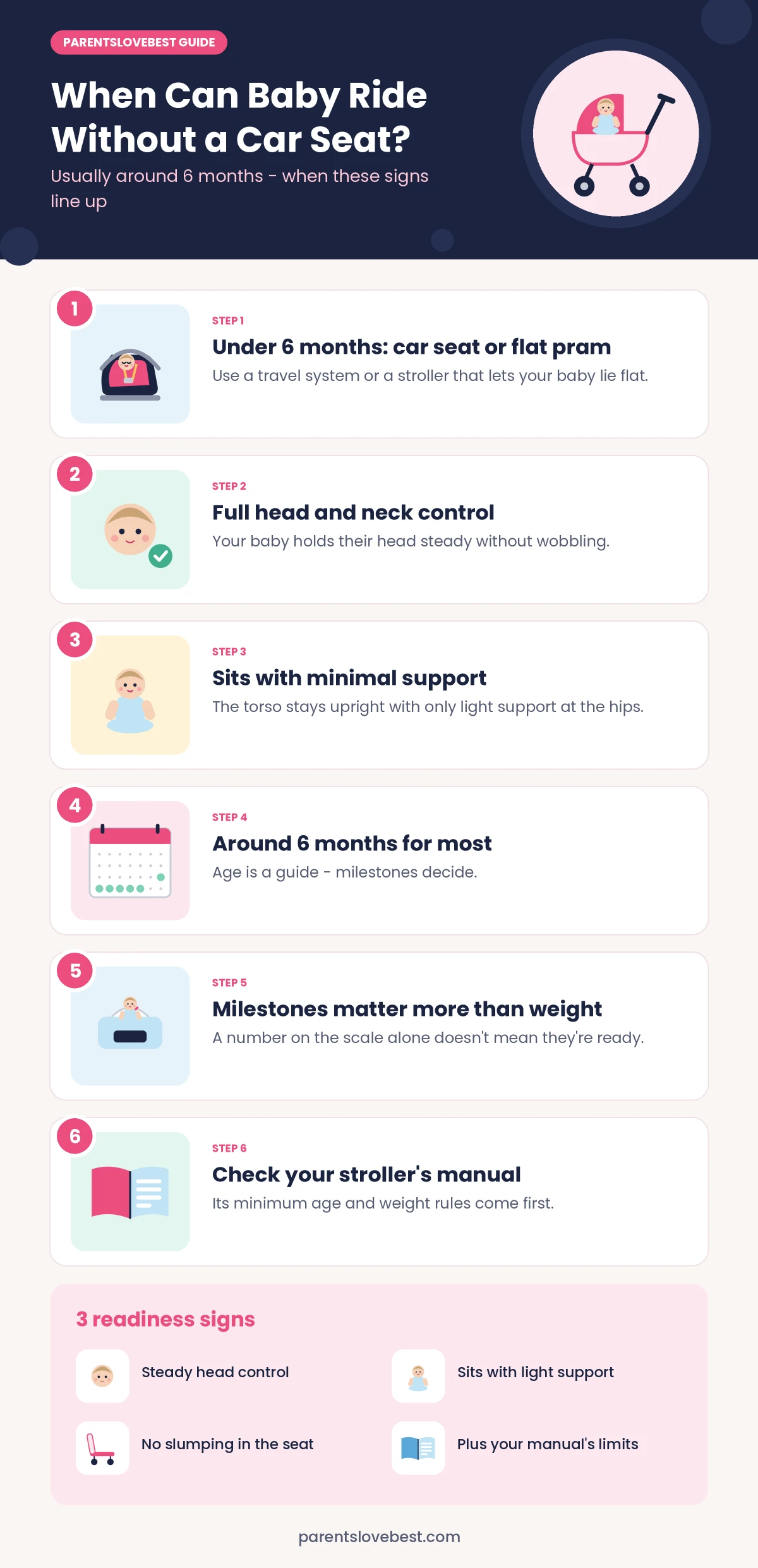
When Can You Put Baby in Stroller Without Car Seat?
Most babies are ready to sit in a standard stroller seat – without a car seat attached – at around 6 months of age. The real threshold is not age itself, but whether the baby has full, independent head and neck control and can sit upright without slumping.
Good to know
Before that point, an infant's neck muscles are not strong enough to hold the head steady in a semi-upright position. A stroller seat that holds a baby at even a 45-degree angle puts stress on an underdeveloped spine and airway. This is why pediatricians and stroller manufacturers set the 6-month mark as the general minimum.
Why the Car Seat Matters Before 6 Months
An infant car seat (also called a bucket seat) does more than transport a baby by car. When clipped onto a compatible stroller frame as part of a travel system, it holds the baby in a fully reclined, protective shell designed for newborns.
This matters for two reasons
Airway safety.
Newborns and young infants have limited control over their head position. A semi-reclined or upright stroller seat can cause the chin to drop toward the chest, partially blocking the airway - a condition called positional asphyxia. The AAP advises moving a baby who falls asleep in a car seat or stroller to a firm, flat surface as soon as possible.
Spinal support.
Infant car seats are contoured to cradle the full length of a newborn's body. Standard stroller seats are not. Using the car seat inside the stroller gives the baby the same safe, flat-ish position it would have in the car.
If you do not have a travel system, a pram (also called a bassinet stroller) is the other safe option before 6 months. A pram lets the baby lie completely flat, which is the safest position for a young infant during travel.
The 3 Developmental Signs Your Baby Is Ready for a Standard Stroller Seat
Six months is the commonly cited age, but readiness depends on three physical milestones. A baby who hits all three before 6 months may be ready slightly earlier. A baby who has not hit them by 6 months is not ready yet.
Full head and neck control. The baby can hold their head upright and steady for extended periods without it wobbling or dropping. Most babies hold their head steady without support by about 4 months, according to the CDC milestone checklist.
Sits with minimal support. The baby can hold a seated posture with only light support at the hips. They do not need to be hands-free yet, but their torso should not be collapsing forward.
No slumping in the seat. When placed in a slightly reclined position, the baby stays upright and does not slide or fold forward. If the baby slumps, the airway risk returns even in a stroller seat.
Good to know
A simple test: if you hold the baby in a seated position on your lap and let go briefly, do they stay upright? If yes, the core and neck strength is likely there. If they tip immediately, wait another few weeks.
Stroller Types and What Each One Is For
Not all strollers work the same way. Choosing the wrong type for your baby’s age is one of the most common mistakes new parents make.
| Stroller Type | Safe from Birth? | How It Works | Best For |
|---|---|---|---|
| Travel system | Yes | Car seat clips onto stroller frame | Newborns through toddlers |
| Pram / bassinet stroller | Yes | Baby lies flat in a bassinet compartment | Newborns to ~6 months |
| Standard stroller | No – 6 months+ | Upright or reclined seat | Babies with full head control |
| Jogging stroller | No – 6-8 months minimum | Upright fixed or swivel seat | Active parents, older babies |
| Umbrella stroller | No – 6 months minimum | Lightweight, minimal recline | Travel, older babies |
Good to know
A travel system is a stroller frame sold alongside a compatible infant car seat. The car seat clicks directly into the frame. This lets you move a sleeping baby from car to stroller without waking them, and it is the most commonly recommended setup for the first 6 months.
Age vs. Weight: Which Threshold Actually Matters More?
Age matters more than weight when it comes to stroller readiness. Weight tells you whether the baby has grown. Age (combined with developmental milestones) tells you whether the body is structurally ready to handle an upright seated position.
That said, stroller manufacturers publish both age AND weight minimums for their seats. You must meet both thresholds - not just one. For example, a stroller may specify "6 months or 9 kg (20 lbs), whichever comes later."
A large baby who weighs 9 kg at 4 months does not have the neck and spinal development to safely ride in an upright seat. Their weight is high, but their developmental readiness is not there yet.
Always read your specific stroller manual. Manufacturers set their own minimums based on the seat's design, recline angle, and harness system. Those numbers are the binding limit for that product - not general advice found online.
4 Common Mistakes Parents Make With Infant Strollers
These are the errors that come up repeatedly in pediatric safety guidelines and parent communities.
Using a standard stroller seat too early.
The most common mistake. If the baby cannot hold their head up independently, the standard seat is not safe. Use a travel system or pram instead.
Skipping the car seat attachment on a travel system.
Some parents place the baby directly in the stroller seat frame even though the car seat is available. For a baby under 6 months, always use the car seat attachment.
Assuming a recline setting makes a standard seat safe for newborns.
Many standard strollers recline fully flat. However, a flat recline in a standard stroller is not the same as a bassinet pram. The materials, support, and airway positioning differ. Check the manual - if the product says 6 months minimum, that applies even when fully reclined.
Using a jogging stroller too early.
Jogging strollers are not designed for babies under 6 to 8 months. Running with an infant in a jogging stroller - even at a slow pace - creates vibration and jostling forces the infant's neck cannot handle. Most manufacturers set 6 months as the absolute minimum; many recommend 8 months for jogging (not just walking).
How to Transition Your Baby to a Standard Stroller Seat
When your baby is showing all three readiness signs and has reached the manufacturer’s minimum age and weight, follow these steps for the first few rides:
Start with short trips. The first few outings in a standard stroller seat should be 10 to 15 minutes. Watch for signs of fatigue – head drooping, fussing, slumping forward.
Use the full recline initially. Even if your baby has good head control, start with the seat slightly reclined rather than fully upright. Move to a more upright angle over several weeks.
Check the harness fit every time. The five-point harness straps should sit at or just below shoulder height. You should be able to fit two fingers under the chest clip, which should sit at armpit level.
Bring the infant car seat for the first few weeks. Even after transitioning, keep the travel system car seat in the car. If the baby gets tired mid-outing, you can switch them back to the car seat attachment for the ride home.
Never use the stroller as a sleep surface for extended periods. Even in a fully reclined standard seat, prolonged unsupervised sleep is not recommended (AAP safe sleep guidance).
Frequently Asked Questions About Putting Baby in Stroller Without Car Seat
When can you put baby in stroller without car seat?
Most babies are ready at 6 months old, once they can hold their head upright independently and sit with minimal support. Weight alone is not the deciding factor – developmental milestones are. Always check your stroller’s manual for its specific minimum age and weight requirements.
Can a 3-month-old go in a stroller without a car seat?
No. At 3 months, most babies do not have the head and neck control needed for a standard stroller seat. Use a travel system with an infant car seat clipped into the stroller frame, or a pram-style stroller that lets the baby lie flat.
Can a 4-month-old sit in a stroller?
Not in a standard upright stroller seat. At 4 months, most babies are still developing full head control. A travel system or pram is the right option. Some babies develop faster and show full head control closer to 4 to 5 months – if in doubt, check with your pediatrician.
What is a travel system and how does it work?
A travel system is a stroller frame that comes with, or is compatible with, a specific infant car seat. The car seat clips directly onto the stroller frame using an adapter or built-in connector. This lets you move a baby from car to stroller without taking them out of the seat. Travel systems are the recommended option for babies from birth to 6 months.
What is the difference between a pram and a stroller?
A pram (also called a bassinet stroller or carrycot stroller) is a stroller where the baby lies completely flat in a bassinet-style bed. A standard stroller holds the baby in a seated or reclined position. Prams are safe from birth because the flat position is appropriate for newborns. Standard strollers require the baby to be at least 6 months old with full head control.
Do I need a special stroller for a newborn?
You need either a travel system (standard stroller frame + compatible infant car seat) or a pram. A standard stroller seat is not safe for newborns. You do not need to buy both – most families start with a travel system, then transition to the standard seat at 6 months without buying a new stroller.
Can a 6-month-old go in an umbrella stroller?
Some umbrella strollers are rated for 6 months, but many are designed for older babies (9 to 12 months) because of their limited recline and minimal head support. Check the specific model’s manual. If the seat does not recline to at least 45 degrees and lacks padded head support, wait until the baby is older.
Key Takeaways
- Babies are ready for a standard stroller seat at 6 months old, when they can hold their head steady and sit upright without slumping.
- Before 6 months, use a travel system (infant car seat on stroller frame) or a pram that allows a fully flat position.
- Weight is a secondary check – development and age come first.
- Jogging strollers require a minimum of 6 to 8 months, and jogging (not just walking) should wait until 8 months.
- Always read your stroller’s manual – manufacturer minimums are the binding limit for that product.