
#1 · Minimalist doorway jumping
Type
Doorway
Overall Height
Hangs from door frame
Weight Limit
28 lb
Approx. Price
Check Amazon

As an Amazon Associate, Parents Love Best earns from qualifying purchases. Learn more
Low ceiling at home? These 10 baby jumpers all fit under a 7-foot ceiling. Here is how their heights, door needs and prices compare.
The Jolly Jumper Iconic is the original doorway jumper, a saddle seat on a spring that clamps to your door frame.
This table compares all 10 jumpers by the specs that matter most in a low-ceiling room. Prices are approximate US retail at the time of writing and change often.


A low ceiling rules out ceiling-hook jumpers and tall A-frame stands, so the right choice is a stationary jumper or a doorway jumper. Both types get their support from the floor or the door frame. A stationary jumper needs about 3 feet of vertical space, and a doorway jumper needs only a standard door opening.
Low ceilings are common in basements, attic rooms, older homes and mobile homes. The International Residential Code sets 7 feet as the minimum ceiling height for most habitable rooms in new US homes (International Code Council, 2021). Basements with beams and ducts can drop lower in spots.
They need a joist hook, a long spring and enough drop for your baby's toes to touch the floor. In a 7-foot room with a soffit or beam, that setup is hard to adjust and hard to install safely.
The same building code requires egress doors to be at least 78 inches tall (International Code Council, 2021), and most interior doors match or exceed that. A jumper that hangs 69.5 inches from the clamp to the seat bottom fits with room to spare.
The most important checks are overall height, mounting type and the weight limit. After those, look at footprint, seat adjustment and how long your baby can use it. The table below lists every criterion used to rank the 10 jumpers in this guide.
Stationary units range from 18.5 to about 39 inches. Shorter units fit under sloped ceilings, low shelves and windowsills.
Doorway and freestanding jumpers avoid ceiling hooks. Ceiling-mounted models need joist access and more drop.
Doorway clamps need flat molding on top of the frame. Rounded or missing trim can stop the clamp from gripping.
Most jumpers stop at 25 lb. A 28 or 30 lb limit adds a few months of use for bigger babies.
Stationary jumpers usually cap at 30 to 32 inches. Tall babies outgrow these before they hit the weight limit.
More positions let you set flat feet at the right bounce depth as your baby grows.
Stationary jumpers take about 30 x 30 to 39 x 39 inches. Doorway models use almost no floor space.
A rotating seat lets your baby reach toys on every side without you moving the unit.
Spring-supported seats bounce the whole body. Some budget units only flex at the legs.
Toy count ranges from none to 58 activities. More toys hold attention longer but add noise and batteries.
Electronic toys need AA or AAA batteries. A volume or off switch helps in a small apartment.
3-in-1 models convert to play tables, which extends use past the jumping stage.
Babies drool and spit up. A machine-washable pad saves time.
Doorway jumpers fold flat. Most stationary jumpers do not fold, which matters if you store them in a closet.
Light units (4 lb) move room to room easily. Heavy units (13 to 22 lb) stay put and resist tipping.
Prices in this guide run from about $40 to $150. Check current listings, because product prices change often.
Each review below covers height, mounting, weight limits, toys and the real downsides parents report. Doorway models come with trim notes, since your door frame decides whether they fit.
The Jolly Jumper Iconic is the original doorway jumper, a saddle seat on a spring that clamps to your door frame. It suits low-ceiling homes because it never touches the ceiling and folds flat for storage.
The Jolly Jumper clamps onto door molding with a flat top at least 1/2 inch wide, on a wall up to 6 inches thick (Jolly Jumper, 2026). Measure your trim before you order. Rounded, beveled or missing trim is the most common reason a doorway jumper will not grip.
The 28 lb limit gives it a longer run than most jumpers, which stop at 25 lb (Jolly Jumper, 2026). The maker recommends starting once your baby has full head control, around 3 months, and stopping just before your baby walks.
It has no toys, lights or sounds. For some parents that is the appeal: nothing to wash except the seat, no batteries, no noise through thin apartment walls. Your baby’s entertainment is the bounce itself and whatever is happening in the room.
The whole unit folds into a flat package about 18 x 8 inches, so it slides into a diaper bag or a suitcase. That makes it a good pick for grandparents’ houses or for parents who split time between two homes.
Parents in small apartments or basements who want a simple jumper that packs away.
Homes with rounded or trimless door frames, or babies who need toys to stay engaged.
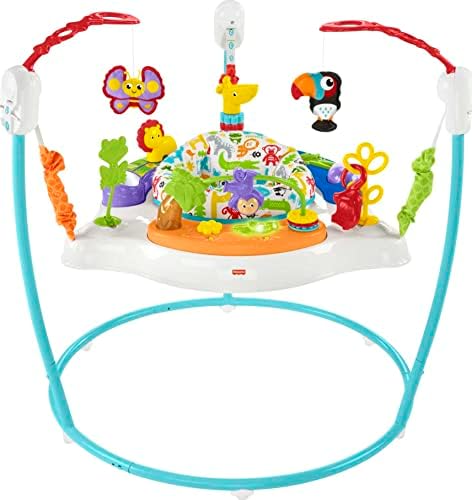
The Fisher-Price Animal Activity Jumperoo (model FFJ00) is a freestanding jumper with a spring frame, a 360-degree seat and seven toys. At roughly 35 inches tall, it fits under any 7-foot ceiling with more than 4 feet to spare.
The Jumperoo holds babies up to 25 lb and is meant for babies who hold their heads up but cannot yet walk or climb out (Mattel, 2026). Fisher-Price’s springs are enclosed in the frame posts, so the whole seat bounces rather than just the leg openings.
The toy lineup is the main reason parents pick it. The electronic toy plays music and lights up when your baby bounces, which rewards movement. The frog teether and spinning animals give quieter options when you want less noise.
Height is not a concern here. The frame is about 35 inches tall (Mommyhood101, 2026), so even a basement with ducts running at 6.5 feet leaves plenty of clearance. The larger issue is floor space, since the frame takes a square about 3 feet wide.
The seat can sit about an inch too high for small babies even on the lowest setting (Mommyhood101, 2026). Fold a towel under your baby’s feet until they grow into it. Batteries (3 AA) are not included, and there is no plug-in option.
Babies who need lots of toys and sounds to stay happy.
Small rooms where 3 feet of floor space is hard to give up.
The Baby Einstein Neptune’s Ocean Discovery Jumper is a 34-inch-tall stationary jumper with an ocean theme and songs in three languages. It is one of the shorter full-size jumpers in this guide.
At 34 inches, Neptune’s frame sits below the height of most kitchen counters (Kids2, 2026). That matters in attic rooms with sloped ceilings, where you may need to push the jumper toward the low side of the room. It also weighs 12.2 lb, so one parent can carry it.
Four seat height positions give it one more setting than most competitors. That helps you match foot contact as your baby grows. The limits are 25 lb and 30 inches tall, and the age range is 6 to 12 months (Kids2, 2026).
The three languages set it apart. Songs play in English, Spanish and French, which bilingual families like. The seat pad is machine-washable, and the unit runs on 3 AA batteries (not included).
Reviews are mixed. Target shows a 3.9 out of 5 rating, and some one-star reviews mention tipping, a snapped base piece and ripped straps (Target, 2026). Place it on a flat floor, away from stairs, and check the straps each week.
Bilingual families and babies who respond to music.
Very active jumpers who bounce hard, given the durability complaints.
The Graco Doorway Bumper Jumper hangs from the top of a door frame and has a padded bumper ring that keeps your baby from hitting the sides. It is the best choice when both ceiling height and floor space are tight.
Graco lists the full hanging height at 69.5 inches (Graco, 2026). A standard 78- to 80-inch door leaves 8 to 10 inches of spare room above the clamp, so it fits well in older homes and mobile homes with shorter doors. The ceiling never comes into play.
The bumper ring is the reason to choose this over a bare doorway jumper. Babies in doorway jumpers swing and twist, and the padded ring absorbs contact with the door frame. Non-twist straps adjust on each side so you can set the right bounce height.
At about 4 lb, it is the lightest jumper in this guide (Graco, 2026). You can move it from the living room doorway to the kitchen doorway in under a minute. The spring clamp is designed not to mark your paint.
Graco’s manual recommends sessions of no more than 15 minutes (Graco manual, 2026). Graco does not publish a minimum trim width, so check that your molding has a flat top edge before you buy. The seat pad is machine-washable.
Small apartments where every square foot of floor counts.
Homes with open archways or no door molding.
The Evenflo ExerSaucer Jump & Learn (Jungle Quest) is a stationary jumper with up to 58 activities. It is the tallest unit in this guide at about 39 inches, which still fits under the lowest legal ceiling with nearly 4 feet to spare.
The Jump & Learn has the largest activity count in this guide. Walmart lists 58 activities across the tray and overhead pieces (Walmart, 2026). That variety keeps older babies busy longer than a jumper with five or six toys.
The volume switch is useful in a small space. In a basement apartment or a single-room setup, you can turn sounds off during naps for siblings. The electronic toys have lights and music that respond to bouncing.
Its height is the tallest here at about 39 inches, so check under sloped ceilings and low-hanging light fixtures. In a flat 7-foot room it is no problem. The limits are 25 lb and 30 inches of child height, per the Evenflo manual (Evenflo, 2026).
Parents report that the springs feel stiff for small babies, the sounds cut off quickly, and the unit is heavy to move (Walmart, 2026). It also takes a large footprint. Pick a permanent spot before you assemble it.
Curious babies who get bored of the same few toys.
Attic rooms with steep slopes, or homes that need a jumper that moves easily.
The Bright Starts Explore and Roar Activity Jumper is a compact stationary jumper about 28 inches tall with a removable lion music station. Bright Starts markets it as space-saving and able to fit in a corner.
At about 28 inches tall and 30 inches square, the Explore and Roar is one of the smallest true jumpers in this guide (WorthPoint listing, 2026). It fits under a window, beside a couch, or in the corner of a bedroom where larger units block walkways.
The removable lion station is the best toy on this jumper. It works as a piano, a song player and a learning toy with three modes. Because it detaches, your baby can keep playing with it on the floor after outgrowing the jumper.
The toy lineup is strong for the size: a ball-launching monkey, spinning globes, a frog bead chaser, a giraffe mirror and a teether. The lion runs on 3 AA batteries (Kids2 manual, 2026).
Limits are 25 lb and 30 inches of child height. Use starts once your baby can sit unassisted, and use stops once your baby walks. Stock is limited in 2026, since Bright Starts now sells newer models such as Bounce Bounce Baby (Kids2, 2026).
Small bedrooms and apartments where the jumper needs to tuck into a corner.
Parents who want a model with easy access to replacement parts.
The Skip Hop Explore & More is a 3-stage activity center, 18.5 inches tall at the base, with a swiveling seat and a see-through “Discovery Window” floor. It is the lowest-profile unit in this guide, but it does not bounce like a true jumper.
Skip Hop lists the height at 18.5 inches (Target, 2026). With no overhead arch, it sits well below windowsills and shelves, so it works under stairs, in low attic nooks and in basement corners where the ceiling dips around ducts.
This is a sit-and-swivel activity center, not a bouncer (Babylist, 2026). If your main goal is bouncing, skip to a spring jumper. If you want a stable play seat for a 4-month-old, the low, wide base is a plus.
The 3 stages extend its use. Stage one is sit and swivel. Stage two turns it into a cruise-and-play station for early walkers. Stage three removes the seat to make a play table. The Discovery Window floor lets your baby watch their own feet move.
Parents report a hard plastic seat, a foot platform set too high for smaller babies, and a window that cannot be removed for cleaning (Mom Loves Best, 2026). It is also the most expensive unit here. The limits are 25 lb and 30 inches tall.
Parents who want a low, stable activity seat that becomes a toddler table.
Babies who love to bounce.
The Ingenuity 3-in-1 Baby Jumper and Activity Center converts from a jumper to an activity table and floor toys. At about 32.7 inches tall, it fits any low-ceiling room, and the table mode lasts into the toddler years.
The 3-in-1 design gives it the longest use span here. Kids2 lists the play center for ages 6 to 48 months across jumper, table and floor-toy modes (Kids2, 2026). The Amazon listing gives a 4-month to 3-year range, so check the manual that ships with your unit.
Wood legs give it a furniture look that blends into a living room. That matters in small homes where the jumper sits in the main living space instead of a dedicated playroom.
The light-up greenhouse plays music and nature sounds, and three toy stations sit around the seat (Kidsy, 2026). Four seat heights let you fine-tune foot contact. It runs on 3 AA batteries.
The downside is size. At almost 40 inches square, it has the largest footprint of any stationary jumper in this guide, and the frame does not shrink once assembled (Mom Loves Best, 2026). Measure your floor space before buying.
Families who want one purchase to cover babyhood and toddler play.
Small rooms where a 40-inch square is too much floor.
The Baby Trend Smart Steps 3-in-1 Bounce N’ Play is the best overall pick for low ceilings. It stands 30.8 inches tall, holds babies up to 30 lb and 32 inches, and converts to two table modes for about $80.
The Smart Steps has the highest limits of any stationary jumper here: 30 lb and 32 inches tall (Baby Trend, 2026). Most competitors stop at 25 lb and 30 inches. For a baby in a high growth percentile, that can add two or three months of use.
Its size fits small homes. At 30.8 inches tall and under 30 inches square, it has a smaller footprint than the Fisher-Price, Baby Einstein or Ingenuity models. It weighs 10.8 lb, so moving it from room to room is easy.
Three modes keep it useful: activity center, activity play table and flat table. The musical keyboard runs on 3 AAA batteries, and the five toys detach. Walmart shoppers rate it 4.6 out of 5 across more than 2,000 ratings (Walmart, 2026).
Some parents say the bounce is weaker than a full spring frame, the floor platform wobbles, and the seat rotation feels stiff at first (Walmart, 2026). For a low-ceiling home that values compact size and a long run, those trade-offs are acceptable.
Most families in basements, apartments and small homes.
Babies who want a big, springy bounce.
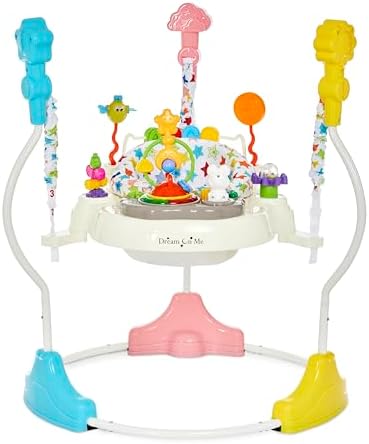
The Dream On Me Zany 2-in-1 is a budget stationary jumper, 33.5 inches tall, with a 360-degree seat and 12 melodies. At about $77, it is the lowest-priced stationary unit in this guide.
The Zany gives you a full stationary jumper for less than most competitors (Dream On Me, 2026). If you want to try a jumper without spending $100 or more, this is the lowest-risk way to see whether your baby enjoys bouncing.
Its 30-inch square footprint matches the Bright Starts and Baby Trend models, and its 33.5-inch height leaves over 4 feet of clearance under a 7-foot ceiling. It weighs 13 lb, so it stays planted during active bouncing.
It works in two modes: a bouncer and a stationary activity center. The 12 melodies and flashing lights keep babies entertained, and the Star Print pattern is gender-neutral for hand-me-downs.
Dream On Me does not recommend it for babies under 6 months. Reviewers mention thin seat padding, basic toys and a weaker bounce than dedicated jumpers (BabyToChild, 2026). Dream On Me does not clearly publish a weight limit, so check the manual before use.
Budget-minded parents who want to test a jumper before spending more.
Babies under 6 months or parents who want premium toys.
Measure three things: the floor area, the vertical clearance at the spot you will use, and your door trim if you want a doorway model. These take five minutes with a tape measure and prevent most returns.
Floor area. Mark a 30 x 30-inch square for compact units, or 40 x 40 inches for the Ingenuity and Baby Einstein. Leave 2 feet on each side so your baby cannot reach furniture, cords or curtains.
Vertical clearance. Measure from the floor to the lowest object above the spot, such as a duct, beam, shelf or sloped ceiling. Keep at least 12 inches above the top of the jumper’s frame or toys.
Door trim (doorway jumpers only). Check that the molding on top of the door frame has a flat top edge at least 1/2 inch wide. Measure the wall thickness across the frame; the Jolly Jumper clamp fits walls up to 6 inches (Jolly Jumper, 2026).
Door height (doorway jumpers only). Measure from the floor to the top of the door frame. The Graco needs about 69.5 inches from clamp to seat bottom, plus room for your baby’s feet to touch the floor.
Use a baby jumper only when your baby has full head control, keep sessions to 15 to 20 minutes, and stay in the room the whole time. Stop using it once your baby can walk or climb out. These rules apply to every model in this guide.
Jennifer Gaewsky recommends no more than 15 to 20 minutes at a time, and only when a baby shows clear head and trunk control (Physical Therapy for Infants, 2026). Graco's manual sets a similar 15-minute limit (Graco manual, 2026). Balance jumper time with floor play so your baby builds the muscles needed to crawl.
The American Academy of Pediatrics describes stationary activity centers as walkers without wheels and recommends them over walkers (HealthyChildren.org, 2022). A study in Pediatrics found that 230,676 US children under 15 months were treated in emergency departments for walker-related injuries from 1990 to 2014 (Pediatrics, 2018).
In a small room, place the jumper away from stairs, heaters, cords and furniture your baby could grab. Doorway jumpers need extra care: keep other children from swinging the door, and make sure no one closes it while your baby is in the seat.
The Baby Trend Smart Steps 3-in-1 Bounce N’ Play is the best overall. It stands 30.8 inches tall, supports babies up to 30 lb and 32 inches, and costs about $80 (Baby Trend, 2026). For a doorway option, the Graco Doorway Bumper Jumper uses almost no floor space.
Yes. Every jumper in this guide fits under a 7-foot ceiling. Stationary units stand between 18.5 and about 39 inches tall, and doorway units clamp to the door frame. Avoid ceiling-hook spring jumpers, which need joist access and extra drop.
No. Doorway jumpers attach to the top of a door frame, so ceiling height does not matter. What matters is flat door molding for the clamp and enough door height for your baby’s feet to touch the floor. The Graco model hangs 69.5 inches, which fits a standard 78- to 80-inch door.
Most stationary baby jumpers are 28 to 39 inches tall. In this guide, the Bright Starts Explore and Roar is about 28 inches, the Baby Trend Smart Steps is 30.8 inches, and the Evenflo ExerSaucer Jump & Learn is about 39 inches.
Most babies can start using a jumper between 4 and 6 months, once they have full head control. Some models set a later start, such as the Dream On Me Zany (6 months) and the Bright Starts Explore and Roar (once baby sits unassisted). Stop when your baby walks or reaches the weight or height limit.
Keep each session to 15 to 20 minutes. Pediatric physical therapist Dr. Jennifer Gaewsky recommends this limit, and Graco’s manual sets 15 minutes as the maximum (Graco manual, 2026). Give your baby plenty of floor time between sessions.
A doorway jumper is better when floor space is tight, because it uses almost none and folds flat. A stationary jumper is better when you want toys, a play tray and no dependence on door trim. The Graco Bumper Jumper and Baby Trend Smart Steps are the top picks for each type.
The Baby Trend Smart Steps 3-in-1 Bounce N’ Play is the best baby jumper for a low ceiling. It is 30.8 inches tall, has the highest limits of any stationary jumper here (30 lb and 32 inches), and converts to two table modes for about $80.
If floor space is your bigger constraint, choose the Graco Doorway Bumper Jumper. It hangs from a standard door frame, weighs about 4 lb, and moves between rooms in seconds. For the longest use span, the Ingenuity 3-in-1 carries on as a play table into the toddler years.