#1 · Best overall
Philips Avent Natural Response
Approx. price
Check current price
Starting nipple
Flow 2 (4 oz bottle)
Sizes
4, 9, 11 oz

As an Amazon Associate, Parents Love Best earns from qualifying purchases. Learn more
The best bottles for breastfed babies pair a slow-flow, breast-shaped nipple with venting that stops nipple collapse. These seven do it best.
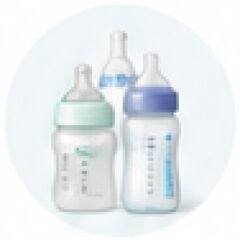
The nipple has a J-slit tip that releases milk only when the baby actively drinks (Philips, 2025).
The table below compares all seven picks by use case, starting flow and size. Prices change often, so treat them as a guide and check the current price before buying.
A good bottle for a breastfed baby makes the baby work for milk the way they do at the breast. That means a slow, steady flow, a nipple with a gradual slope to a wide base, and a vent that keeps the nipple from collapsing. Everything else on this list is about convenience and budget.
Use these 16 criteria to judge any bottle, including ones not reviewed here.
A slow flow makes the baby suck actively, which keeps bottle feeding closer to breastfeeding and lowers the chance of a bottle preference.
A nipple that slopes gradually into a wide base encourages the wide-open mouth a baby uses to latch at the breast.
Soft silicone compresses more like breast tissue, so the baby can use the same tongue movement they learned while nursing.
Vents let air back into the bottle so the nipple does not flatten, and they reduce the air a baby swallows.
A brand with several flow levels lets you move up slowly as your baby grows without switching bottles.
Breastfed babies take about 3 oz per feed on average from 1 to 6 months, so 4 to 5 oz bottles cover most early feeds (Kent et al., 2006).
Polypropylene is light and cheap, PPSU lasts longer, glass resists staining, and silicone is soft and squeezable.
All reputable brands now meet this standard, so treat it as a minimum, not a selling point.
Fewer parts mean faster washing and fewer pieces to lose when you are washing bottles at 2 a.m.
A wide neck is easier to fill with pumped milk and easier to clean by hand.
Some bottles screw straight onto a pump, so you can pump, store and feed from one container.
Bottles that handle the top rack and steam sterilizers save time every day.
A bottle that leaks in the diaper bag wastes milk that took time to pump.
Clear ounce and milliliter markings help caregivers track how much the baby actually drank.
Most parents need 4 to 8 bottles, so a small price gap per bottle adds up fast.
Nipples wear out and need replacing every few months, so pick a brand you can restock easily.
Each review below covers what the bottle does well for breastfed babies, its weak spots, and who should skip it.
The Philips Avent Natural Response is the best all-round bottle for breastfed babies because its nipple holds milk back until the baby sucks. That one design choice keeps the baby in charge of the pace, which is the main goal when you mix breast and bottle.
Sold in single bottles and multi-packs. Check the current price on Amazon.
Most bottles drip as soon as you tip them. The Natural Response nipple stays closed until the baby creates suction, so milk does not pour into the mouth during pauses. For a breastfed baby, this matches how milk flow stops when they stop sucking at the breast.
In the US and Canada, Natural Response nipples come in flow rates 1 to 5, and other countries get flows 1 to 6 (Philips, 2025). That range covers the newborn weeks through the older-baby stage, so you can stay with one bottle system for most of the first year.
Philips warns parents not to mix the older Natural nipples with Natural Response nipples, because the two behave differently and can confuse a baby’s drinking pattern (Philips, 2025). You can tell them apart easily: Natural Response nipples have a J-slit tip and one number on the side.
If your baby already uses a free-flowing bottle, Philips suggests jumping to a higher Natural Response flow number, since the new nipple feels slower (Philips USA, 2026). A baby who plays with the nipple instead of drinking usually needs one flow size up.
Some parent reviewers report leaks when the nipple sits sideways. Turning the nipple notch to face up or down during feeds is a common fix shared in Babylist reviews (Babylist, 2026).
Breastfed babies who switch between breast and bottle every day and need the bottle to behave like the breast.
Babies already used to fast-flowing bottles who will not accept a slower nipple.
The Comotomo Natural Feel is the bottle to try when a breastfed baby rejects everything else. Its soft silicone body and extra-wide nipple feel closer to skin than plastic or glass, and many parents report it as the first bottle their baby accepted.
About $23 for the 8 oz listing on Babylist (Babylist, 2026). Check the current price on Amazon.
Comotomo surveyed over a thousand mothers and found that nearly half named nipple confusion and bottle rejection as big problems (Comotomo, 2026). The bottle was designed around those two complaints, and its wide-mound nipple is the main reason babies who refuse narrow nipples often latch on.
The squeezable silicone body gives babies something soft to knead while they feed, the way many breastfed babies press on the breast. Some parents also use a gentle squeeze to put a few drops on the nipple as a reward when coaxing a reluctant baby.
The neck is very wide, so you can clean the inside with your hand instead of a bottle brush. With only a bottle, nipple and collar, it is one of the fastest bottles on this list to wash and reassemble.
Flow is the main point of debate. Some parents call the slow-flow nipple the slowest they tried, while others found it too fast for a newborn (Babylist, 2026; Desertcart, 2026). If your baby gulps or leaks milk from the mouth, pause more often or try a different bottle.
The molded measurement lines are raised silicone rather than printed ink, which some parents find hard to read in low light (Babylist, 2026).
Breastfed babies with bottle refusal, especially those who need a bottle to feel different from hard plastic.
Caregivers who need clear volume markings to track exact intake.
The Dr. Brown’s Options+ is the best bottle for breastfed babies who struggle with gas, spit-up or colic. Its internal vent system sends air through a tube to the back of the bottle, so air bubbles do not mix with the milk the baby drinks.
The Options+ Wide-Neck Breast to Bottle Slow Flow Set lists at about $31 (Babylist, 2026). Check the current price on Amazon.
A breastfed baby does not swallow much air at the breast, because there is no air in the breast. Dr. Brown’s vent pushes incoming air past the milk to the end of the bottle, which prevents vacuum pressure and nipple collapse (Dr. Brown’s, 2026). Many parents of gassy babies notice fewer burps after switching.
The Breast to Bottle set includes both Preemie Flow and Level 1 nipples (Babylist, 2026). That matters for breastfed babies, because the Preemie Flow is slower than most bottle brands’ newborn nipple and gives you a gentler starting point.
Dr. Brown’s says each nipple level is engineered so flow rate does not change between nipples of the same level (Dr. Brown’s, 2026). Consistent flow helps caregivers who switch between several bottles in a day, since the baby gets the same experience each time.
The vent system has more parts than any other bottle on this list. Expect to wash a vent tube and insert with a small brush after every feed. Once colic symptoms ease, you can remove the vent and keep using the same bottle.
Options+ comes in narrow and wide-neck versions, plus glass. The narrow bottle fits most breast pumps directly (Stop & Shop listing, 2026).
Breastfed babies with gas, spit-up or colic symptoms.
Parents who want the fewest possible parts to wash.
The Lansinoh NaturalWave bottle is the best pick for babies who move between breast and bottle several times a day. Lansinoh built the nipple to support the wave-like tongue motion babies use while nursing, so the baby practices one sucking style instead of two.
About $20 for a 3-pack of 5 oz bottles (Kindred Bravely, 2026). Check the current price on Amazon.
Babies feed at the breast by latching, moving the tongue in a wave from front to back, and swallowing. This wave is called peristaltic tongue movement. Lansinoh designed the NaturalWave nipple to allow this motion, and the brand cites its LUIS-2 ultrasound study of 33 newborns aged 1 to 10 weeks (Lansinoh, via Online Apotheke, 2026).
The wide, textured base gives the baby’s lips a place to rest and seal, similar to the areola. Several parent reviews describe the nipple as passing the “triangle test”, meaning it keeps a flared shape in the mouth (Desertcart, 2026).
If you use a Lansinoh breast pump, you can pump directly into this bottle, cap it for storage, then add the nipple collar to feed. Fewer transfers means less spilled milk and fewer containers to wash.
Lansinoh recommends spending 6 to 8 weeks establishing breastfeeding before introducing a bottle (Galaxus listing, 2026). Other sources suggest 3 to 6 weeks, so talk with your pediatrician or a lactation consultant about timing for your baby.
A minority of reviewers felt the flow was faster than expected (Babylist, 2026), so watch your baby closely during the first few feeds.
Combo-feeding families who want the bottle to reinforce breastfeeding habits.
Parents who want a wide range of bottle sizes.
The Evenflo Balance+ is the best low-cost bottle for breastfed babies. It was developed with pediatric feeding specialists, uses a naturally sloped nipple for a wide latch, and costs a fraction of premium bottles.
About $10 for a 2-pack of 9 oz Wide bottles (H-E-B, 2026). Glass 6 oz 3-packs list around $27 (Walmart, 2026). Check the current price on Amazon.
Evenflo says the Balance+ is recommended by 97% of parents, based on its own data through March 2022 (Evenflo, 2022). That is a brand figure, but parent reviews back up the main claim: many breastfed babies latch on quickly.
Balance+ comes in two neck styles. Standard-neck bottles fit all Evenflo pumps and most standard-neck pumps, while Wide bottles need an adapter for pumping (Evenflo, 2026). Wide and Standard nipples do not swap between bottle types, so buy one system and stick with it.
On the Wide bottles, the nipple’s air vent needs to line up with the small dent on the bottle top. Several reviewers missed this at first (Walmart, 2026). Check the alignment each time you assemble the bottle to avoid leaks and nipple collapse.
The low price makes Balance+ a smart first bottle to test before committing to an expensive system. If your baby takes it, you can stock up for very little money.
Families on a budget who want a breastfeeding-friendly bottle to test first.
Parents who mix bottle brands and want swappable parts.
The Hegen PCTO is the best bottle for parents who pump often. You can express milk into it, freeze it, warm it and feed from it without pouring milk between containers, and it closes with a press instead of a screw thread.
About $23 for a single 5 oz bottle and $44 for a 2-pack of 8 oz bottles on Hegen's US store (Hegen, 2026). Check the current price on Amazon.
Hegen’s main advantage is its express, store and feed system. You swap a pump module, storage lid or feeding collar onto the same bottle, so the milk you pump stays in one container until your baby drinks it (Hegen, 2026). Every transfer loses a little milk, and this design cuts those losses.
The off-center nipple lets you feed with the baby sitting fairly upright, similar to a nursing position. Upright feeding pairs well with paced bottle feeding, because milk does not pour forward when the bottle is held nearly flat.
The 2 oz bottle comes with an extra-slow nipple and doubles as a colostrum collector in the first days after birth (Hegen, 2026). That makes Hegen a rare system you can use from day one through toddler cups.
The soft-square “Sqround” shape does not roll off tables and is easier for older babies to grip. The trade-off is price, since Hegen costs two to four times as much per bottle as Evenflo or Lansinoh.
Exclusive pumpers and working parents who handle a lot of stored milk.
Families buying on a tight budget.
The Pigeon SofTouch Peristaltic PLUS is the best bottle for babies who latch shallowly on a bottle. Its nipple has a printed latch-on line that shows where the baby’s lips should sit, plus a textured surface to help the lips grip.
Sold in PP (polypropylene) and PPSU bottles. Check the current price on Amazon.
Pigeon designed this nipple around three stages of infant sucking: latching, peristaltic tongue movement and swallowing (National Pharmacies, 2026). The wide-neck nipple is shaped to fit the sucking fossa, the natural groove in a baby’s palate where the breast nipple sits during nursing.
The latch-on line is a small but useful detail for new caregivers. Grandparents and daycare staff can see exactly how deep the nipple should go, which helps prevent the shallow, clicking latch that lets air in.
Nipple sizes start at SS with a round hole for newborns and S for 1 month and up (Super Pharmacy Plus, 2026; Medon Online, 2026). The PPSU bottle ships with an SS nipple, while the cheaper PP bottle ships with a faster M nipple, so newborn buyers should choose the PPSU version or buy SS nipples separately.
Pigeon nipples are heat-resistant up to 120°C and suit steam sterilizers (Medon Online, 2026). They also fit all current and previous SofTouch bottles (40dogs listing, 2026).
Babies with a shallow bottle latch and caregivers who want a visual guide.
Parents who want to buy everything in one trip to a US big-box store.
Choose the slowest nipple your baby can feed from comfortably, and keep it longer than the age on the package suggests. Package ages are written for formula-fed babies, and breastfed babies do not need faster flow as they grow, because their milk intake stays about the same from 1 to 6 months (Kent et al., 2006).
Signs your baby needs a faster nipple include collapsing the nipple, frustration, or feeds that take much longer than 30 minutes. Signs the flow is too fast include coughing, gulping, and milk leaking from the corners of the mouth (Huron Perth Public Health, accessed 2026).
Think of nipple flow like a drinking straw. A thin straw makes you work and sip slowly, while a wide straw floods your mouth. Breastfed babies are used to the thin straw.
Most sources recommend introducing a bottle at about 3 to 6 weeks, after breastfeeding is well established. Breastmilk Counts advises exclusive breastfeeding for the first 3 to 4 weeks, then starting bottles at 4 weeks or two weeks before returning to work, whichever comes first (Breastmilk Counts, accessed 2026).
Do not wait too long. Solid Starts notes that bottle acceptance often gets harder as babies approach 4 months, when the reflexive suck begins to fade (Solid Starts, accessed 2026).
Have someone other than the nursing parent offer the bottle, since many babies refuse a bottle when they can smell their mother nearby.
Offer the bottle when the baby is calm and only slightly hungry, not when they are crying for a feed.
Start with 1 to 2 oz of pumped milk so less milk goes to waste during practice feeds (Breastmilk Counts, accessed 2026).
Offer a bottle once a day to keep the skill, then stop and try again later if the baby gets upset.
Paced bottle feeding is a method that slows the bottle down so the baby controls the pace, as they do at the breast. It helps babies switch back and forth between breast and bottle and lets them stop when full (Ohio Department of Health, 2021).
Follow these steps from the Ohio Department of Health (2021):
Hold the baby fairly upright with the head supported, instead of lying flat.
Point the bottle straight toward the mouth with little or no milk in the nipple.
Touch the top lip with the nipple and let the baby draw it in.
After three to five sucks, tip the bottle down if the baby does not pause, so they can swallow and breathe.
Keep feeding this way until the baby shows fullness, such as open hands, a relaxed body or turning away.
A paced feed usually takes about 15 minutes before the baby signals fullness (Breastmilk Counts, accessed 2026). Leaving some milk in the bottle is normal and expected.
Exclusively breastfed babies drink an average of 25 oz (750 ml) per day between 1 and 6 months, with a normal range of 19 to 30 oz (Kent et al., 2006, via KellyMom). Divide that by the number of times your baby usually nurses in 24 hours to estimate one bottle.
For example, a baby who nurses 8 times a day needs about 3 oz per bottle while you are away. This is why 4 to 5 oz bottles are enough for most breastfed babies, even after the newborn stage.
Average daily intake for exclusively breastfed babies from 1 to 6 months
Normal daily range at the same age
Per bottle for a baby who nurses 8 times a day
Freshly expressed breast milk lasts up to 4 hours at room temperature, up to 4 days in the refrigerator, and 6 to 12 months in the freezer (CDC and AAP guidelines, via Valley Children’s Healthcare, accessed 2026).
Up to 4 hours
Up to 78°F (26°C)
Up to 4 days
Below 39°F (4°C)
6 months best, up to 12 months acceptable in a deep freezer
0°F (-17°C)
Use within 24 hours, never refreeze
Below 39°F (4°C)
Once your baby has drunk from a bottle of breast milk, use or discard the rest within 2 hours, because saliva on the nipple can introduce bacteria (Solid Starts, accessed 2026). Never warm breast milk in a microwave, as it heats unevenly.
These are the most frequent bottle mistakes that make breastfeeding harder.
Moving up nipple sizes by age
Faster flow can make the breast feel slow and frustrating by comparison.
Stay on the slowest nipple your baby feeds well from.
Holding the bottle vertically
Milk pours into the mouth, so the baby gulps and overfeeds.
Hold the bottle close to horizontal and pace the feed.
Buying a full set before testing
Many breastfed babies reject the first bottle they try.
Buy one or two bottles from two brands and test before stocking up.
Filling bottles to 6 to 8 oz
Breastfed babies average about 3 oz per feed, so large bottles lead to waste or overfeeding (Kent et al., 2006).
Start with 2 to 4 oz and add more only if the baby still shows hunger.
Mixing nipple types within a brand
Some nipples look alike but flow differently, such as Avent Natural vs Natural Response (Philips, 2025).
Keep one nipple type per bottle system.
The Philips Avent Natural Response is the best overall bottle for breastfed babies because its nipple releases milk only when the baby actively sucks (Philips, 2025). If your baby refuses it, the Comotomo Natural Feel and Lansinoh NaturalWave are the next two to try.
The Comotomo Natural Feel is the most common success story for bottle refusal, thanks to its soft silicone body and extra-wide nipple. Pair it with practical steps: have someone else offer the bottle, try when the baby is calm, and practice once a day.
Some breastfed babies develop a bottle preference, usually because the bottle flows faster than the breast and takes less effort. Using a slow-flow nipple and paced bottle feeding lowers this risk by making the bottle work more like the breast (Ohio Department of Health, 2021).
Most guidance points to 3 to 6 weeks, once breastfeeding and milk supply are established (Breastmilk Counts, accessed 2026). Starting before about 4 months matters, because babies often become more resistant to bottles after that age (Solid Starts, accessed 2026).
Most combo-feeding families need 4 to 6 bottles, and exclusive pumpers often need 8 or more. Buy one or two first to test your baby’s preference, then stock up on the brand that works.
Both are safe when BPA and BPS free. Glass resists stains and odors but is heavier and can break, while plastic and silicone are lighter and better for daycare. Many families keep glass at home and plastic for outings.
Not always, but a vented bottle helps if your baby is gassy, spits up often or collapses the nipple. The Dr. Brown’s Options+ has the most thorough venting on this list, while Comotomo and Evenflo build simpler vents into the nipple.
Yes, but frequent switching can unsettle some breastfed babies, since each nipple shape and flow feels different. Once your baby accepts a bottle, use that brand for most feeds and tell every caregiver which nipple size to use.
The Philips Avent Natural Response is our top pick for breastfed babies, because its nipple holds milk back until the baby sucks and keeps feeds at the baby’s pace. If your baby refuses it, try the Comotomo Natural Feel next for its soft, wide silicone nipple.
For a gassy baby, choose the Dr. Brown’s Options+, and for a tight budget, start with the Evenflo Balance+. Whichever bottle you choose, the slowest nipple and paced feeding will do more to protect breastfeeding than any brand name.
This article is for general information and does not replace advice from your pediatrician or an International Board Certified Lactation Consultant (IBCLC). Prices and product details change often, so check the retailer listing before you buy. As an Amazon Associate, Parents Love Best earns from qualifying purchases.