
#1 · Best overall
Approx. Price
$10.99 / 6-pack
Flow Options
Ultra-Preemie to Level 4, plus Y-Cut
Fits
Dr. Brown's narrow bottles

As an Amazon Associate, Parents Love Best earns from qualifying purchases. Learn more
The best baby bottle nipple matches your baby’s feeding pace and fits your bottle. We compared 10 options by flow, shape and venting.
The Dr. Brown’s Natural Flow Level 1 Narrow Nipple is the best baby bottle nipple for most families because it gives a steady, predictable slow flow.
The table below compares all 10 picks side by side. Prices change often, so treat them as a guide and check the current Amazon listing before you buy.





Look at flow rate first, then bottle fit. A good baby bottle nipple lets your baby drink at a calm pace without gulping or tiring out, and it must match the neck of your bottle exactly. Shape, venting and material come next. The table below lists the 16 criteria we used to judge every nipple on this list.
Flow rate is the speed at which milk moves from the nipple into your baby’s mouth. There is no industry standard for flow labels, so a “slow flow” nipple from one brand can run much faster than a “slow flow” from another (Boston College Magazine, 2020).
Nipples of the same type can drip at different speeds, and a predictable flow makes feeds calmer.
More levels let you move up in small steps as your baby's suck gets stronger.
Most nipples fit only one brand's bottle, and a poor fit leaks.
Wide-neck nipples have broader bases; narrow-neck nipples suit small mouths.
Breast-like, flat (orthodontic) and traditional shapes each change how a baby latches.
A wider base encourages a wide-open latch with flared lips, like at the breast.
Silicone is clear, holds up to heat and lasts longer than latex.
Softer silicone compresses more like breast tissue during sucking.
Vents let air back into the bottle so less air ends up in your baby's stomach.
A collapsing nipple stops the flow and frustrates a hungry baby.
Nipples that flow only with active sucking let babies pause to breathe.
Fewer crevices mean fewer places for milk residue to build up.
A torn nipple can release a piece that becomes a choking hazard (Evenflo, 2026).
You will rotate several nipples a day, so pack size changes the real cost.
Replacements should be easy to find online and in local stores.
Some bottles attach straight to a breast pump, which saves pouring milk between containers.
Each review covers who the nipple suits, what makes it different and where it falls short. Prices change often, so check the current price before buying.
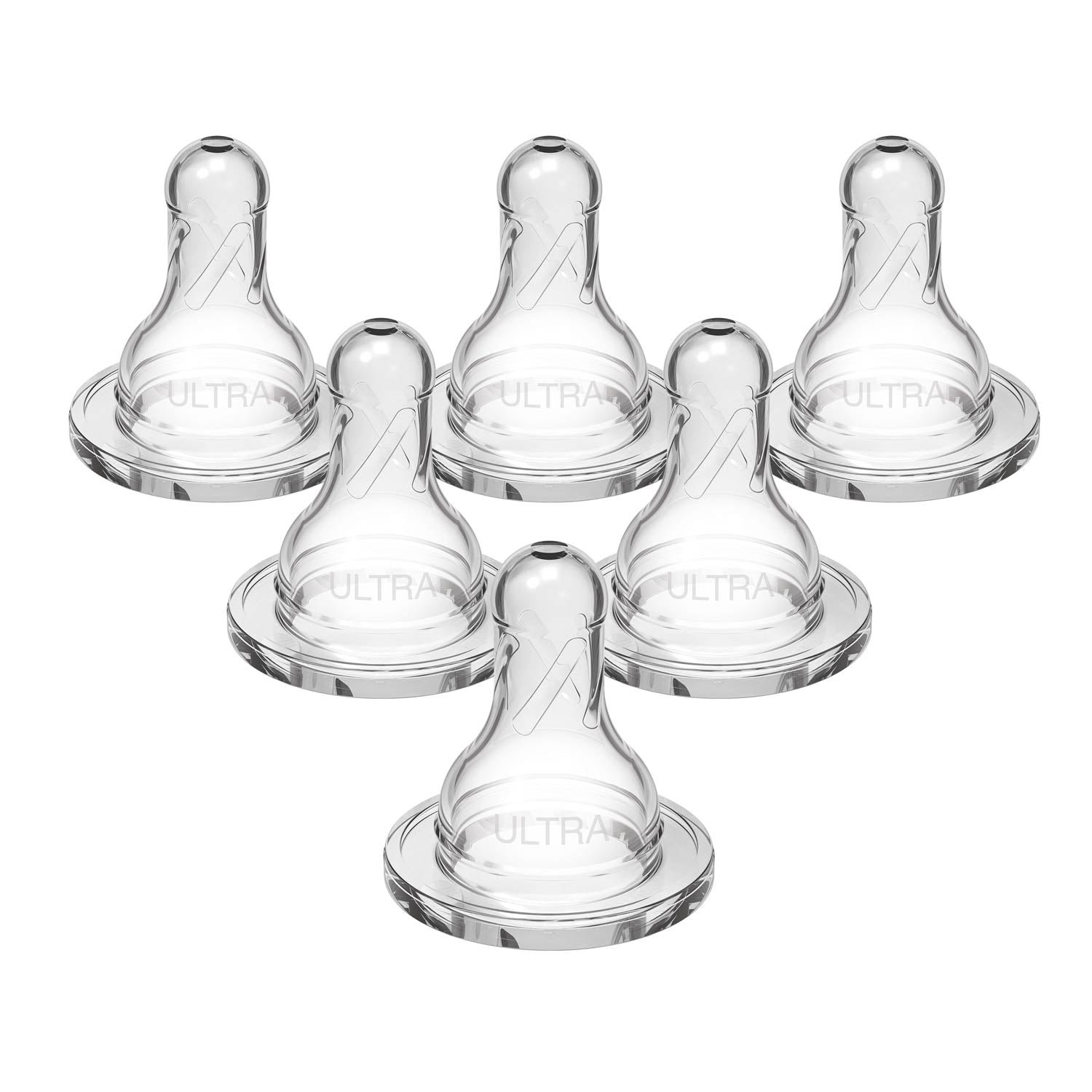
The Dr. Brown’s Natural Flow Level 1 Narrow Nipple is the best baby bottle nipple for most families because it gives a steady, predictable slow flow. It works with Dr. Brown’s internal vent system, which the brand says is clinically proven to reduce colic (Dr. Brown’s, 2026).
Consistency is the main reason this nipple ranks first. In flow-rate testing led by nurse researcher Britt Pados, Dr. Brown’s was the most consistent brand, with 6 of its nipple types showing low variability (Pados et al., 2015-2016). Every nipple in the pack should feed at the same pace.
That consistency matters more than most parents expect. Across 45 nipple types tested, only 10 had low variability, and flow ranged from under 2 mL to more than 80 mL per minute (Pados et al., 2015-2016). A predictable nipple removes one variable when you are troubleshooting a fussy feed.
The narrow shape suits small newborn mouths and babies who prefer a longer, traditional nipple. A Dr. Brown’s narrow 6-pack topped Amazon’s bottle nipple sales chart in June 2026, out of 134 tracked products (ASINSIGHT, 2026), so replacements are easy to find.
The 6-pack also keeps the cost per nipple low. You can rotate nipples through the day and still have spares while others are in the dishwasher. To plan the full set, read how many baby bottles you need. Dr. Brown’s nipples are top-rack dishwasher safe and sterilizer safe (Dr. Brown’s, 2026).
Formula-fed babies, combo-fed babies and gassy babies already using Dr. Brown's bottles.
Breastfed babies who reject longer, narrow nipples.
The Philips Avent Natural Response Nipple is the best pick for babies who switch between breast and bottle. Its tip releases milk only when your baby actively drinks, and the flow stops when your baby pauses to swallow and breathe (Philips, 2026).
Baby-controlled flow is the reason to buy this nipple. At the breast, milk does not pour out on its own; the baby has to work for it. The Natural Response nipple copies that pattern, so your baby sets the pace instead of the bottle.
Expect a short adjustment period. Philips says babies commonly need 2-3 tries before milk flows well from a new bottle (Philips, 2026). If your baby used the older free-flowing Avent Natural nipple, Philips recommends starting one or more numbers higher in the Natural Response range.
The no-drip tip saves pumped milk. Milk stays inside until your baby sucks, so less of it ends up on bibs, car seats and your lap during a messy feed.
Philips gives clear signs for moving up a flow: your baby falls asleep mid-feed, gets frustrated or plays with the nipple instead of drinking (Philips, 2026). Slow, steady drinkers often do better on a higher number, whatever their age.
Combo-fed babies and breastfed babies taking their first bottles.
US families who need an extra-fast flow for thickened feeds, since Flow 6 is not sold in the US.
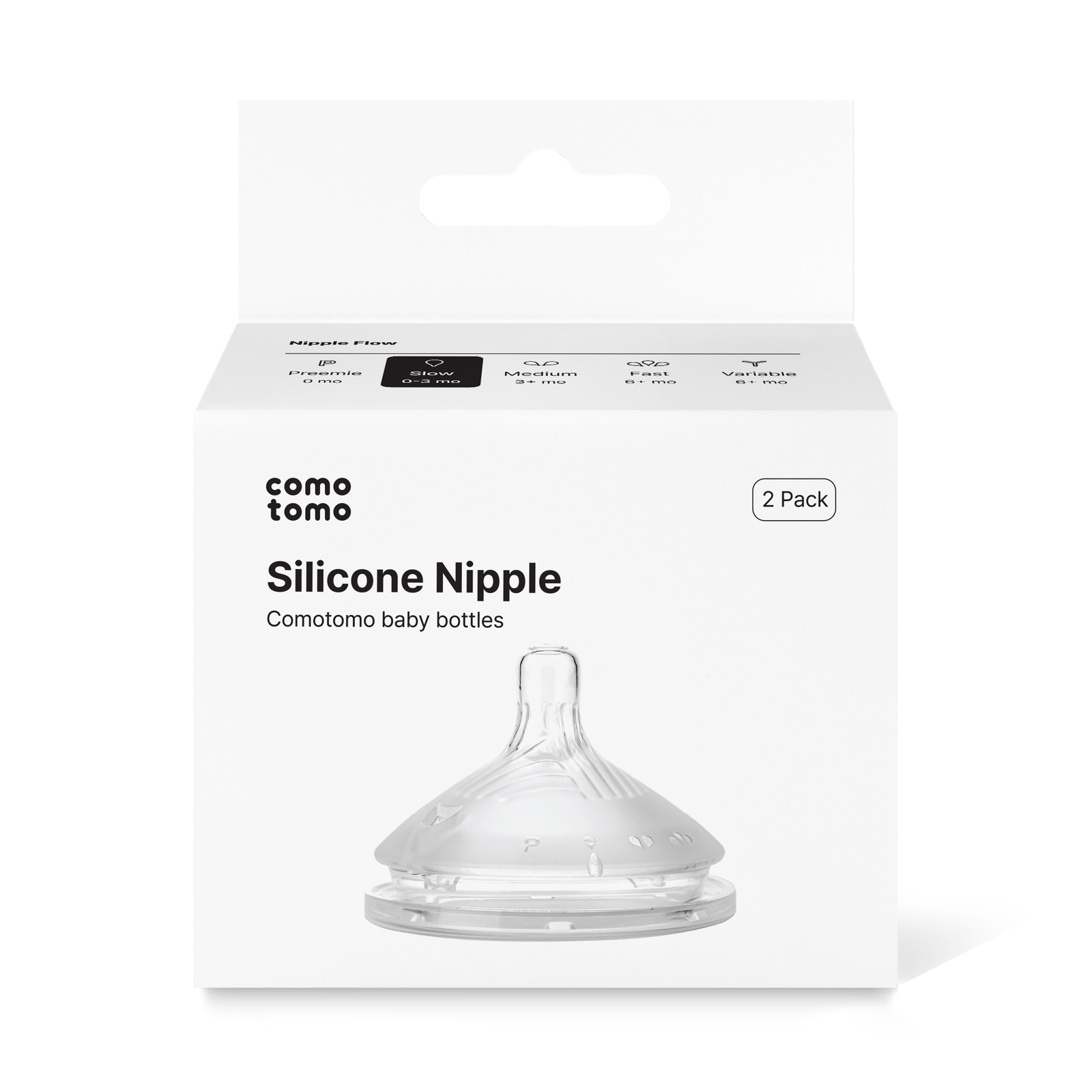
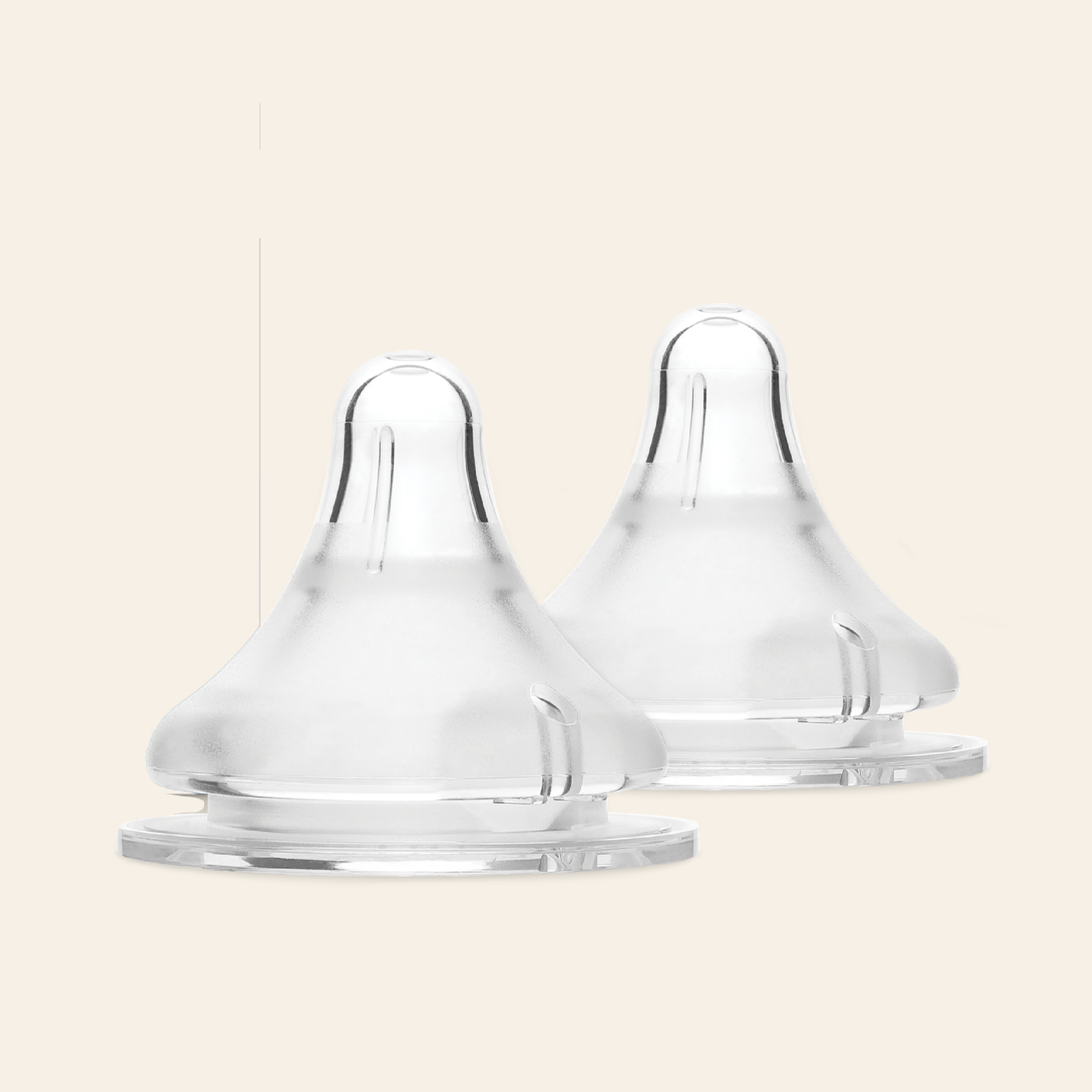
Comotomo Replacement Nipples are the best choice for breastfed babies who refuse other bottles. The nipple sits on a wide, soft silicone base that lets your baby open wide and rest their lips on something that feels close to the breast.
The wide, squishy base is what wins over stubborn breastfed babies. Instead of meeting a hard plastic collar, your baby’s lips land on soft silicone. That small difference is often enough to get a reluctant baby to latch.
Venting is built into the nipple itself. Two small vents let air back into the bottle, so there is no separate vent insert to lose or scrub (Comotomo, 2026). Assembly takes seconds.
Flow levels follow hole count, which makes them easy to tell apart in a pile of clean parts. One hole means slow, two means medium and three means fast. The Y-Cut variable flow is meant for thicker liquids after 6 months.
The trade-off is cleaning. The vent holes are tiny, and milk residue can block them if you skip the brush. Squeeze soapy water through the vents and the tip at every wash, as the CDC advises for bottle nipples. For warm feeds at night, a quiet bottle warmer helps keep milk at an even temperature (CDC, 2026).
Exclusively breastfed babies who have refused standard bottle nipples.
Premature babies or newborns who need a flow slower than Comotomo's slow nipple.
The Pigeon SofTouch Peristaltic PLUS Nipple is the best option for parents who want help getting a deep latch. A wavy “Latch-on Line” on the nipple shows where your baby’s lips should sit, so you can see at a glance whether the latch is too shallow (Pigeon, 2026).
The Latch-on Line is the standout feature. Pigeon designed it to encourage a deep latch, with lips opened wide and flared outward at roughly 130-160 degrees (Pigeon, 2026). For first-time parents, a visible target takes the guesswork out of positioning.
Pigeon builds the nipple around how babies feed at the breast. Peristaltic movement is the wave-like motion of the tongue squeezing the nipple from front to back to draw out milk. The soft, elastic silicone lets your baby repeat that same tongue action on the bottle.
Pigeon publishes its safety testing. Each nipple must pass a 150-newton pull test and tens of thousands of bite tests (Pigeon, 2026). The brand still advises inspecting the nipple before every feed and pulling it in all directions to check for weak spots.
Pigeon also recommends rotating a few nipples instead of using one constantly, and keeping them out of direct sunlight, since heat and UV can weaken silicone over time (Pigeon, 2026).
Breastfed babies with a shallow latch and parents who want a visual guide.
Shoppers who want to pick up replacements at any US supermarket.
The MAM SkinSoft Nipple Size 0 is the best baby bottle nipple for the smallest newborns. It has an extra-small mouthpiece, a very soft lip rest and an extra-slow flow adapted to the thin consistency of breast milk (MAM, 2026).
Size 0 adds a step below the usual “slow flow.” Many brands start their range at slow, which can still be too fast for a newborn in the first weeks. MAM’s extra-slow option gives you somewhere to start before moving up.
Acceptance is MAM’s main claim. The company reports that 94% of babies accept the SkinSoft nipple (MAM, 2026). This is a manufacturer figure, so treat it as a positive signal, but it fits MAM’s standing with parents of picky newborns.
The symmetrical, flat shape sits correctly no matter which way it goes into your baby’s mouth. Some flat nipples only work one way up. At 3 a.m., not having to check orientation is a real help.
One nipple fits every MAM bottle, including the Easy Start Anti-Colic bottle, plus the Trainer+ sippy cup. Families that own several MAM bottle styles only need to stock one nipple type.
Newborns in their first weeks and babies who sputter on standard slow-flow nipples.
Families using bottles from other brands.
The Lansinoh NaturalWave Nipple is the best pick for parents who pump. Lansinoh bottles attach directly to Lansinoh pumps, so you can pump, store and feed from one bottle (Lansinoh, 2026). It is also one of the cheapest breast-like nipples on this list.
The pump-to-bottle setup saves time and milk. Every time you pour breast milk from one container to another, some sticks to the sides. Feeding straight from the bottle you pumped into cuts out those transfers.
Lansinoh says NaturalWave is clinically proven to reduce nipple confusion (Lansinoh, 2026). Nipple confusion is when a bottle-fed baby starts struggling to latch at the breast because the two feel and flow differently. The flexible nipple lets your baby use the same tongue action learned while nursing.
Flow labels are printed on the bottom rim: 2S for slow, 3M for medium and 4L for fast (Lansinoh, 2026). When nipples get mixed together in the drying basket, you can sort them in seconds.
Before first use, Lansinoh recommends sterilizing the nipple in boiling water for 5 minutes (Lansinoh, 2026). After that, the dishwasher or hot soapy water in a dedicated basin keeps it clean.
Exclusively pumping parents and combo feeders on a budget.
Families who use a different pump brand and do not want Lansinoh bottles.
The Tommee Tippee Natural Start Nipple is the best choice for families already using Tommee Tippee Natural Start bottles. It has a breast-like shape, flexible ripples that stretch as your baby sucks, and an anti-colic valve built into the nipple (Tommee Tippee, 2026).
The Extra Slow flow is a good place to start with first bottles. Tommee Tippee positions this level for first feeds and for babies who are still getting used to a bottle (Tommee Tippee, 2026). Starting slower lowers the chance of choking or sputtering.
The ripples along the nipple let it flex and stretch like breast tissue. Tommee Tippee says this supports paced feeding (Tommee Tippee, 2026). Paced feeding means your baby controls the speed and takes natural breaks, rather than milk pouring in steadily.
The anti-colic valve sits in the nipple itself, so you get venting with no extra inserts. The brand says the valve reduces the amount of air your baby swallows, a common source of discomfort after feeds.
Check which nipple comes in the box. Walmart customer reviews note that larger Natural Start bottles ship with a slow-flow nipple, so older babies may need faster nipples bought separately (Walmart reviews, 2026).
Families who already own Tommee Tippee Natural Start bottles.
Parents who need nipples to fit other bottle brands.
The NUK Simply Natural Nipple is the best option if you want milk to come out through several small holes, the way it does from a breast. The slow nipple has 3 holes, the medium has 6 and the fast has 9 (NUK, 2026).
Multiple holes spread the milk out. A breast releases milk through several openings, so the flow comes as a gentle spray instead of one stream. NUK copies that pattern, which some breastfed babies find more familiar.
NUK reports that 96% of babies accepted the nipple, based on 2019 market research among 203 mothers in Germany (NUK, 2019). That is a small, manufacturer-run survey, so read it as a good sign rather than proof.
The scooped cavity inside the nipple gives your baby’s tongue and jaw room to move, similar to nursing (NUK, 2026). The anti-colic air system is a single piece, so there is no separate vent to assemble or clean.
Check your bottle line before buying replacements. NUK sells several bottle ranges, and Simply Natural nipples only fit Simply Natural bottles (NUK, 2026). Buying the wrong NUK nipple is a common mistake.
Breastfed babies who dislike single-hole nipples.
Newborns who need an extra-slow start.
The Evenflo Balance+ Wide Neck Nipple is the best low-cost nipple for paced feeding. Evenflo developed it with pediatric feeding specialists, and its sloped shape gives your baby’s lips a place to rest at a wide latch (Evenflo, 2026).
The sloped shape solves a common problem. On many nipples, a baby’s lips slide down toward the tip, which leads to a shallow latch and a tired mouth. The Balance+ slope keeps the lips parked at the wide part of the nipple (Evenflo, 2026).
Evenflo made the flow slower on purpose to prevent chugging. The brand also lists clear signs it is time to move up: your baby collapses the nipple, unlatches and relatches, bites or tugs, or sucks several times before each swallow (Evenflo, 2026).
Check the neck size before you buy. Balance+ Wide nipples do not fit Balance+ Standard bottles, and Standard nipples do not fit Wide bottles (Evenflo, 2026). Evenflo also advises against using other brands’ nipples on Balance+ bottles.
The combo packs are useful. One pack includes a Medium and a Fast nipple, so you can test the next flow before committing to a full set.
Budget-minded parents who want a paced-feeding nipple for a breastfed baby.
Families who already own a different bottle brand.
The Dr. Brown’s Ultra-Preemie Narrow Nipple is the best choice for premature babies and newborns who gulp, cough or sputter on standard slow flows. It is one of the slowest nipples in the Dr. Brown’s range, alongside the Preemie flow.
Slow flow gives a young baby time to coordinate sucking, swallowing and breathing. Pados notes that when milk flows faster than a baby can handle, the baby has only four options: swallow it, let it drool out, let it pool in the mouth or refuse the bottle (Pados et al., 2015-2016).
Full-term babies can benefit too. One Walmart reviewer described a one-week-old who gulped and struggled with gas on a Level 1 nipple, then settled after switching to a Preemie nipple (Walmart reviews, 2026). If your newborn gulps loudly, a slower nipple is worth trying.
Because it uses the same narrow neck as the Level 1 nipple, you can move up to Level 1 later without buying new bottles. That keeps the whole feeding setup on one bottle system.
Talk to your pediatrician or a feeding specialist if your baby was born early or has a medical condition. Flow labels have no shared standard, and Pados’s measured flow data now guides how many hospitals pick nipples (Boston College Magazine, 2020).
Premature babies, early-term babies and newborns who gulp on standard slow flows.
Older babies with a strong, steady suck.
Choose nipple flow by your baby’s behavior, not the age printed on the package. Start with the nipple that came with the bottle, watch the next few feeds and then move one level up or down. Age ranges are only a rough guide because nipple flow labels have no shared standard across brands (Boston College Magazine, 2020).
A flow is too fast when your baby cannot keep up with the milk. Watch for milk spilling from the corners of the mouth, coughing, sputtering, loud gulping or pulling away often. Pados describes these as the four ways a baby copes with too much milk: swallowing, drooling, pooling it in the mouth or refusing (Pados et al., 2015-2016).
A flow is too slow when your baby works hard for little milk. Evenflo lists the nipple collapsing, unlatching and relatching, biting or tugging, and sucking several times before each swallow (Evenflo, 2026). Philips adds falling asleep mid-feed and playing with the nipple instead of drinking (Philips, 2026).
Replace a bottle nipple as soon as you see tears, cracks, thinning, stickiness or a change in flow. Pigeon advises inspecting every nipple before each feed and pulling it in all directions (Pigeon, 2026). Evenflo warns that any tear can let a piece break off, which is a choking hazard (Evenflo, 2026).
Most baby bottle nipples are not interchangeable. Each brand designs its nipples around its own collar and vent system, and brands such as Philips Avent, NUK and Evenflo state their nipples should only be used with their own bottles (Philips, 2026; NUK, 2026; Evenflo, 2026). A mismatched nipple can leak or stop the vent from working.
The Philips Avent Natural Response nipple is the best all-round choice for breastfed babies because milk flows only when the baby actively sucks (Philips, 2026). For babies who refuse bottles, the Comotomo nipple’s wide, soft base is the next thing to try.
Most newborns should start on the slowest standard flow, such as Dr. Brown’s Level 1 or MAM Size 0. Premature babies or newborns who gulp may need a preemie or ultra-preemie nipple. Move up only when your baby shows signs of frustration or works hard for each swallow.
The CDC recommends cleaning bottle nipples after every feed and sanitizing feeding items at least once a day for extra germ removal (CDC, 2026). Daily sanitizing matters most for babies under 2 months old, babies born prematurely and babies with weakened immune systems.
Silicone nipples are the better choice for most families. Silicone is clear, holds its shape after repeated sterilizing and lasts longer than latex. Latex nipples are softer but wear out faster and can trigger latex allergies, which is why all 10 nipples on this list are silicone.
The wrong nipple can make gas worse. A flow that is too fast makes babies gulp and swallow air, and a nipple without proper venting can collapse and pull air in. Vented nipples, such as Dr. Brown’s and Tommee Tippee Natural Start, are designed to keep that air out of your baby’s stomach.
Babies refuse bottle nipples most often because the shape, softness or flow feels different from the breast. Try a wider, softer nipple such as Comotomo, and give each new nipple a few attempts, since Philips says 2-3 tries is normal (Philips, 2026). Having someone other than the nursing parent offer the bottle can also help.
You should not move up a flow level just to speed up feeds. A flow that is faster than your baby can handle forces them to swallow quickly with less time to breathe (Pados et al., 2015-2016). Move up only when your baby shows the signs of a too-slow flow listed above.
The Dr. Brown’s Natural Flow Level 1 Narrow Nipple is our top pick because it delivers the most predictable flow at a low price per nipple. If you switch between breast and bottle, choose the Philips Avent Natural Response nipple, and if your baby refuses every bottle, try Comotomo before anything else.