
How Many Baby Bottles Do I Need: The Complete Guide for 2026
- Published September 9, 2026
- Updated October 12, 2026
- 7 min read
Most parents need 4-6 bottles for a breastfed baby and 8-10 bottles for a formula-fed baby.
Most parents need 4-6 bottles for a breastfed baby and 8-10 for a formula-fed baby. Count daily bottle feeds and add 2 spares.
TL;DR: The Quick Answer
- Most parents need 4-6 bottles for a breastfed baby and 8-10 bottles for a formula-fed baby.
- Newborns feed every 2-3 hours, so you need enough bottles to last between wash cycles without running out.
- Bottle size matters: start with 4 oz (120 ml) bottles for newborns, then move to 8-9 oz (240-270 ml) bottles around 4 months.
- You do not need to buy all your bottles before birth – start with 4, test which nipple your baby accepts, then stock up.
- Most parents find they use 3-4 different bottle brands before settling on one that works for their baby.
How Many Baby Bottles You Actually Need
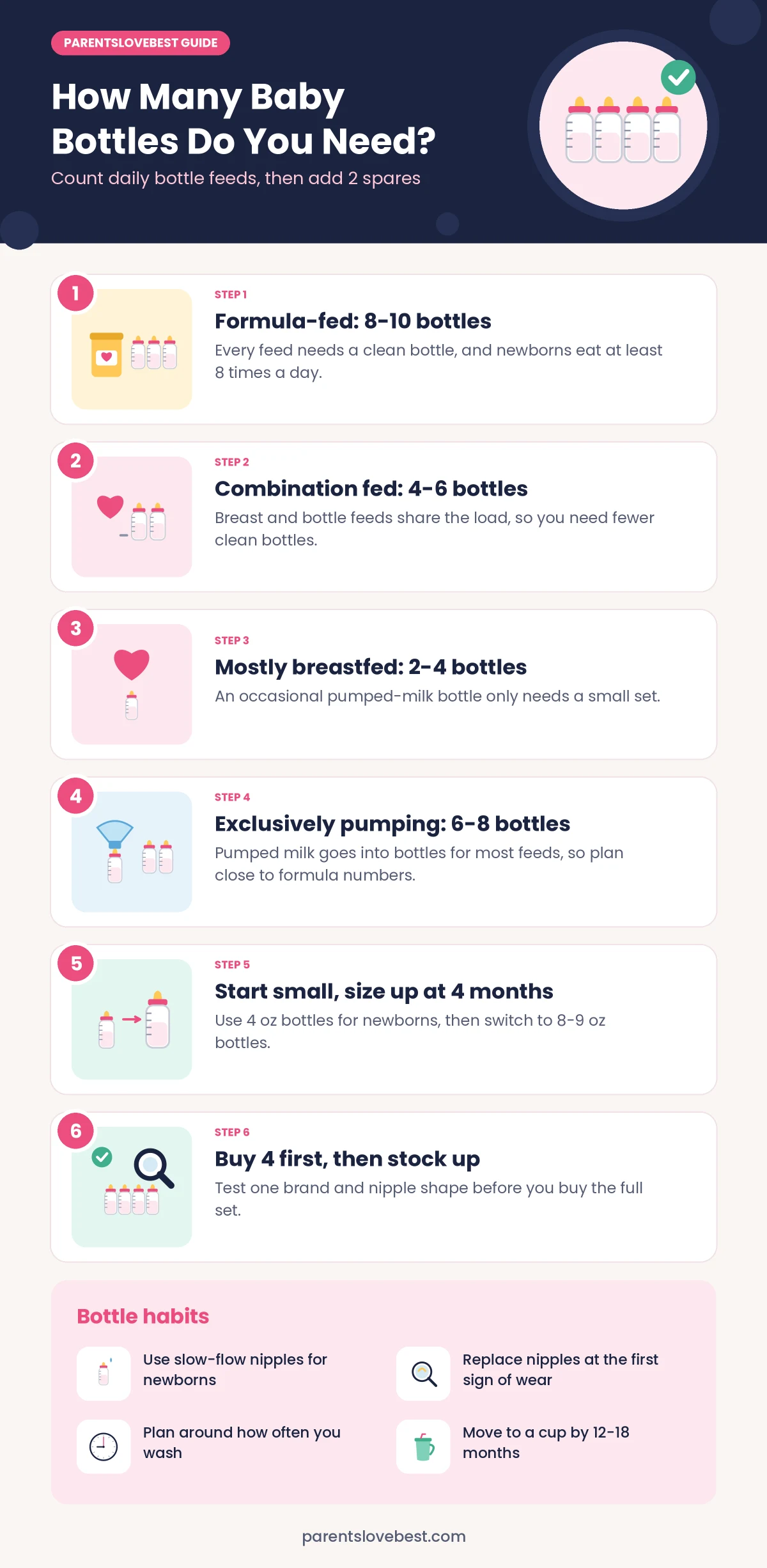
Most parents need between 4 and 10 baby bottles, depending on how they feed. Formula-fed babies need more bottles on hand because every feed requires a clean one. Breastfed babies who only take an occasional pumped bottle need far fewer.
Here is the standard breakdown by feeding method:
| Feeding Method | Recommended Number of Bottles |
|---|---|
| Exclusively formula-fed | 8-10 bottles |
| Combination fed (breast + formula) | 4-6 bottles |
| Primarily breastfed, occasional bottle | 2-4 bottles |
| Exclusively pumped breast milk | 6-8 bottles |
Good to know
These numbers assume you wash bottles once per day. If you wash after every feed, you can get by with fewer. A bottle brush and a countertop drying rack make daily washing faster. If you go longer between washes, you need more.
How Many Baby Bottles You Need: At a Glance
What Bottle Size to Buy for a Newborn vs. an Older Baby
Start with 4 oz (120 ml) bottles for the first 1-4 months. Newborns eat small amounts – typically 1-3 oz per feed in the first few weeks – so a full-size bottle is wasted on them at that stage.
Around 4 months, most babies move to 4-6 oz per feed
That is when you switch to 8-9 oz bottles (also labelled as 240-270 ml in most brands).
A practical starting kit for most parents
4-6 small bottles (4 oz / 120 ml) for the newborn stage
Plan to buy 4-6 large bottles (8-9 oz / 240-270 ml) around the 4-month mark
Good to know
Buying a large stock of 8 oz bottles before birth is a common mistake. Your baby may not need them for months, and some babies resist certain bottle shapes entirely.
How Feeding Frequency Affects How Many Bottles You Need
Most newborns eat every 2-3 hours, at least 8 times in 24 hours, according to the American Academy of Pediatrics. If you formula-feed and wash bottles once a day, you need at least 8 clean bottles ready each morning. The CDC recommends cleaning every bottle part after each feeding, so how often you wash decides your number.
By 6 months, most babies drop to 4-6 feeds per day
At that point, 4-6 bottles are enough even for exclusively formula-fed babies.
Here is how to calculate your personal number
Count how many times per day your baby feeds by bottle.
Add 2 extra bottles as buffer for unexpected delays in washing.
That total is your working number of bottles.
Good to know
Example: Baby feeds 8 times per day by bottle. Add 2 buffer. Buy 10 bottles. For outings, a formula dispenser in your diaper bag holds pre-measured powder for several feeds.
Why You Should Wait Before Buying All Your Bottles
Buy only 4 bottles before your baby arrives. This is the single piece of advice most experienced parents wish someone had told them.
Babies are specific about bottles
Some reject the nipple shape. Others refuse a particular flow rate. Some breastfed babies will only accept bottles that closely mimic the natural latch - bottles marketed as "anti-colic" or "wide-neck" are designed for this. See our picks for the best bottles for breastfed babies.
Buying 10 of one bottle before testing it risks being stuck with a set your baby will not use.
The better approach
Buy 2-4 bottles from one brand before birth.
Test them in the first weeks.
If your baby accepts them, buy more of the same.
If not, try a different brand before restocking.
Glass vs. Plastic Bottles: Which Type to Buy
Glass and plastic are the two main bottle materials, each with real trade-offs.
Glass bottles
are heavier and more expensive, but they do not scratch or stain, and they do not contain BPA or other plastics that can transfer to milk when heated. Many parents who heat bottles regularly prefer glass for this reason, often paired with a quiet bottle warmer for night feeds.
Plastic bottles
are lighter and less likely to break if dropped - a genuine consideration for older babies who grab and throw things. Look for bottles labelled "BPA-free," which has been the standard for most major brands since 2012 (FDA, 2012).
Silicone bottles, such as the Comotomo Natural Feel Bottle, are a third option
They are soft, light, and heat-resistant - but they cost more and are harder to find in standard stores.
Most parents buy plastic bottles for day-to-day use and glass bottles at home when heating milk.
Anti-Colic Bottles: Do You Actually Need Them?
Anti-colic bottles are designed to reduce the amount of air a baby swallows during a feed, which in theory reduces gas and fussiness. They use venting systems, angled necks, or collapsible liners to limit air intake. A well-known example is the Dr. Brown’s Options+ Anti-Colic Bottle, which uses an internal vent.
Whether they work depends on the baby
Some parents report a clear difference. Clinical evidence is limited, and there is no strong proof that bottle design alone prevents colic.
Where anti-colic bottles tend to help most
Babies who gulp quickly and swallow a lot of air.
Babies with diagnosed reflux.
Breastfed babies transitioning to bottle feeds, who often have a slower, steadier natural suck.
Good to know
If your baby is not particularly gassy, a standard bottle is fine. Start with one type and switch if you notice consistent discomfort after feeds.
Common Bottle-Buying Mistakes to Avoid
Buying too many of one brand before testing it.
Your baby may reject the nipple shape, leaving you with a set of unusable bottles. Buy 2-4 first.
Skipping nipple flow rates.
Nipples come in slow, medium, and fast flow. Newborns need slow-flow nipples, such as Dr. Brown's Level 1 nipples. Using fast-flow too early causes babies to gulp, swallow air, and often choke. Most brands label nipples by age range to guide you.
Buying only large bottles before birth.
8-9 oz bottles are unnecessary for the first 4 months. Newborns eat 1-3 oz per feed, so fill only what they need regardless of bottle size.
Ignoring the parts count.
Some bottles have 5-6 components (body, collar, nipple, valve, vent, cap). More parts means more washing. If you hate washing up, choose a simpler 3-part bottle.
Not buying extras of the same nipple.
Nipples wear out, and most brands suggest replacing them every 1-3 months. Buy a spare pack of the same flow-rate nipple when you find one your baby accepts.
Frequently Asked Questions About Baby Bottles
How many baby bottles do I need for a newborn?
Start with 4-6 bottles. For a formula-fed newborn, 8-10 is more practical because most newborns eat at least 8 times a day and you need enough clean bottles to last between wash cycles. Breastfed babies who only occasionally take a bottle can manage with 2-4.
What size bottle should I buy for a newborn?
Buy 4 oz (120 ml) bottles for the newborn stage. Newborns eat 1-3 oz per feed in the first few weeks, so a large bottle is unnecessary. You will move to 8-9 oz (240-270 ml) bottles around 4 months, when feed volumes increase.
How often do baby bottle nipples need to be replaced?
Replace nipples every 1-3 months, or sooner if you see any cracks, tears, or changes in the nipple shape. Damaged nipples can become choking hazards and also affect the flow rate your baby is used to.
Can I use the same bottles for a second baby?
Bottle bodies in good condition can be reused. Replace all nipples and any valves or venting parts before use. Do not reuse scratched plastic bottles – scratches trap bacteria that are hard to clean out. Glass bottles in good condition can be reused fully.
Are expensive baby bottles worth it?
Not necessarily. Higher price usually reflects materials (glass vs. plastic), anti-colic venting systems, or brand reputation. What matters most is whether your specific baby accepts the nipple shape and flow rate. A $6 bottle your baby feeds from happily is better than a $20 bottle they reject.
When do babies stop using bottles?
Most babies transition off bottles between 12 and 18 months. The American Academy of Pediatrics suggests offering a cup around 6 months and completing the switch between 12 and 18 months. A spill-proof cup like the Munchkin Miracle 360 Cup makes the change easier.
Do I need different bottles for breast milk and formula?
No. Any bottle that works for your baby can hold either breast milk or formula. Some breastfed babies do better with wide-neck nipples that mimic the natural latch, but this is about nipple shape, not the liquid inside.
Key Takeaways
- Formula-fed babies need 8-10 bottles; breastfed babies need 2-6 depending on how often they take a bottle.
- Start with 4 oz bottles for newborns and move to 8-9 oz bottles around 4 months.
- Buy only 4 bottles before birth, test one brand, and restock once you know your baby accepts them.
- Replace bottle nipples every 1-3 months and any time you see wear or damage.
- Calculate your exact number by counting daily bottle feeds and adding 2 as a buffer.