
#1 · Best overall
Approx. Price
$12-15
Age Range
18 months+
Batteries
No

As an Amazon Associate, Parents Love Best earns from qualifying purchases. Learn more
The best toys for an 18 month old build walking confidence, hand control and first words. These 10 picks match what toddlers this age can actually do.
Spike is a 6-inch plastic hedgehog with chunky, peg-shaped quills that toddlers push into holes on its back.
Prices below are approximate at the time of writing and change often. Check the Amazon link for the current price.




An 18-month-old can usually walk alone, climb on and off a couch, scribble, and play with toys in a simple way like pushing a toy car (CDC, 2022). The best toys for this age give those new skills something to do.
The Centers for Disease Control and Prevention (CDC) and the American Academy of Pediatrics (AAP) revised the milestone checklists in 2022. Each milestone now marks a skill that 75% or more of children reach by that age, so "by 18 months" means most kids, not the average kid (CDC, 2022).
| Milestone at 18 Months (CDC, 2022) | Toy Type That Supports It |
|---|---|
| Walks without holding on to anyone or anything | Push toys, walker wagons, pull-along vehicles |
| Climbs on and off a couch or chair without help | Low toddler slides and climbers |
| Scribbles | Chunky, washable crayons |
| Looks at a few pages in a book with you | Sturdy board books and touch-and-talk books |
| Plays with toys in a simple way, like pushing a toy car | Trucks, cars, simple playsets |
| Points to show you something interesting | Playsets with animals and named objects |
Think of this age as the bridge between baby toys and preschool toys. A rattle is too simple now, and a 3+ puzzle with small pieces is unsafe. The sweet spot is chunky, durable toys that reward movement and repetition.
The right toy for an 18-month-old is safe for mouthing, sized for a palm grip, and open-ended enough to stay interesting for a year or more. We judged every pick on the criteria below.
Toys meant for children under 3 must pass the federal small-parts test, so the label tells you which rules the maker followed.
Any piece that fits in the CPSC test cylinder (2.25 inches long, 1.25 inches wide) is a choking hazard for this age (CPSC, 16 CFR 1501).
Most 18-month-olds still grab with the whole hand, so thin pegs and small knobs cause frustration.
Quiet toys invite you to talk and sing along, and loud ones wear on the whole household.
Blocks and trucks can be used in new ways each month, while one-trick toys get ignored fast.
Toddlers throw, drop and chew, so cracked plastic or loose paint is a real safety issue.
Look for BPA-free plastic, water-based finishes on wood, and AP-certified art supplies.
Everything goes in the mouth at this age, so wipeable or dishwasher-safe surfaces save time.
Toys that make walking, pushing or climbing more fun support the biggest physical milestone of this age.
Pegs, blocks and crayons strengthen the small hand muscles toddlers will later need for spoons and buttons.
Toys with animals, vehicles and pictures give you things to name, which builds vocabulary.
An age range that runs to 3 years or beyond stretches the cost across more months of use.
Toys that pack away inside themselves stay complete longer and cut cleanup time.
Slides and playsets need floor space, so measure before you buy.
A $30 toy used for two years is cheaper in practice than a $15 toy used for two weeks.
The AAP's 2018 clinical report found that toys work best when they support parents and children playing together (AAP, 2018).
Each review covers what the toy does, which 18-month skill it supports, and who should skip it. Picks are ordered by overall value for this age.
Spike is a 6-inch plastic hedgehog with chunky, peg-shaped quills that toddlers push into holes on its back. It is the best overall pick because it is cheap, silent, and built around the grip-and-aim skill that 18-month-olds practice all day.
Pushing a peg into a hole asks a toddler to grip, aim and press at the same time. That is harder than it looks at 18 months, which is why kids repeat it again and again. The quills are thick enough for a whole-hand grab, so toddlers succeed before their pincer grip is fully refined.
The toy changes as your child does. At 18 months, the game is pulling quills out and pushing them back in. Around age 2, the same quills become a color-sorting game. By 3, the numbered holes turn it into a counting activity. Learning Resources rates it from 18 months up.
Cleanup is built in. All the quills fit inside the hedgehog’s two-piece body, so the toy stays complete in a diaper bag or a restaurant booth. Missing pieces are the main reason toddler toys get thrown out, and Spike avoids that problem better than most.
Because Spike makes no sound, the talking is up to you. Counting quills aloud or naming colors as your toddler plays is the kind of shared play the AAP recommends over electronic toys that do the talking themselves (AAP, 2018).
Parents who want one low-cost, screen-free toy that builds hand strength.
Toddlers who only engage with toys that move or make noise.
The DUPLO Classic Brick Box is a 65-piece starter set of large interlocking bricks in a brick-shaped storage box. It earns a spot because blocks are one of the few toys that stay useful from toddlerhood through early school age.
The AAP’s toy report uses blocks as its main example of a toy that grows with a child. It notes that an 18-month-old will mostly stack blocks, while a 2-year-old starts using the same blocks for pretend play (AAP, 2018). DUPLO fits that path well.
The set includes more than plain bricks. A car with turning wheels, two small figures, flowers, a window piece and bread give toddlers things to name and push around. That matters at 18 months, when simple play with familiar objects is one of the main milestones (CDC, 2022).
DUPLO bricks are sized for small hands and are much larger than regular LEGO pieces. LEGO rates this set from 18 months. Pulling bricks apart takes more strength than stacking them, so expect to help with separation for the first few months.
Long-term value is the strongest argument for this box. DUPLO is compatible with every other DUPLO set made, so you can add themed sets later instead of starting over. Many families keep using the same bricks until age 5.
Families who want a long-lasting building system that starts at 18 months.
Toddlers who get frustrated quickly with tasks that need an adult's help at first.
The Pop-a-Balls Bulldozer is a push toy that shoots colored balls out of a smokestack and scoops them back up as it rolls. It is the best pick for toddlers who love seeing an instant result from their own actions.
Cause and effect is the main draw here. Push the bulldozer, and balls fly. Drop a ball in, and it pops back out. Toddlers at this age repeat actions to test what happens, and this toy pays off every single time.
It also gives walking a purpose. Motion sensors trigger music as the toy moves, so toddlers chase it around the room. VTech rates it for 12 to 36 months, which means it fits an 18-month-old right in the middle of its range.
The number buttons introduce colors and counting, and the balls are counted as they pop. These learning features are a bonus, not the main reason to buy. The value is in the movement and the repetition.
One honest point: this is an electronic toy. The AAP notes that electronic toys alone do not give the back-and-forth interaction that supports development (AAP, 2018). Use it alongside quieter toys, and sit with your child sometimes to cheer the pops.
Active toddlers who love chasing and repeating a fun result.
Homes that prefer quiet, battery-free toys.
The Learning Friends 100 Words Book is a sturdy electronic book where each picture says its word aloud when touched. It is the best pick for building vocabulary, especially in bilingual homes.
Looking at a few pages of a book with a parent is one of the CDC’s 18-month social milestones (CDC, 2022). This book makes that easy. Your toddler touches a picture, hears the word, and you repeat it. That loop turns page-turning into a vocabulary game.
The bilingual mode sets it apart. Every word and song plays in both English and Spanish. For families raising a child in two languages, or parents who want early exposure to Spanish, this is one of the simplest ways to hear native-style pronunciation daily.
LeapFrog rates it for 18 to 48 months, so it lasts. At 18 months, toddlers press pictures for the sounds. By age 3, they use the fun-fact mode and start naming items before the book does.
The pages are thick, wipeable plastic, and the book is about 9 by 9 inches. That size makes it easy to carry in the car. Note that the batteries shipped in the box are for store demos, so buy fresh AAs.
Bilingual families and parents focused on early vocabulary.
Parents who prefer traditional paper board books with no electronics.
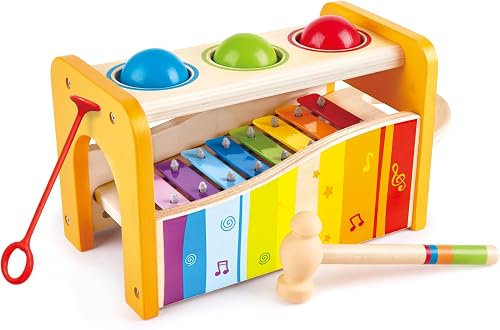
The Hape Pound & Tap Bench is a wooden toy where toddlers hammer balls through holes and the balls roll down xylophone keys. It is the best musical pick because it combines two classic toddler toys in one sturdy piece.
Hammering is satisfying for an 18-month-old because it combines big arm movement with a clear result. Each hit sends a ball through the hole and down the xylophone, making a tune. Toddlers learn that harder or softer taps change what happens.
The xylophone slides out and works on its own. That gives you two toys: a pounding bench and a mini instrument. Hape rates it from 12 months and markets it to about age 3, so it covers this age well.
Wood is the main reason parents choose this over plastic pounding toys. It is heavier, harder to tip and quieter on the floor. Hape won the 2018 Cribsie Award for Favorite First Musical Toy with this bench.
Expect the xylophone to sound pleasant rather than perfectly tuned. Some buyers note the keys do not form a true musical scale. For a toddler exploring sound, that matters little, but it is worth knowing if you want a real instrument.
Parents who want a battery-free musical toy made from wood.
Homes where toddlers tend to swing toys at people or pets.
The Little People Caring for Animals Farm is a fold-open barn playset with a farmer, four animals and interactive buttons. It is the best pick for early pretend play, which starts to appear between 18 months and 2 years.
Pointing to show you something interesting is a CDC milestone for 18 months (CDC, 2022). A farm full of animals gives toddlers plenty to point at. You name the cow, make the “moo,” and your child copies. That simple exchange builds language faster than any button.
The Little People figures are chunky and sized for small hands. Toddlers can carry them around, put them in the barn and drop them through the hayloft. Moving figures from place to place is early pretend play, the stage the AAP links to language and social growth (AAP, 2018).
Smart Stages levels change the content as your child grows. At first, the barn plays animal sounds. Later levels introduce counting, colors and opposites. Fisher-Price rates it for ages 1 to 5, which is one of the longest ranges on this list.
The barn folds closed and has a carry handle, so the figures store inside. The set is large when open, at roughly 24 inches wide, so plan for floor space.
Toddlers who love animals and parents who want to encourage pretend play.
Small apartments with limited floor space.
The Green Toys Dump Truck is a chunky truck with a working dump bed, made from recycled milk jugs. It is the best vehicle pick because it handles living room floors, sandboxes and bath time equally well.
Pushing a toy car is a CDC example of simple play at 18 months (CDC, 2022). This truck is big enough for a toddler to push with both hands and sturdy enough to sit on by accident. Filling and dumping the bed adds a second activity.
Materials are the main reason parents choose Green Toys. The company makes every toy from recycled milk jugs, and the plastic meets FDA food contact standards. There are no metal axles, so the truck can go in water and sand without rusting.
It is dishwasher safe. That matters more than it sounds at this age, when toys go from the mouth to the floor to the yard. A run through the top rack cleans it fully.
The truck is open-ended. Toddlers fill it with blocks, stuffed animals or sand. That flexibility keeps it in rotation long after more specific toys are forgotten. Green Toys rates it from 1 year up.
Families who want one durable vehicle for every play setting.
Toddlers who expect lights and sound effects from their vehicles.
The Little Tikes First Slide is a short plastic slide built for toddlers, with a 38-inch slide and folding design. It is the best gross motor pick for kids who climb everything in the house.
Climbing on and off a couch without help is a CDC 18-month milestone (CDC, 2022). If your toddler is already scaling furniture, a slide gives that urge a safer outlet. Climbing the steps builds leg strength, and sliding down builds balance.
The slide is rated from 18 months, which makes it one of the few climbing toys designed for this exact age. Its 23-inch deck is low enough that falls are short. Little Tikes says it must be placed on a soft play surface.
It folds flat in seconds and the steps come off without tools. That makes it practical for indoor winter play and easy to move outside in summer. The slide weighs about 9 pounds, so a parent can carry it with one hand.
The 60-pound limit and 6-year age range mean it lasts well past toddlerhood. Many families move it to the backyard once kids outgrow indoor play, so it gets several years of use.
Climbers who need a safe outlet during indoor days.
Homes without space for a 3-foot slide or a soft play surface.
The Radio Flyer Classic Walker Wagon is a wooden push wagon with adjustable resistance that keeps it from rolling away from unsteady toddlers. It is the best pick for 18-month-olds who are still building walking confidence.
Walking alone is the headline milestone at 18 months (CDC, 2022). Most toddlers reach it, but many still wobble. This wagon gives them something stable to hold as they practice. The resistance clickers stop the wagon from shooting forward, which is the main danger with cheap push toys.
Once your toddler walks well, the wagon becomes a hauling toy. Toddlers love loading stuffed animals, books and blocks, then pushing them across the room. The handle sits 16 inches from the floor, which suits toddler height.
The wooden body and rubber furniture bumper make it feel like a family heirloom. Radio Flyer rates it to age 4 and up to 35 pounds, so younger siblings can inherit it.
This is the most expensive pick on the list. You pay for build quality and longevity. If your child is already walking confidently, a cheaper push toy may be enough.
Toddlers still building walking confidence and families planning to pass it down.
Parents on a tight budget or toddlers who already run confidently.
Crayola My First Palm Grasp Crayons are egg-shaped, washable crayons sized to fit inside a toddler’s fist. They are the best budget pick because scribbling is an 18-month milestone and these cost about $8.
Scribbling is on the CDC’s list of 18-month movement milestones (CDC, 2022). Most toddlers cannot hold a regular crayon yet, because a thin crayon needs a finger grip that develops later. The egg shape lets them grab with the whole hand and still make bold marks.
Regular crayons also snap the moment a toddler presses hard. These are thick enough to survive heavy pressure. Crayola says each egg holds the same amount of wax as 14 standard crayons, so a 3-pack lasts months.
Washability is the second reason to choose them. The crayons wash off skin and most clothing, which matters when art time ends with marks on arms and shirts. Crayola rates them from 12 months up.
Scribbling also gives you a chance to talk. Naming the colors and describing the marks (“big circle,” “long line”) is a free vocabulary lesson that costs nothing beyond the crayons.
Budget-conscious parents and toddlers who are starting to scribble.
Unsupervised play or toddlers who still mouth everything constantly.
Toys for an 18-month-old are safest when they carry an age label under 3 years, contain no small parts, and are checked regularly for damage. Choking on small parts is the main risk at this age because toddlers still explore with their mouths.
US hospital emergency departments treated an estimated 154,700 toy-related injuries among children 12 and younger in 2023, and 10 children died in toy-related incidents (CPSC, 2024). Ingestion was among the most common diagnoses for children under 5 (CPSC, 2024).
The federal small parts rule is your best guide. Toys intended for children under 3 cannot contain or break into pieces that fit inside a test cylinder 2.25 inches long and 1.25 inches wide (CPSC, 16 CFR 1501). Toys for ages 3 to 6 that contain small parts must carry a choking warning.
Keep older siblings' toys in a separate room or a high bin, since 3+ sets often contain small parts.
Check toys weekly for cracks, loose pieces and peeling paint, because a broken toy can create a new small part.
Check that battery compartments on electronic toys close with a screw and cannot be opened by small fingers.
if a piece slides through, keep it away from your toddler.
The best toy for most 18-month-olds is the Learning Resources Spike the Fine Motor Hedgehog. It costs about $12-15, needs no batteries and trains grip and aiming skills. For walking, the Radio Flyer Classic Walker Wagon is the top pick.
Yes. Crayola My First Palm Grasp Crayons cost about $8, and the Spike hedgehog costs under $15. Household items also work well, such as plastic bowls, wooden spoons and cardboard boxes, as long as no piece is small enough to fit in the CPSC test cylinder.
LEGO DUPLO bricks are about twice the size of regular LEGO bricks and are designed for children from 18 months. Regular LEGO sets are usually rated 4 years and up because their small pieces are a choking hazard. DUPLO bricks connect to regular LEGO, so collections can grow together later.
Start with the skills your child is practicing right now, such as walking, climbing, scribbling or naming objects. Pick a toy that supports one of those skills, has an age label under 3 years and contains no small parts. Then choose toys you can play with together, since shared play gives the most benefit (AAP, 2018).
Electronic toys are not harmful in themselves, but they should not replace hands-on play with a parent. The AAP’s clinical report found that electronic toys alone do not give children the interaction that supports healthy development, and that many educational claims are unproven (AAP, 2018). Mix them with simple toys like blocks and crayons.
An 18-month-old does not need many toys. A small rotation of 6 to 10 toys covering movement, hand skills, books and pretend play is enough. Rotating toys every week or two keeps them feeling new without buying more.
Toys labeled 3+ are not safe for an 18-month-old, because they are not tested against the small parts ban for children under 3 (CPSC, 16 CFR 1501). Toys labeled 2+ are not covered by that warning but may be too hard or frustrating. Stick with toys labeled for 18 months or younger when possible.
The AAP recommends avoiding screen time for children younger than 18 to 24 months, except video chatting with family (AAP, 2018). Physical toys and shared reading are better choices at this age.
The Learning Resources Spike the Fine Motor Hedgehog is the best toy for an 18 month old: it is cheap, quiet and grows from simple peg play into counting and color games. For toddlers still wobbling on their feet, the Radio Flyer Classic Walker Wagon is worth the higher price. If you want one building set that lasts until kindergarten, the LEGO DUPLO Classic Brick Box is the runner-up.