Importance of Toys in Child Development and Education: What the Research Shows in 2026
- Published July 12, 2026
- Updated October 17, 2026
- 13 min read
The importance of toys in child development comes down to one fact: children learn by handling things. Here is what studies show, by age.
Toys matter because hands-on play builds attention, language, and motor control, and the American Academy of Pediatrics (AAP) recommends simple, hands-on toys over digital ones (Healey & Mendelsohn, Pediatrics, 2019).
TL;DR: The Quick Answer
- Toys matter because hands-on play builds attention, language, and motor control, and the American Academy of Pediatrics (AAP) recommends simple, hands-on toys over digital ones (Healey & Mendelsohn, Pediatrics, 2019).
- Parents spoke about 40 words per minute while playing with electronic toys, compared with 56 for blocks and puzzles and 67 for board books (Sosa, JAMA Pediatrics, 2016).
- Toddlers given 4 toys played with each one about twice as long as toddlers given 16 toys (Dauch et al., Infant Behavior and Development, 2018).
- Block and puzzle play between ages 2 and 4 is linked with stronger spatial skills and early math ability (Verdine et al., Child Development, 2014; Levine et al., 2012).
- Safety is part of every toy choice: U.S. emergency departments treated an estimated 91,600 toy-related injuries in children aged 4 and under in 2024 (CPSC, 2026).
- Is the Importance of Toys in Child
- Toys Build Executive Function
- Blocks and Puzzles Build Spatial
- Toys Build Fine Motor Skills That
- How Toys Affect Language Development
- Pretend Play Toys Support Social
- How Many Toys Does a Child Need
- Best Toys by Age
- To Choose Safe Toys for Babies
- Common Mistakes Parents Make When
- Parents Should Remember About Toys
- Sources Used in This Article
- FAQ
What Is the Importance of Toys in Child Development?
Toys give young children something to act on, and acting on objects is how young children learn. When a baby bangs two cups together or a 3-year-old stacks blocks, the child is testing cause and effect, practicing hand control, and hearing new words from the adult nearby.
The AAP clinical report The Power of Play (Yogman et al., Pediatrics, 2018) states that play supports executive function (the mental skills behind planning, focus, and self-control) and helps buffer children against the effects of stress. The report also recommends that pediatricians write a "prescription for play" at well-child visits through age 2.
A toy is a tool for play, not the play itself
The AAP's companion report on toys says the best toys match a child's current abilities while stretching them toward new ones, and invite children and caregivers to play together (Healey & Mendelsohn, Pediatrics, 2019). In practice, that means a $15 set of wooden blocks often does more for a toddler than a $60 talking tablet.
What is the difference between play and learning for young children?
For children under 5, play and learning are mostly the same activity. A toddler fitting a square block into a shape sorter is solving a geometry problem, even though nobody calls it that.
Think of toys the way a coach thinks of practice drills. The drill itself is simple, but repeating it builds the skill that shows up later in the game. Blocks, puzzles, and pretend play sets are the drills; reading, writing, and math in school are the game.
How Toys Build Executive Function and Self-Control
Toys build executive function when a child has to hold a goal in mind, ignore distractions, and switch strategies when something does not work. A shape sorter, a simple board game with turn-taking rules, or a pretend tea party all ask for this kind of mental effort.
Executive function has three parts that researchers measure
working memory (holding information in mind), inhibitory control (stopping an impulse), and cognitive flexibility (switching between rules). Games with rules, memory-matching cards, and "red light, green light" style activities give children regular practice with all three.
The research on pretend play and executive function is promising but still developing:
A study of 104 preschoolers (average age 4) found that executive function scores were linked to pretend play ability, even after accounting for verbal ability and memory (Carlson, White & Davis-Unger, Cognitive Development, 2014).
In a 5-week study, 39 children aged 3 to 5 who joined daily 15-minute fantasy pretend play sessions improved on an attention-shifting task, though the difference compared with a no-play group was not statistically significant (Thibodeau et al., Journal of Experimental Child Psychology, 2016).
A major review concluded that current evidence does not prove pretend play is uniquely necessary for development, and that it may be one of several routes to the same skills (Lillard et al., Psychological Bulletin, 2013).
Good to know
The practical takeaway for parents is simple. Toys that make children wait, plan, follow rules, or play a role give them repeated practice with self-control, and that practice is low-cost and low-risk.
How Blocks and Puzzles Build Spatial Skills and Early Math
Blocks and puzzles build spatial skills, which are the mental abilities children use to reason about the shape, size, position, and movement of objects. Spatial skills are one of the strongest early predictors of later math ability.
In a study of more than 100 three-year-olds, children who were better at copying block structures from a model also scored higher on early math tests (Verdine et al., Child Development, 2014). The same study found that by age 3, children from lower-income families were already behind in spatial skills, likely because they had less access to blocks and similar toys.
Follow-up research from the same team found that spatial skills at age 3 predicted math skills at age 5, and predicted them better than early counting ability did (Verdine et al., Monographs of the Society for Research in Child Development, 2017).
Puzzle play shows a similar pattern
Researchers at the University of Chicago observed 53 children at home between 26 and 46 months of age. The children who played with puzzles performed better on shape-rotation tasks at 54 months (Levine et al., 2012).
Do puzzles make children better at math?
Puzzles are linked with better spatial and math skills, but the research does not yet prove that puzzles cause the improvement. In the Levine study, families chose whether to do puzzles, so other parts of home life may also play a role. The lead author said at the time that further studies were needed to confirm a causal link (Levine et al., 2012).
Even so, puzzles and blocks are inexpensive, safe for the right age, and backed by consistent findings. That makes them a sensible choice for any toy shelf.
| Age | Toy Type | What It Builds | Where to Find It |
|---|---|---|---|
| 12-24 months | Chunky knob puzzles, stacking cups | Matching shapes, size order | Shop knob puzzles on Amazon |
| 2-3 years | Wooden unit blocks, large interlocking bricks | Balance, copying structures | Shop wooden unit blocks on Amazon |
| 3-5 years | 12-48 piece jigsaw puzzles, magnetic tiles | Mental rotation, part-to-whole thinking | Shop magnetic tiles on Amazon |
| 5-8 years | Tangrams, building sets with plans | Following diagrams, geometry | Shop tangram puzzles on Amazon |
One tip makes block and puzzle play more useful: use spatial words while you play. Words like “above,” “behind,” “turn it,” and “bigger” give children the vocabulary to think about space.
What spatial toys work best at each age?
How Toys Build Fine Motor Skills That Predict School Readiness
Fine motor skills are the small, controlled movements of the hands and fingers, such as pinching, gripping, threading, and drawing. Toys build these skills by giving children objects to grasp, twist, stack, and fit together every day.
Fine motor skills matter for school more than many parents expect
An analysis of several large U.S. and U.K. datasets found that fine motor skills at kindergarten entry were a strong predictor of later math and reading achievement, with predictive strength similar to attention for math (Grissmer et al., Developmental Psychology, 2010).
A later study of kindergartners found that fine motor skills and executive function each contributed to school achievement on their own (Cameron et al., Child Development, 2012). Among low-income preschoolers, both writing-type fine motor tasks and object-handling tasks predicted reading and math performance in second grade (Dinehart & Manfra, Early Education and Development, 2013).
| Age | Recommended Toys | Skill Being Practiced |
|---|---|---|
| 0-6 months | Soft rattles, crinkle toys, an activity gym | Reaching, grasping, tracking with the eyes |
| 6-12 months | Stacking rings, soft blocks, board books | Passing objects hand to hand, releasing on purpose |
| 1-2 years | Shape sorters, pop-up toys, chunky crayons | Twisting wrists, early pincer grip |
| 2-3 years | Play dough, large beads to string, peg boards | Finger strength, two-hand coordination |
| 3-5 years | Lacing cards, child-safe scissors, building bricks | Precision, hand-eye control for writing |
| 5-8 years | Model kits, craft supplies, card games | Fine control, sustained focus |
For babies, floor time on a padded surface such as a foam play mat gives them space to reach for toys, roll toward them, and build the arm and core strength that fine motor control depends on.
Which toys build fine motor skills by age?
How Toys Affect Language Development: Traditional vs Electronic Toys
Toys support language development when they get parents and children talking to each other. Simple toys and books do this better than electronic toys, according to the strongest study on the question.
In a controlled in-home experiment, 26 parents and their babies aged 10 to 16 months played with three toy sets: electronic toys, traditional toys (a wooden puzzle, a shape sorter, and rubber blocks), and board books. During electronic toy play, parents used fewer words, responded less often to their babies, and had fewer back-and-forth exchanges. Babies also vocalized less with electronic toys than with books (Sosa, JAMA Pediatrics, 2016).
The word counts showed a clear gap
| Toy Type | Average Parent Words per Minute |
|---|---|
| Electronic toys (lights, sounds, talking) | 40 |
| Traditional toys (blocks, puzzles, shape sorter) | 56 |
| Board books | 67 |
Source (Sosa, JAMA Pediatrics, 2016, as reported by ASHA Leader, 2016)
Study author Anna Sosa summed up her advice this way
a toy should be "10 percent toy and 90 percent child." The study was small and mostly involved educated families, so the results should be repeated with larger groups. Still, the AAP reached a similar conclusion and advises parents not to treat digital toys as a replacement for hands-on toys (Healey & Mendelsohn, Pediatrics, 2019).
Are electronic learning toys bad for babies?
Electronic toys are not harmful in small amounts, but there is no good evidence that they teach language to babies. Sosa suggested treating them as entertainment rather than learning tools (Sosa, JAMA Pediatrics, 2016). If your time for one-on-one play is limited, spend it with books, blocks, and puzzles.
What toys help a toddler start talking?
The toys that help most are the ones you talk about together. Board books, toy animals, play food, and simple puzzles give you natural things to name, describe, and ask about. If your toddler is not using single words by around 15 to 18 months, raise it with your pediatrician, who can refer you to a speech-language pathologist if needed.
How Pretend Play Toys Support Social and Emotional Growth
Pretend play toys support social and emotional growth by letting children act out roles, practice relationships, and try on other people’s feelings. Pretend play (also called symbolic play) is any play where a child uses one thing to stand for another, such as a block becoming a phone or a doll becoming a baby who needs feeding.
When a 4-year-old plays doctor, parent, or shopkeeper, they practice seeing a situation from someone else's point of view. Playing with other children adds turn-taking, negotiation, and handling disagreement.
The AAP reports that play with caregivers helps build the safe, stable, and nurturing relationships that protect children from the effects of toxic stress (Yogman et al., Pediatrics, 2018). In other words, much of the emotional benefit comes from the shared play, not from the toy alone.
Good pretend play toys for ages 2 to 6 include
A play kitchen with pretend food gives children a familiar setting to copy adult routines and take turns with a sibling or friend.
Dolls and stuffed animals let children practice caring for someone, which is an early form of empathy.
Dress-up clothes and simple props help children step into a role and build a story around it.
Small figure sets and play scenes let children narrate events, which builds storytelling and vocabulary.
Good to know
The AAP also notes that some toys reinforce gender or racial stereotypes (Healey & Mendelsohn, Pediatrics, 2019). Offering every child access to blocks, dolls, kitchens, and vehicles gives them a wider range of roles to explore.
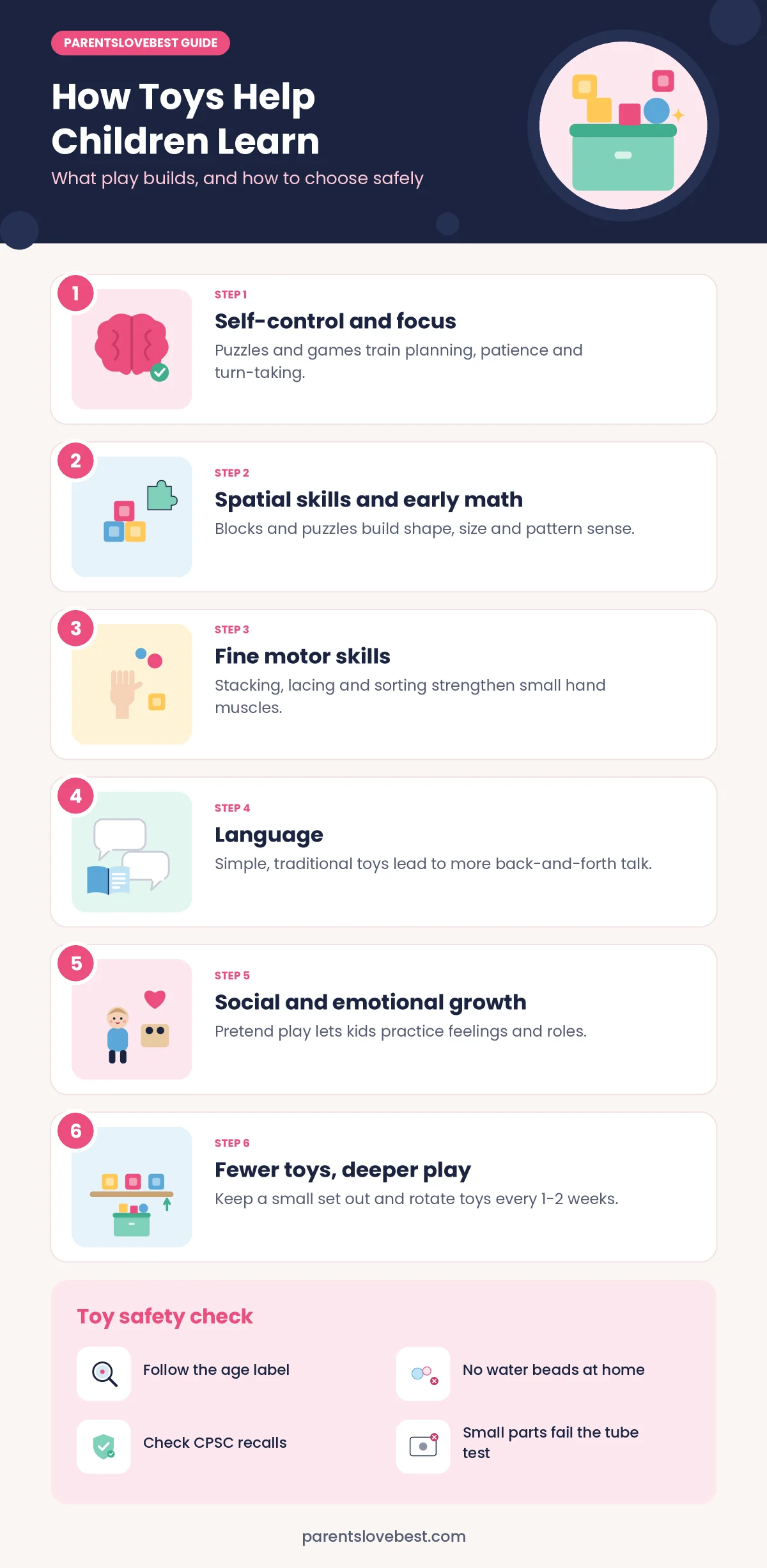
How Toys Help Children Learn at a Glance
How Many Toys Does a Child Need?
Most children need fewer toys out at one time than they currently have. A smaller selection leads to longer, deeper play with each toy.
Researchers at the University of Toledo observed 36 toddlers aged 18 to 30 months in playrooms with either 4 toys or 16 toys. With 4 toys, toddlers played with each toy about twice as long and used each toy in more varied ways. With 16 toys, they moved quickly from toy to toy and played with less depth (Dauch et al., Infant Behavior and Development, 2018).
Co-author Carly Dauch described the difference
in the 16-toy room, toddlers mostly poked, lifted, and carried toys, while in the 4-toy room they did more pretending and role play (University of Toledo, 2017).
What is toy rotation and how do you start it?
Toy rotation means keeping only a small set of toys available and swapping them out every week or two. It works like a library: the collection stays the same size, but what is on the shelf changes.
- Gather all toys and sort them into groups by type, such as building, pretend, puzzles, books, and movement.
- Choose 6 to 10 toys for a toddler, taking one or two from each group, and put them on a low open shelf.
- Store the rest out of sight in labeled bins.
- Swap a few toys every 7 to 14 days, and keep any toy your child is still deeply engaged with.
Best Toys by Age: A Development-Based Guide
The best toys at each age are simple, open-ended, and slightly challenging for your child’s current skills. Open-ended toys are toys that can be used in many ways, such as blocks, play dough, or toy animals, rather than toys with one button and one result.
| Age | Top Toy Picks | Main Skills Supported | Shop |
|---|---|---|---|
| 0-6 months | High-contrast cards, soft rattles, activity gym | Visual tracking, reaching | See our activity gym picks |
| 6-12 months | Stacking cups, soft blocks, cloth or board books | Grasp and release, early words | Shop stacking cups on Amazon |
| 12-24 months | Shape sorter, push toy, knob puzzles | Problem-solving, walking balance | Shop shape sorters on Amazon |
| 2-3 years | Wooden blocks, play kitchen, chunky crayons | Spatial skills, pretend play | Shop wooden blocks on Amazon |
| 3-5 years | Jigsaw puzzles, magnetic tiles, lacing beads, dress-up | Planning, fine motor precision | Shop lacing beads on Amazon |
| 5-8 years | Board games with rules, building sets, art supplies | Self-control, following steps | Shop family board games on Amazon |
Good to know
For more ideas on age-appropriate play gear, browse our Baby Play Time guides.
How to Choose Safe Toys for Babies and Toddlers
A safe toy matches the child’s age, has no parts small enough to swallow, and has no loose batteries, magnets, or long cords. Age labels on toy packaging are based on safety testing as well as skill level, so treat them as minimums.
The latest U.S. Consumer Product Safety Commission (CPSC) report estimates that 267,100 toy-related injuries were treated in U.S. emergency departments in 2024. Children aged 4 and under accounted for 91,600 of those injuries, about 34 percent (CPSC, Toy-Related Deaths and Injuries Calendar Year 2024, 2026).
For children under 5, ingestion and internal injuries were the second and third most common injury types after cuts. Water beads were linked to roughly 6,000 emergency visits in 2024. One of the six toy-related deaths reported for 2024 was a 6-month-old who choked on a small piece of pretend food (CPSC, 2026).
Use this checklist before a toy reaches your child
Check the age label and keep toys for older siblings stored where babies and toddlers cannot reach them.
Test small parts with an empty toilet paper roll; if a piece fits inside, it is a choking risk for children under 3.
Avoid water beads entirely in homes with young children, since they expand inside the body if swallowed.
Make sure battery compartments, especially those with button batteries, close with a screw.
Keep small, powerful magnets away from young children, and check magnetic tiles for cracked edges.
Search new and secondhand toys on CPSC.gov/Recalls before giving them to your child.
Pair ride-on toys and scooters with a helmet, since nonmotorized scooters were linked to 23 percent of all toy-related injuries in 2024 (CPSC, 2026).
Common Mistakes Parents Make When Choosing Toys
The most common mistake is choosing toys based on marketing claims instead of how a child will actually play with them. Here are the mistakes that come up most often:
Many parents trust "educational" labels on electronic toys, even though the AAP notes that a digital format does not make a toy more educational (Healey & Mendelsohn, Pediatrics, 2019).
Putting every toy out at once can shorten attention, since toddlers with fewer choices play longer and more creatively (Dauch et al., 2018).
Letting the toy do the talking reduces the parent-child conversation that drives early language, so turn off sounds or choose quiet toys for shared play.
Skipping open-ended toys like blocks and play dough in favor of single-function gadgets limits how many ways a child can use what they own.
Passing down an older sibling's small-part toys to a baby or toddler creates choking risks that the original age label was designed to prevent.
What Parents Should Remember About Toys and Learning
Simple toys like blocks, puzzles, board books, and pretend play sets are backed by the strongest research for early learning.
Your involvement makes the biggest difference, because talking and playing together is where most language and emotional growth happens.
Fewer toys at a time lead to longer, more creative play, so a rotation system works better than a crowded toy box.
Safety comes first
check age labels, test for small parts, avoid water beads, and search recalls before giving any toy to a child under 5.
Sources Used in This Article
Yogman, M. et al. (2018). The Power of Play
A Pediatric Role in Enhancing Development in Young Children. Pediatrics. AAP summary on HealthyChildren.org
Healey, A. & Mendelsohn, A. (2019). Selecting Appropriate Toys for Young Children in the Digital Era. Pediatrics. AAP news release
Sosa, A. V. (2016). Association of the Type of Toy Used During Play With the Quantity and Quality of Parent-Infant Communication. JAMA Pediatrics. ASHA Leader summary
Dauch, C. et al. (2018)
The influence of the number of toys in the environment on toddlers' play. Infant Behavior and Development. University of Toledo news
Verdine, B. N. et al. (2014). Deconstructing Building Blocks
Preschoolers' Spatial Assembly Performance Relates to Early Mathematical Skills. Child Development. SRCD summary
Levine, S. C. et al. (2012). Early Puzzle Play
A Predictor of Preschoolers' Spatial Transformation Skill. ScienceDaily summary
Grissmer, D. et al. (2010)
Fine Motor Skills and Early Comprehension of the World: Two New School Readiness Indicators. Developmental Psychology.
Carlson, S. M., White, R
E. & Davis-Unger, A. (2014). Evidence for a relation between executive function and pretense representation in preschool children. Cognitive Development. Full text on PMC
Lillard, A. S. et al
(2013). The Impact of Pretend Play on Children's Development: A Review of the Evidence. Psychological Bulletin.
U.S. Consumer Product Safety Commission (2026)
Toy-Related Deaths and Injuries Calendar Year 2024. CPSC report page
Frequently Asked Questions About Toys and Child Development
What is the importance of toys in child development?
Toys give children objects to explore, which is how they build motor skills, language, spatial reasoning, and self-control. The AAP describes play as a central part of healthy brain development and recommends simple toys that encourage caregivers and children to play together (Yogman et al., 2018; Healey & Mendelsohn, 2019).
At what age do toys matter most for development?
Toys support development from birth, but ages 0 to 5 are when everyday play has the biggest influence on foundational skills. Research links block and puzzle play at ages 2 to 4 with later math ability, and fine motor skills at kindergarten entry with later reading and math (Verdine et al., 2014; Grissmer et al., 2010).
What is the difference between educational toys and regular toys?
“Educational toy” is a marketing label, not a tested standard. Many ordinary toys, such as wooden blocks, play dough, and toy animals, support learning well because children must think and use their hands to play with them. A toy that does most of the work through lights and sounds usually teaches less, whatever the box says.
Are electronic toys bad for toddlers?
Electronic toys are not dangerous in moderation, but they tend to reduce parent-child talk. In one study, parents spoke about 40 words per minute with electronic toys versus 67 with books (Sosa, JAMA Pediatrics, 2016). Use them as occasional entertainment, not as language-learning tools.
How many toys should a toddler have available at once?
Six to ten toys on a shelf is a practical range for most toddlers. A University of Toledo study found toddlers played with each toy about twice as long when 4 toys were available instead of 16 (Dauch et al., 2018). Rotating toys every week or two keeps play fresh without buying more.
How do toys help children learn in school?
Toys build the skills that school learning depends on. Puzzles and blocks build spatial reasoning used in math, hand-based toys build the finger control needed for writing, and games with rules build the attention and self-control needed in a classroom (Grissmer et al., 2010; Cameron et al., 2012).
Are wooden toys better than plastic toys for development?
Material matters less than design. A plastic shape sorter and a wooden one teach the same skill. What matters is whether the toy is open-ended, safe for the child’s age, and encourages hands-on play and conversation.