
#1 · Best overall
Typical Price
$10 to $13
Age Range
6 months+
Batteries
No

As an Amazon Associate, Parents Love Best earns from qualifying purchases. Learn more
The best toys for 6 month old babies are ones they can grab, mouth, shake and stack safely. Here are 10 picks that match this stage.
Fisher-Price Baby’s First Blocks is a bucket with a shape-sorter lid and 10 chunky blocks.
Prices below are typical U.S. retail prices seen in October 2026 and change often. Check the current price on Amazon before buying.



A good toy for a 6 month old is safe to chew, easy to grip, and gives a clear response when the baby moves it. At this age most babies reach for toys, put objects in their mouths, and lean on their hands while sitting, so toys should reward those exact skills (CDC, 2022).
Every product on this list was checked against the criteria below.
Toys labeled for this age are tested to infant use-and-abuse standards for children 0 to 18 months.
The U.S. Consumer Product Safety Commission (CPSC) bans small parts in toys made for children under 3 because of choking risk.
Babies explore with their mouths at 6 months, so materials should be BPA-free and non-toxic.
Chunky rings, holes and handles let small hands hold a toy without frustration.
A toy that gets chewed daily should wipe clean or wash in warm soapy water.
Bumps, ridges and smooth surfaces give a baby new information through the hands and gums.
Toys that rattle, spin or light up when touched teach a baby that their actions make things happen.
Musical toys should have a low setting, since the AAP advises avoiding loud toys to protect hearing.
Battery compartments closed with a screw keep batteries out of a baby's reach.
Thin plastic can crack into sharp or small pieces, so sturdy builds matter for toys that get thrown.
A toy rated from 6 to 24 or 36 months gives more months of use for the money.
Toys that work on the floor or a high chair tray match how a 6 month old actually plays.
Simple toys like blocks and balls can be used in many ways as skills develop.
A light, compact toy is easy to bring in a diaper bag, car seat or stroller.
Most good 6-month toys cost under $25, so a high price should come with clear extra value.
Established brands with long sales histories and no active recalls carry less risk.
Each review below covers what the toy does, what it costs, and which baby it suits. Toys are ranked by developmental value, safety and price.
Fisher-Price Baby’s First Blocks is a bucket with a shape-sorter lid and 10 chunky blocks. It earns the top spot because it gives a 6 month old something to grab and drop now, and a sorting puzzle to grow into later.
At 6 months, most babies will not match shapes to slots yet. They will grab blocks, bang them together, and drop them into the open bucket. That simple fill-and-dump game is one of the first ways babies learn that objects still exist after they disappear from view.
Around 9 to 12 months, the same set becomes a real sorting toy. The lid introduces circles, squares and triangles, and parents can name each shape as the baby tries it. One purchase covers two developmental stages without needing a new toy.
The blocks are light enough that a dropped block will not hurt a baby sitting nearby. Their chunky size also keeps them well above the small parts threshold, so they are safe to mouth during supervised play.
Everything fits back inside the bucket. For parents short on floor space, this matters more than it sounds, since loose pieces are what usually end up under the couch or in the dog’s mouth.
Parents who want one versatile, no-battery toy that lasts from 6 months to toddlerhood.
Babies who need strong teething relief, since the blocks are not textured teethers.
Sassy Stacks of Circles is a 9-piece ring stacker rated for 6 to 24 months. Each ring has a different texture and weight, which makes it as much a sensory toy as a stacking toy.
Traditional stackers only work when rings go on biggest to smallest. Sassy designed every ring with the same center hole, so a 6 month old gets a win no matter which ring lands on the post. That early success keeps babies trying instead of giving up.
The texture variety is the real reason to choose this stacker. Bumpy, ridged and smooth rings give a teething baby different surfaces to chew on, and the rings are BPA-free according to the manufacturer listing.
The bead-filled clear ring links sound to sight. When a baby shakes it, they can watch the beads move and hear the rattle at the same time, which helps them connect what they do with what happens.
Nine pieces also means the rings work well as loose toys. Many 6 month olds ignore the post entirely at first and simply carry, chew and pass rings from hand to hand, which is a skill this age is still practicing.
Teething babies who love chewing on everything and parents who want a stacker with built-in sensory play.
Parents who specifically want a toy that teaches biggest-to-smallest ordering.
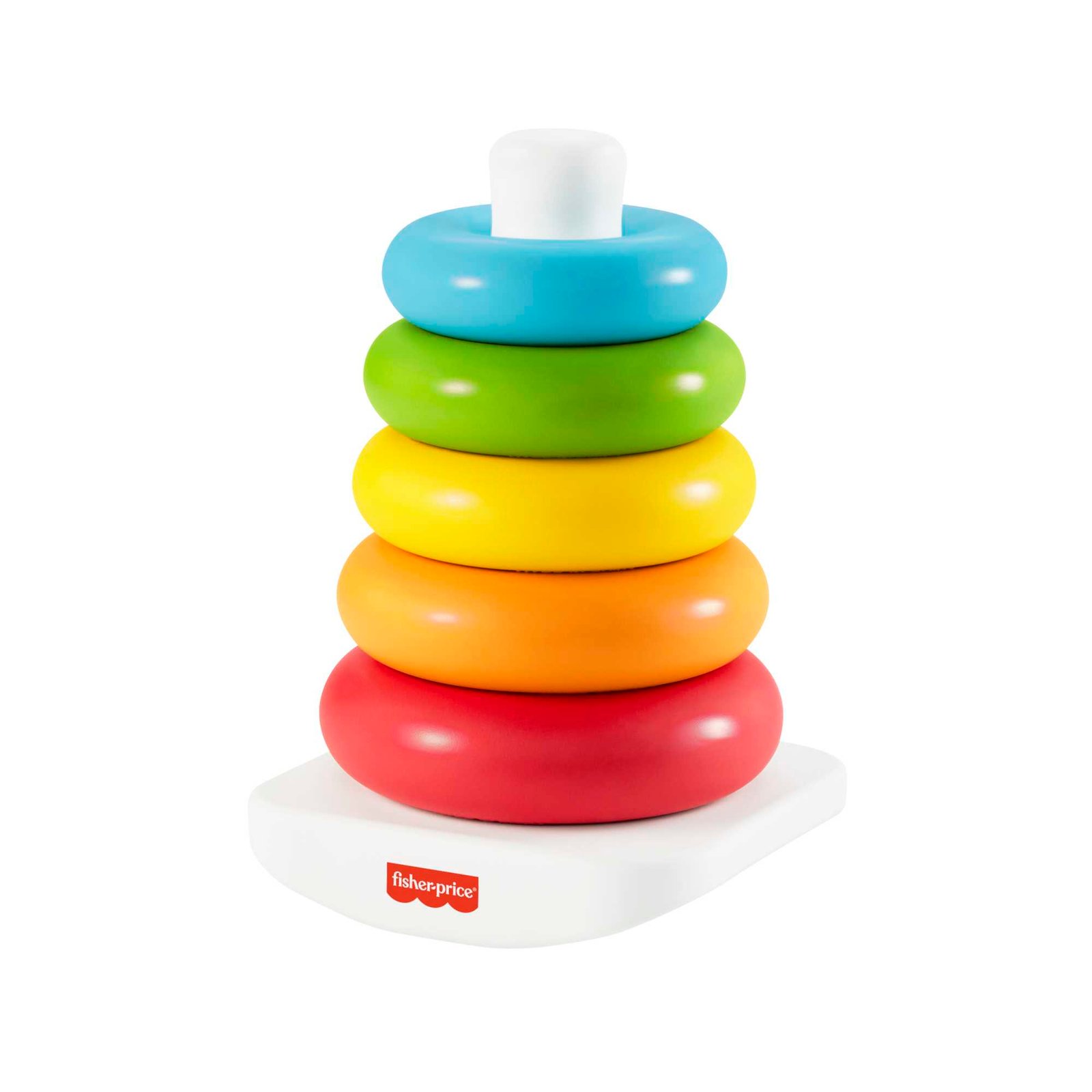
The Fisher-Price Rock-a-Stack is the classic 5-ring stacker with a wobbly rocking base. It is one of the cheapest toys on this list and still one of the most useful for a 6 month old.
The rocking base gives a 6 month old something to do before they can stack. Babies who are just learning to sit can swat the post and watch it wobble back, which rewards reaching and batting, two skills this age is building.
The smallest ring doubles as a rattle with a reflective surface. Babies can look at their own reflection in it, and the CDC lists enjoying their own image as a typical 6-month social milestone (CDC, 2022).
Later, the rings teach relative size. Because the rings only stack neatly from biggest to smallest, older babies start to notice that size matters, which the Sassy stacker above does not teach as directly.
For families buying on a tight budget, this is the toy to start with. Under $10 gets a stacker, a rattle and a bat-at toy in one piece that has been sold in some form for decades.
Budget-conscious parents and babies who are just learning to sit up.
Babies who need a lot of tactile variety or a strong teething toy.
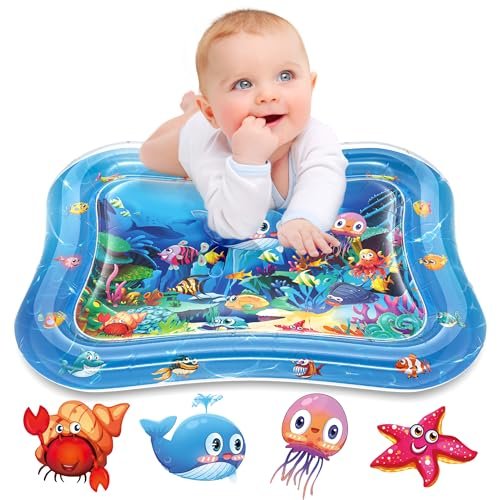
The Infinno Inflatable Tummy Time Mat is a water-filled play mat with floating sea creatures inside. It is rated for 3 to 24 months and is designed to keep babies interested while they push up on their arms.
Tummy time still matters at 6 months. Once your baby is ready for upright play, a jumper for a 6 month old or an exersaucer adds variety. The CDC lists pushing up with straight arms while on the tummy as a typical 6-month movement milestone (CDC, 2022). This mat gives babies a reason to stay on their stomachs longer, since every press moves the fish around.
The water creates gentle visual movement that does not need batteries or sound. For babies who fuss after a minute or two of tummy time, the moving shapes can stretch that window, which is the main reason parents buy it.
It also works for seated play. A baby who sits with support can slap at the mat from above and watch the creatures swirl, so it stays useful after tummy time becomes easy.
The low price makes it an easy add-on to a playroom. Drained and folded, it fits in a bag for visits to grandparents or a hotel room.
Babies who resist tummy time and parents who want an inexpensive fix.
Unsupervised play, since this is a water-filled toy that should only be used while an adult is watching and the baby is awake.
The VTech Busy Learners Activity Cube is a 5-sided activity toy with lights, music and manual features. It is rated for 6 months to 3 years and gives babies many things to press, spin and slide in one compact toy.
The cube is built to sit on the floor in front of a baby who is learning to sit. Its weight and flat sides keep it stable, and the light-up buttons on top are easy targets for a 6 month old’s palm.
The motion sensor is useful for babies starting to crawl. When the cube gets nudged, it plays a sound, which gives a baby a reason to reach for it and move toward it.
The age range is the main value argument. At 6 months a baby presses buttons and watches lights. By 18 months to 3 years, the same cube offers shape sorting, sliding beads and naming games that a 6 month old cannot use yet.
Parents who worry about noise can turn the volume down, and the toy shuts itself off when left alone, so batteries last longer and the house stays quieter.
Parents who want one electronic toy that will still be useful at age 2.
Families who prefer screen-free, battery-free, quiet play.
The Munchkin Mozart Magic Cube is a musical cube that plays 8 Mozart pieces using 5 instrument sounds. It is rated for 6 months and up and is the most musically interesting toy on this list.
Most baby music toys play short electronic jingles. The Mozart Cube plays real classical pieces with recognizable instrument sounds, which many parents find far easier to listen to through hundreds of repeats.
Each button adds or removes one instrument from the song. A 6 month old will mostly slap at random buttons, but every press changes the sound, which teaches cause and effect in a way babies notice quickly.
As a baby gets older, the cube supports listening games. Parents can press the violin and name it, then switch to the flute. The CDC recommends singing and playing music with babies at this age as a way to support development (CDC, 2022).
The cube has rounded corners and flat sides, so it rolls a short distance when pushed and then stops. That makes it a gentle motivator for a baby who is close to crawling.
Music-loving families who want a toy with long-term appeal and pleasant sound.
Parents on a tight budget or those avoiding battery-powered toys.
Baby Einstein Take Along Tunes is a handheld musical toy with one big button and 10 classical melodies. It is rated for 3 to 36 months and has sold over 30 million units worldwide (Kids2 product listing, 2026).
This is the toy to keep in the diaper bag. It is small and light, and the single large button is easy for a 6 month old to find and press, so a baby can operate it without help in a car seat or stroller.
The screw-secured battery door matters for safety. The AAP warns parents to be cautious with battery-powered toys because swallowed batteries can cause serious harm, and a screw closure keeps the 2 AA batteries out of reach.
The volume control is the second reason it travels well. A low setting keeps music quiet enough for a restaurant or waiting room while still holding a baby’s attention.
Because it has been on the market for years, replacement units are easy to find. Many families buy a second one so a lost toy does not mean a meltdown on the road.
Car rides, stroller walks, and waiting rooms.
Parents who want a quiet, battery-free floor toy.
The Bright Starts Oball Classic is a soft, flexible 4-inch ball with 32 finger holes. It is rated from birth and is one of the easiest toys for a 6 month old to grab and hold.
A regular ball is hard for a baby to hold because there is nothing to grip. The Oball’s open lattice lets tiny fingers hook through the holes, so a 6 month old can pick it up, hold it, and pass it from one hand to the other.
The soft material makes it safe to toss. When a baby throws it, which they will, it will not hurt a sibling, a pet, or a window.
It rolls slowly and not very far. That makes it a good crawling motivator, since a baby can push it a short distance and follow it across the floor.
The open design also makes it easy to clean. There are no seams or hidden spots where moisture can collect, which is a real plus for a toy that spends a lot of time in a baby’s mouth.
Babies practicing grasp and hand-to-hand transfer, and early crawlers.
Parents who want one toy with many features.
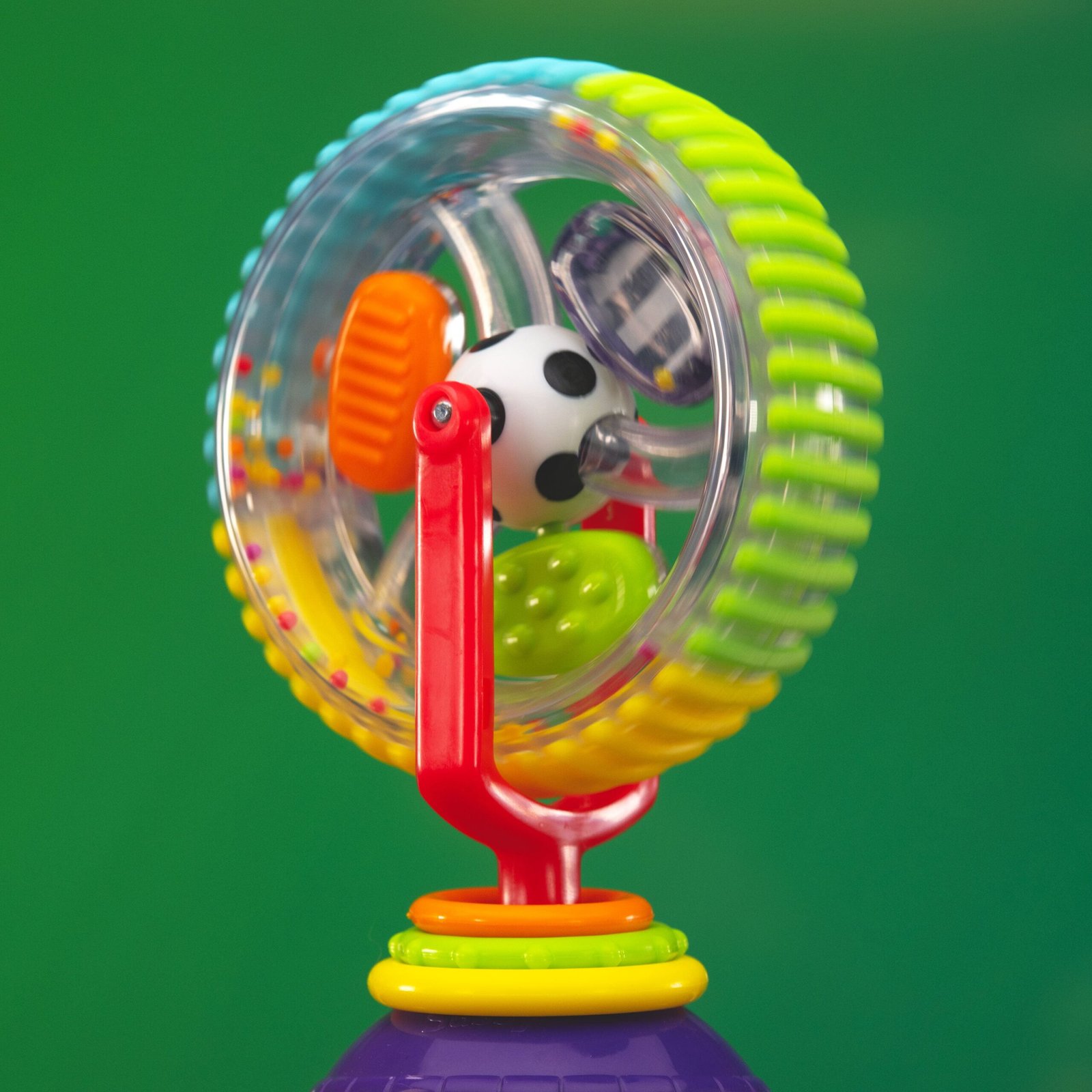
The Sassy Wonder Wheel is a suction-cup spinning toy that sticks to a high chair tray or table. It is rated for 6 months and up and keeps a baby busy while sitting in one spot.
Six months is when many babies start solid foods, which means more time sitting in a high chair. The suction base holds the wheel in place on the tray, so the toy stays put instead of landing on the floor every few seconds.
Spinning is easy for a 6 month old to trigger. A clumsy swipe of the hand sets the wheel in motion, which gives instant feedback even before a baby has fine control of their fingers.
The trapped beads give sound with every turn. Because they are sealed inside the clear structure, they add interest without creating a small parts risk.
It also works on a restaurant table or a smooth tray at a family dinner. For parents who eat out with a baby, a toy that stays in one place is worth a lot.
Babies starting solids who spend time in a high chair.
Floor play or tummy time.
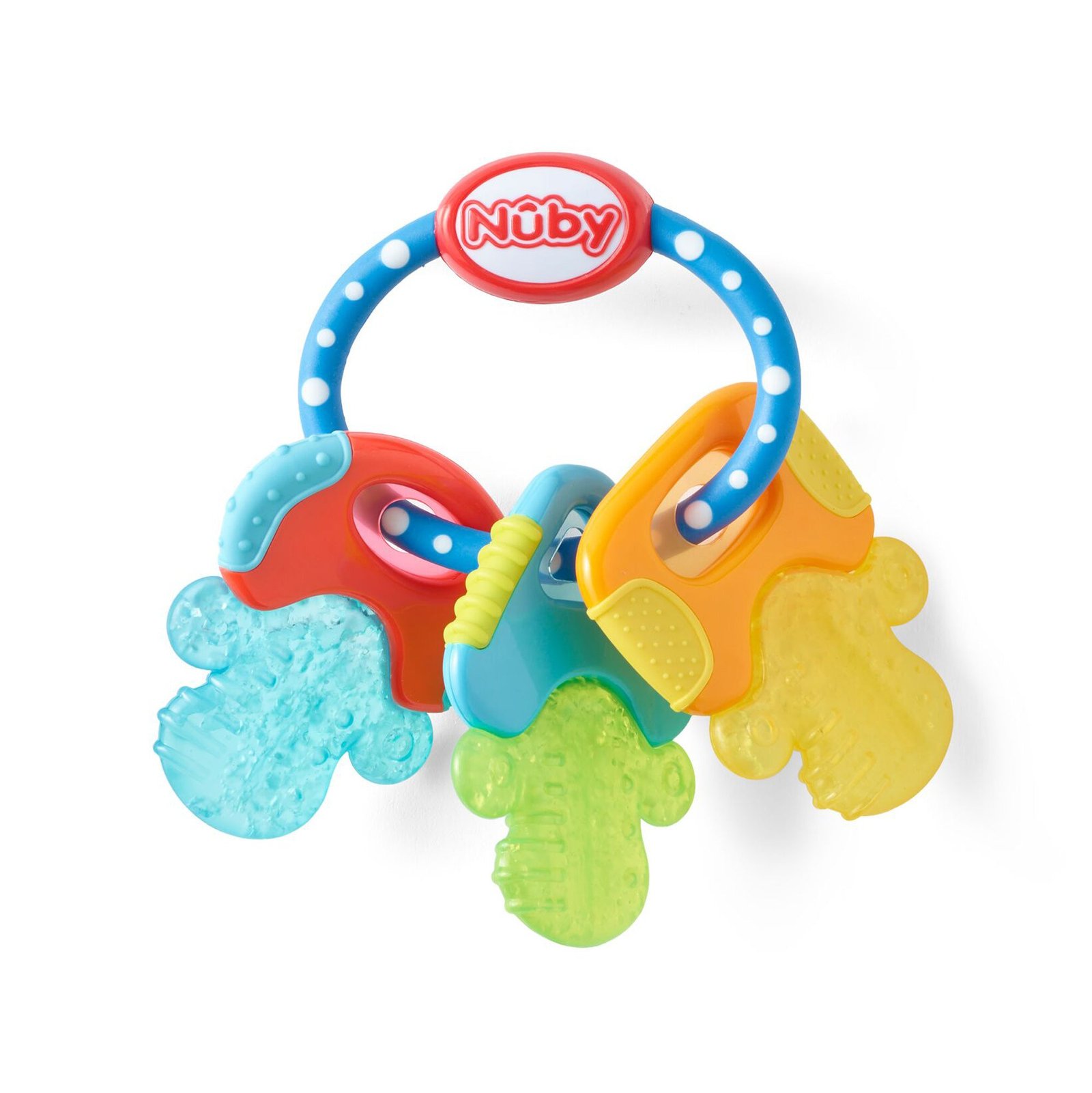
The Nuby IcyBite Keys Teether is a set of key-shaped teethers filled with cooling gel. It is rated for 3 months and up and is made for babies with sore gums.
Many babies get their first teeth around this age, and chewing on something cool is one of the simplest ways to ease sore gums. The gel-filled keys hold the chill from the refrigerator, giving a baby a cool surface to bite on.
Nuby’s label says to cool the teether only in the refrigerator, never the freezer. A frozen teether can get too hard for tender gums, so this matters for safety.
The keys have different textures on each piece. Softer textured tops press gently against gums, while the smooth cooled sections soothe. Babies can switch between them on their own.
The ring makes the set easy to hold and hard to drop. At this price, many parents keep two sets so one is always chilled and ready.
Babies who are actively teething.
Parents who want a toy that also offers sound, stacking, or sorting play.
Toys for a 6 month old are safe when they have no small parts, no loose batteries, and no damage. Babies at this age put everything in their mouths, so the biggest risk is a piece that can be swallowed or inhaled.
The CPSC estimates that 154,700 children aged 12 and under were treated in U.S. emergency rooms for toy-related injuries in 2023, and that ingestion was the second most common diagnosis for children under 5 (CPSC, 2024).
if a toy or piece fits inside a cardboard toilet paper or paper towel roll, it is a choking risk for a baby (Mississippi State University Extension, 2026).
Choose toys with battery compartments that close with a screw, and keep button batteries and magnets away from babies entirely, as the AAP advises.
Toys are for supervised awake time only.
A 6 month old should play with toys they can grasp, shake, mouth and drop safely. Stacking rings, chunky blocks, soft balls, rattles and teethers all match this stage. A baby activity gym is also a good fit for floor play. Look for toys that respond to touch, since babies this age are learning cause and effect.
Most 6 month olds reach for toys they want, put objects in their mouths to explore them, and lean on their hands while sitting (CDC, 2022). Many can pass a toy from one hand to the other. They are not ready for most sorting or puzzle features yet.
A 6 month old needs only a small set of toys, usually 5 to 8 that cover grasping, mouthing, sound and tummy time. Learn more about the importance of toys in child development. Rotating a few toys every week keeps them interesting. A large pile of toys at once can be more distracting than helpful.
Electronic toys are not bad for 6 month olds if they have volume control and secure battery doors. Use them alongside simple toys like blocks and balls. Keep the volume low, since the AAP advises avoiding loud toys to protect a child’s hearing.
Most gel-filled teethers, including the Nuby IcyBite Keys, should go in the refrigerator, not the freezer. A frozen teether can become too hard for a baby’s gums. Always follow the cooling instructions printed on the package.
A water play mat is safe for a 6 month old when an adult supervises every use. Check the mat for leaks before each session and use it only during awake tummy time or seated play. Never leave a baby alone on the mat.
Most stacking rings, including the Fisher-Price Rock-a-Stack and Sassy Stacks of Circles, are rated for 6 months and up. At this age, babies grab, chew and shake the rings. Actual stacking usually comes later, often closer to the first birthday.
The Fisher-Price Baby’s First Blocks is the best toy for a 6 month old because it costs about $10 to $13, needs no batteries, and grows from simple grabbing into shape sorting before the first birthday.
For teething babies, the Sassy Stacks of Circles is the better pick thanks to its textured rings. For families on a tight budget, the Fisher-Price Rock-a-Stack gives the most play value for under $10.