
How to Set Up a Nursery in a Small Room: A Step by Step Guide
- Published October 11, 2026
- Updated October 11, 2026
- 9 min read
You can set up a safe, functional nursery in a room as small as 70 square feet by choosing furniture that doubles as storage and placing the crib away from windows and vents.
A safe, functional nursery fits in a room as small as 70 square feet if you pick a compact crib, use a dresser as the changing table, build storage upward and keep the crib away from windows and cords.
TL;DR: The Quick Answer
- You can set up a safe, functional nursery in a room as small as 70 square feet by choosing furniture that doubles as storage and placing the crib away from windows and vents.
- The average American nursery is 132 square feet, but infant sleep guidelines from the American Academy of Pediatrics (AAP, 2022) focus on crib placement and room-sharing access, not room size.
- You need a crib, a changing surface, and clothing storage at minimum – a dedicated glider or dresser is optional in tight spaces.
- A well-planned small nursery takes one weekend to set up once you have a room measurement and a furniture layout sketched out.
- What You Need Before You Start
- Step 1: Measure the Room
- Step 2: Choose the Right Crib Size
- Step 3: Pick a Furniture Layout Before Buying
- Step 4: Replace Single-Purpose Furniture
- Step 5: Use Vertical Space for Storage
- Step 6: Handle Lighting with Wall-Mounted
- Step 7: Finalize the Room
- Common Problems and How to Fix Them
- FAQ
- Key Takeaways
What You Need Before You Start
Room dimensions - measure length, width, and ceiling height before buying any furniture.
A floor plan sketch - even a rough pencil drawing on graph paper will prevent costly furniture mistakes.
AAP safe sleep guidelines - the crib must sit at least 2 feet from windows, blind cords, heaters, and wall outlets (AAP, 2022).
A firm budget - nursery furniture averages $1,500-$3,000 for a complete set (Consumer Reports, 2024), but a small room actually reduces cost because you buy less.
Small-Room Nursery Setup: The 7 Steps at a Glance
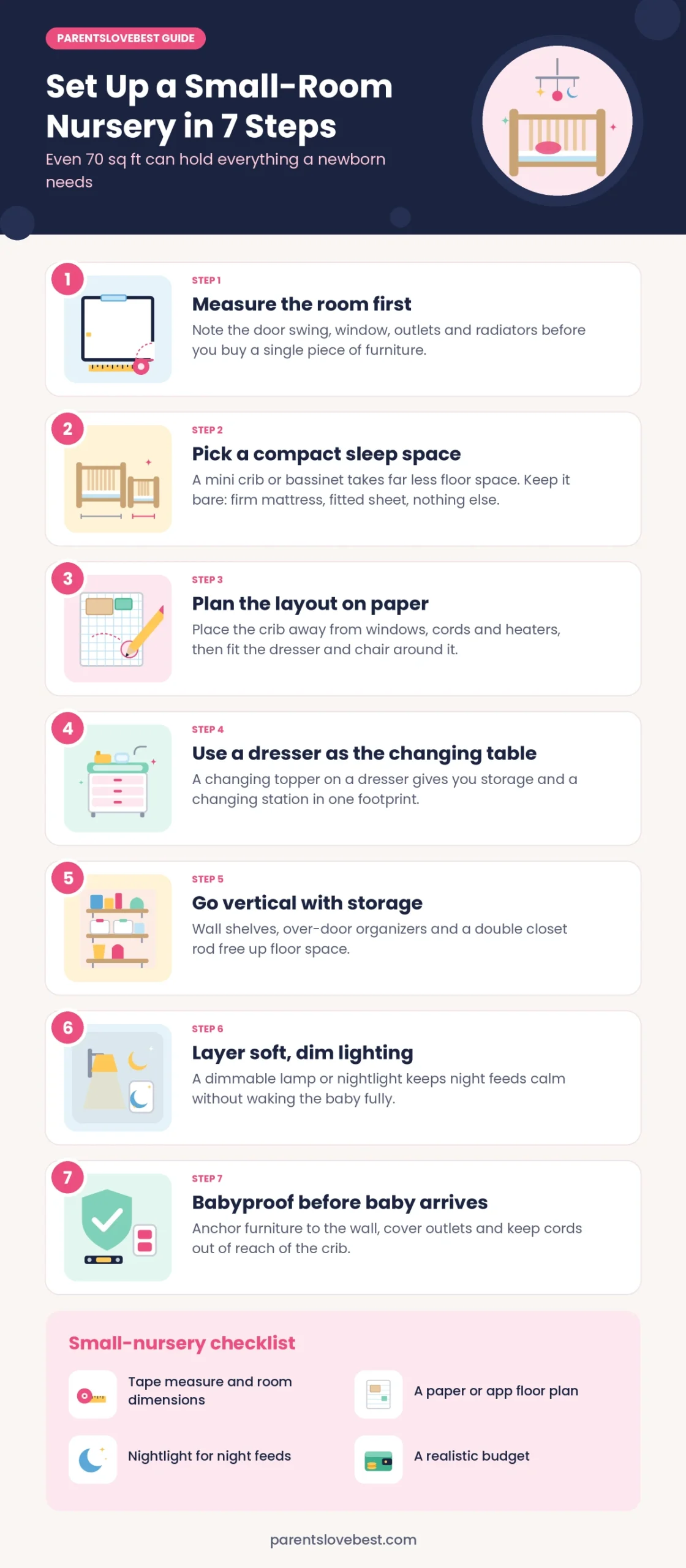
Step 1: Measure the Room and Identify Your Fixed Constraints
Measure all four walls and mark every fixed element – door swing radius, window placements, closet doors, and any outlets or vents. These are non-negotiable obstacles your furniture plan must work around.
Good to know
A standard crib is 54" x 30" (137 x 76 cm). Add 24 inches of clearance on the side where you'll stand to lift the baby. If the room is under 100 square feet, that crib placement will determine where everything else goes - plan the crib first, then fit remaining pieces around it.
Step 2: Choose the Right Crib Size for the Space
A full-size crib fits most rooms above 90 square feet. For rooms between 70-90 square feet, a mini crib (38″ x 24″ / 97 x 61 cm) saves roughly 3 square feet of floor space and works for most babies up to 18 months.
Do not use a portable play yard (Pack 'n Play) as a permanent sleep space in place of a crib. The AAP recommends a firm, flat mattress in a crib or bassinet for infant sleep - not a soft or inclined surface (AAP, 2022).
If the baby will share your bedroom for the first 6 months - which the AAP recommends to reduce SIDS risk by up to 50% (AAP, 2022) - a bedside bassinet is a practical first choice and frees up the nursery room entirely until the baby transitions.
Step 3: Pick a Furniture Layout Before Buying Anything
Draw three possible layouts on your floor plan before ordering a single piece of furniture. Retailers will not accept returns on assembled cribs or dressers, so this step prevents expensive mistakes.
The most space-efficient layout for a small nursery puts the crib against the longest unbroken wall, the changing table or dresser directly adjacent, and any seating in a corner. This creates a single working zone where everything you need at 2 a.m. is within three steps.
Avoid placing the crib under a window - even in summer, drafts and direct sunlight disrupt infant sleep and violate AAP placement guidelines (AAP, 2022).
Step 4: Replace Single-Purpose Furniture with Dual-Purpose Pieces
A small nursery cannot support furniture that does only one job. Here is how to replace common single-purpose pieces:
| Single-Purpose Piece | Dual-Purpose Replacement | Space Saved |
|---|---|---|
| Dresser + changing table | Dresser with removable changing topper | ~8 sq ft |
| Bookshelf + toy bin | Vertical wall shelves with bins | ~6 sq ft |
| Dedicated glider | Compact nursing chair with storage ottoman | ~4 sq ft |
| Separate hamper | Hamper built into closet organizer | ~2 sq ft |
Good to know
A dresser-changing table combo is the single best swap for a small nursery. The Babyletto Lolly 3-Drawer Dresser with Changer Topper, for example, is 33.5" wide - narrower than most standalone changing tables - and handles both functions (Babyletto, 2024).
Step 5: Use Vertical Space for Storage
Most small nurseries have 8-9 feet of wall height but only use the bottom 4 feet for storage. Mount floating shelves at 5-6 feet for items you grab weekly but not daily – extra blankets, seasonal clothing, and décor.
Good to know
Install a closet organizer system rather than leaving the closet as-is. A standard 24" closet with a double-hang rod and shelf system can hold 6-8 months of baby clothing per hanging section, plus diapers and wipes on the shelf. The Elfa system from The Container Store runs $150-$400 depending on closet size (The Container Store, 2024) and doubles closet storage capacity without touching floor space.
Step 6: Handle Lighting with Wall-Mounted or Clip-On Fixtures
Floor lamps and table lamps take up floor or surface space you cannot spare in a small nursery. Use two light sources: a dimmable overhead fixture for daytime changes and feedings, and a plug-in wall-mounted nightlight or clip-on reading light for overnight checks without fully waking the baby.
Good to know
Avoid lights with exposed bulbs within reach of the crib. The AAP recommends keeping the sleep area clear of all objects, including dangling cords from any fixture placed near the crib (AAP, 2022).
Step 7: Finalize the Room and Do a Safety Walk-Through
Before the baby moves in, run through this safety check:
Crib is at least 24 inches from any window, blind cord, outlet, or heating vent.
No loose fabric, bumpers, or pillows are inside the crib - a firm mattress with a fitted sheet only (AAP, 2022).
All heavy furniture (dresser, bookshelves) is anchored to the wall with anti-tip straps (see the CPSC Anchor It! campaign).
Outlet covers are installed on every unused outlet.
Baby monitor (compare options in our best baby monitors guide) is positioned with a clear line of sight to the crib, with the cord tucked and secured away from the crib.
Common Problems and How to Fix Them
| Problem | Likely Cause | Solution |
|---|---|---|
| Crib won’t fit without blocking door or window | Room too narrow for full-size crib | Switch to a mini crib or use a bedside bassinet for the first 6 months |
| No space for a nursing chair | Room under 90 sq ft with crib + dresser already placed | Use a compact floor rocker (no armrests) or nurse in an adjacent room |
| Closet is too small to be useful | Standard builder closet with only one rod | Install a double-hang closet organizer – it typically doubles hanging capacity |
| Room feels too dark after furniture placement | Window blocked by large furniture | Use a floor mirror on the opposite wall to reflect natural light; swap to LED daylight bulbs overhead |
| No room for a second adult to help during changes | Tight layout | Place the changing surface on the open side of the dresser, not against a wall |
Frequently Asked Questions About Setting Up a Nursery in a Small Room
What is the minimum room size for a nursery?
70 square feet is widely cited as the functional minimum for a nursery with a full-size crib (National Association of Home Builders, 2023). Below that, a mini crib or bedside bassinet is a more practical starting point. There is no legal minimum room size for a nursery in most U.S. jurisdictions, but local building codes may apply if you are converting a space like a closet or bonus room.
How do I make a small nursery feel bigger?
Paint the walls a light, solid color – off-white, pale gray, or soft sage – to reflect more light. Use one large nursery rug instead of multiple small ones, which makes the floor look fragmented. Mount a full-length mirror on one wall. Avoid dark furniture finishes if the room gets limited natural light.
Can a nursery and home office share a small room?
Yes, but it requires clear separation between the two zones. Place the crib on the wall farthest from the desk. Use a blackout curtain or room divider to block desk light during naps. The main issue is noise – keyboard typing and video call audio disrupt infant sleep. A white noise machine helps, but working during naps becomes difficult once the baby is a light sleeper (typically after 4-6 months).
What furniture can I skip in a small nursery?
You can skip a dedicated glider, a separate toy storage unit, a standalone bookshelf, and a separate hamper without any safety or functional loss. The three things you cannot skip are: a crib or bassinet meeting current safety standards, a changing surface at counter height (to protect your back), and some form of clothing storage. Everything else is optional.
How do I organize a small nursery closet?
Remove the single rod and shelf that most builder closets come with. Replace it with a double-hang rod system (two rods stacked) for baby clothing, which is short enough to hang on both levels. Add a shelf above for diapers, wipes, and seasonal items. A simple wire shelf kit like the ClosetMaid 5-Foot Shelf and Rod runs about $25 at most hardware stores (ClosetMaid, 2024) and takes about 30 minutes to install.
Is it safe to put a baby in a very small room?
Room size does not determine safety – crib setup does. A baby in a 70-square-foot room with a properly set up crib, no loose bedding, and a clear sleep area is safer than a baby in a large room with an overfilled or poorly positioned crib. Follow AAP safe sleep guidelines regardless of room size (AAP, 2022).
Key Takeaways
- Measure the room and plan furniture placement on paper before buying anything – a standard crib is 54″ x 30″ and needs 24″ of clearance on the access side.
- A dresser with a removable changing topper is the most space-efficient piece of furniture for a small nursery.
- Vertical storage (wall shelves, double-hang closet rods) is how small nurseries get organized – not by buying less, but by building upward.
- A room as small as 70 square feet works as a nursery when the crib placement follows AAP guidelines: away from windows, cords, vents, and outlets.
- Skip the glider, separate bookshelf, and toy bins until you know how the room functions with the essentials in place.