
How to Get Rid of Baby Diaper Rash: A Step by Step Guide
- Published October 11, 2026
- Updated October 11, 2026
- 8 min read
Diaper rash clears up in 2-3 days with consistent treatment: clean, dry, and protect the skin at every diaper change.
Change diapers more often, clean gently and pat dry, give 10-15 minutes of air time, then apply a thick layer of zinc oxide cream. Call the pediatrician if there is no improvement after 3 days.
TL;DR: The Quick Answer
- Diaper rash clears up in 2-3 days with consistent treatment: clean, dry, and protect the skin at every diaper change.
- The most effective barrier creams contain zinc oxide at 10-40% concentration.
- Air time – leaving the diaper off for 10-15 minutes after each change – speeds healing faster than any product.
- See a doctor if the rash has raised red bumps, blisters, or has not improved after 3 days of home treatment.
- Fragrance-free, alcohol-free wipes and gentle cleansing are the two most important prevention habits to build.
- What Causes Diaper Rash
- What You Need Before You Start
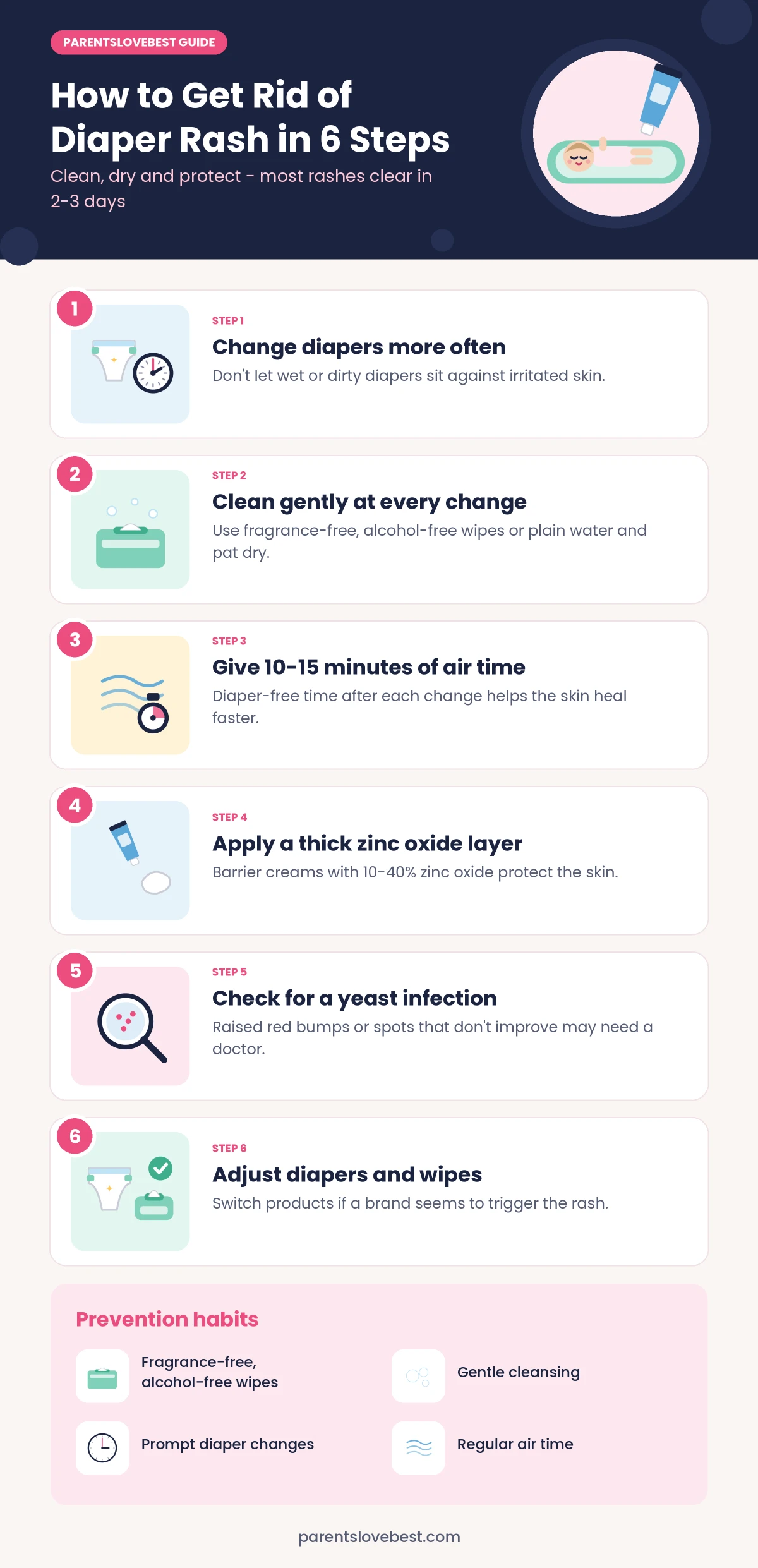
- Step 1: Change the Diaper More Often
- Step 2: Clean the Area Gently at Every Change
- Step 3: Give the Skin 10-15 Minutes of Air
- Step 4: Apply a Thick Layer of Zinc Oxide
- Step 5: Check for Signs of a Yeast Infection
- Step 6: Adjust Diapers and Wipes Going Forward
- When to Call the Pediatrician
- Common Problems and How to Fix Them
- FAQ
- Summary
How to Get Rid of Diaper Rash at a Glance
What Causes Diaper Rash and Why It Spreads Fast
Diaper rash is skin inflammation (see Mayo Clinic’s treatment guide) caused by prolonged contact with urine, stool, or friction inside the diaper. It shows up as red, irritated skin on the bottom, inner thighs, and genitals. Newborns and babies aged 9-12 months get it most often – that peak at 9-12 months lines up with the introduction of solid foods, which changes stool acidity.
The rash spreads quickly because the inside of a diaper traps moisture and heat, which breaks down the skin's outer barrier. Once that barrier is compromised, even a brief exposure to urine or stool causes inflammation.
The four most common causes
Sitting in a wet or soiled diaper too long
Friction from a diaper that fits too tightly
A new food introduced to the baby's diet
Antibiotic use, which disrupts gut bacteria and changes stool composition
What You Need Before You Start
Fragrance-free, alcohol-free baby wipes or a soft washcloth with warm water
A zinc oxide barrier cream (10-40% zinc oxide concentration)
Clean diapers - sized correctly for the baby's weight
A clean, flat surface for diaper changes
Optional
a hair dryer on the cool setting to speed drying
Step 1: Change the Diaper More Often Than Usual
Check the diaper every hour while the rash is active, and change it immediately after every bowel movement. The standard recommendation of every 2-3 hours is for healthy skin – irritated skin needs shorter exposure windows.
Good to know
At night, consider using a diaper one size up to reduce friction and improve airflow, especially if the baby sleeps for long stretches.
Step 2: Clean the Area Gently at Every Change
Wipe from front to back using fragrance-free, alcohol-free wipes. For a moderate or severe rash, wipes can sting – switch to a soft washcloth with plain warm water instead.
Pat the skin dry. Do not rub
Rubbing removes the top layer of already-damaged skin and makes the rash worse. If the skin is very sensitive, let it air dry for 30 seconds before moving to the next step.
Avoid baby powder. The American Academy of Pediatrics advises against talc-based powders because babies can inhale the particles, and cornstarch-based powders can encourage yeast growth.
Step 3: Give the Skin 10-15 Minutes of Air Time
Lay the baby on a waterproof mat or a few layers of towels and leave the diaper off for 10-15 minutes after cleaning. Air drying is one of the fastest ways to reduce inflammation because it eliminates all moisture and friction from the affected area.
Good to know
Do this at every diaper change until the rash is gone - at a minimum, 3-4 times per day.
Step 4: Apply a Thick Layer of Zinc Oxide Barrier Cream
Once the skin is completely dry, apply a generous layer of zinc oxide cream. The layer should be thick enough that you cannot see the skin underneath – similar in thickness to frosting on a cake. Thin applications wear off before the next change and leave the skin exposed.
Products with 10-40% zinc oxide concentration are the standard recommendation from pediatric dermatologists. Common over-the-counter options include Desitin Maximum Strength (40% zinc oxide), Boudreaux's Butt Paste, and A+D Zinc Oxide Cream.
Do not wipe off all the cream at the next change
Remove only the soiled portion - leave the clean barrier layer in place. Scrubbing off all the cream at every change removes the protection and irritates the skin further.
Step 5: Check for Signs of a Yeast Infection
Standard diaper rash responds to the steps above within 2-3 days. If it does not improve – or gets worse – the rash may have developed a secondary yeast (Candida) infection.
Signs that the rash has become a yeast infection:
Bright red patches with a sharp, defined border
Small red bumps or pustules at the edge of the rash
Rash present in the skin folds and creases (standard diaper rash usually skips the folds)
No improvement after 3 days of zinc oxide treatment
Good to know
A yeast infection requires an antifungal cream - clotrimazole or miconazole - available without a prescription. Apply it before the zinc oxide cream at each change. If you are not sure whether it is a yeast infection, call the pediatrician before starting antifungal treatment.
Step 6: Adjust Diapers and Wipes Going Forward
Once the rash clears, make two permanent changes to prevent recurrence:
Switch to fragrance-free wipes if you have not already
Fragrances and preservatives in standard wipes are a common irritant, even in babies who have not reacted before.
Check diaper fit. A diaper that leaves red marks on the thighs or waist is too small. A diaper that gaps at the legs lets waste contact the skin directly. Both cause friction and rash.
When to Call the Pediatrician
Go to the doctor – not the pharmacy – if any of the following apply:
The rash has not improved at all after 3 days of home treatment
The rash has blisters, open sores, or is bleeding
The baby has a fever alongside the rash
The rash has spread beyond the diaper area (to the stomach, back, or thighs)
The baby seems to be in significant pain during changes
Good to know
These signs point to a bacterial infection (most often Staphylococcus or Streptococcus) or a more serious skin condition that needs a prescription antibiotic or antifungal.
Common Problems and How to Fix Them
| Problem | Likely Cause | Fix |
|---|---|---|
| Rash keeps coming back | Wipes contain fragrance or alcohol | Switch to water and washcloth permanently |
| Rash is not improving after 3 days | Yeast infection has developed | Add OTC antifungal cream under zinc oxide |
| Baby screams during cleaning | Wipes are stinging broken skin | Use warm water and soft cloth only |
| Cream wipes off too quickly | Layer is too thin | Apply thicker – skin should not be visible through it |
| Rash appears in skin folds | Yeast, not standard diaper rash | See pediatrician for antifungal treatment |
| Rash started with new food | Stool acidity changed | Pause the new food and reintroduce slowly after rash clears |
Frequently Asked Questions About Diaper Rash
How long does diaper rash take to clear up?
Most cases of diaper rash clear within 2-3 days when treated consistently with zinc oxide cream, frequent diaper changes, and air time. If the rash has not improved after 3 days, it may be a yeast infection and needs antifungal treatment.
What is the fastest way to get rid of diaper rash?
The fastest combination is: change the diaper immediately after every bowel movement, give 10-15 minutes of air time without the diaper, and apply a thick layer of 40% zinc oxide cream at every change. Air time is what most parents skip – and it makes the biggest difference.
Can breast milk help diaper rash?
Some parents apply breast milk to the rash before air drying. A small study published in Pediatric Dermatology (2013) found breast milk as effective as 1% hydrocortisone cream for mild diaper rash. It is safe to try, but zinc oxide cream has stronger evidence behind it for moderate to severe rashes.
Is diaper rash caused by a specific diaper brand?
Not typically. Diaper rash is more often caused by prolonged exposure to moisture than by the diaper brand. That said, some babies react to dyes or fragrances in certain brands. If the rash appears with a new diaper brand, switch back and see if it resolves.
What is the difference between diaper rash and a yeast infection?
Standard diaper rash looks pink or red, is flat, and skips the skin folds. A yeast infection is bright red with a sharp border, has small bumps or pustules at the edges, and appears inside the skin creases. Yeast infections do not respond to zinc oxide alone – they need an antifungal cream.
Should I use hydrocortisone cream on diaper rash?
Only on a doctor’s recommendation. Over-the-counter 1% hydrocortisone reduces inflammation quickly, but using it for more than a few days on diaper area skin – which is thin and absorbs more than other areas – can cause skin thinning. Zinc oxide is the safer first-line treatment.
Can I use adult diaper rash cream on a baby?
Check the active ingredient. If it contains zinc oxide and no fragrances or numbing agents (like benzocaine), it is generally safe. Numbing agents are not recommended for infants.
Summary
- Change diapers every hour while the rash is active, and immediately after every bowel movement.
- Clean with fragrance-free wipes or plain warm water and a soft cloth – always pat dry, never rub.
- Give 10-15 minutes of air time without the diaper at every change.
- Apply a thick, skin-covering layer of zinc oxide cream (10-40% concentration) before closing the diaper.
- If the rash includes defined red borders, bumps in the creases, or shows no improvement after 3 days, add an OTC antifungal cream and call the pediatrician if it still does not clear.