
When Can Baby Use a Jumper: Age, Safety Rules and Time Limits
- Published October 11, 2026
- Updated October 11, 2026
- 8 min read
Babies can use a jumper once they can hold their head up steadily without support – typically between 4 and 6 months old.
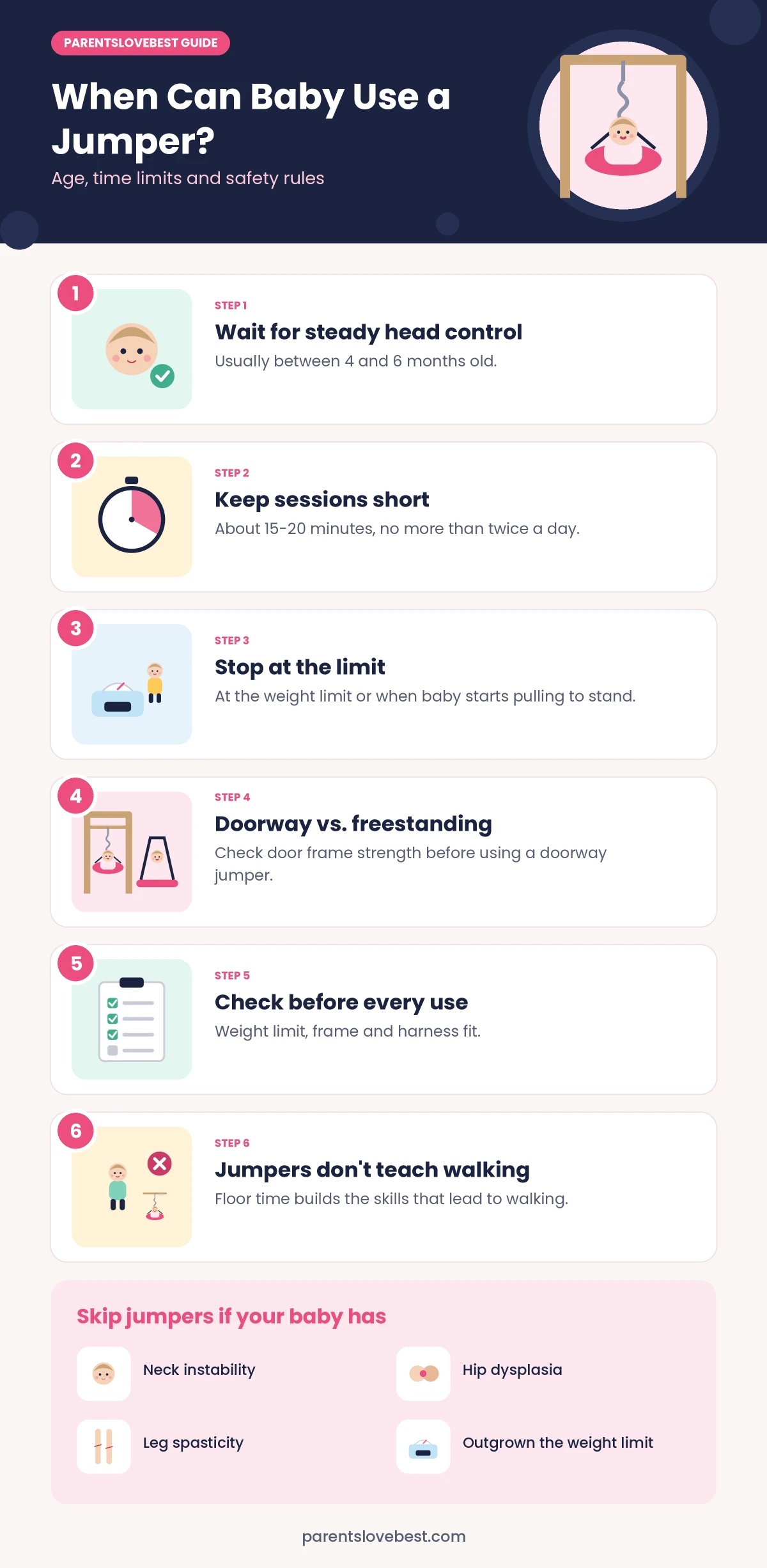
Start once your baby has steady head control – usually 4-6 months. Keep sessions to 15-20 minutes, twice a day, and stop at the weight limit or when your baby starts pulling to stand.
TL;DR: The Quick Answer
- Babies can use a jumper once they can hold their head up steadily without support – typically between 4 and 6 months old.
- Keep jumper sessions short – about 15-20 minutes, no more than twice a day.
- Jumpers do not help babies learn to walk and can delay motor development if overused.
- Never use a doorway jumper with a baby who has neck instability, hip dysplasia, or leg spasticity.
- Always check weight limits, door frame strength, and harness fit before every use.
- When Can Baby Use a Jumper? The Minimum Age
- How to Tell If Your Baby Is Ready for a Jumper
- How Long Can a Baby Stay in a Jumper
- At What Age Should Baby Stop Using a Jumper?
- Doorway Jumpers vs. Freestanding Jumpers
- Baby Jumper Safety Rules Every Parent Needs
- What Pediatricians Say About Jumpers
- When to Avoid Jumpers Entirely
- Common Mistakes Parents Make With Baby Jumpers
- FAQ
- Key Takeaways
When Can Baby Use a Jumper at a Glance
When Can Baby Use a Jumper? The Minimum Age and Physical Requirements
Most babies are ready for a jumper between 4 and 6 months old. By about 4 months, most babies hold their head steady without support, according to the CDC milestone checklist. The deciding factor is not age – it is whether your baby can hold their head upright and steady without any support from you or the seat.
A baby whose head still wobbles or tips forward does not have the neck strength to safely absorb the movement a jumper creates. Placing them in one before they reach that milestone puts direct strain on the cervical spine.
Before the first use, check two things
your baby holds their head at 90 degrees without drifting, and their feet touch the floor flat when seated in the harness - not on tiptoes, and not with knees bent.
How to Tell If Your Baby Is Ready for a Jumper
Your baby is ready for a jumper when they meet all four of the following signs:
Head control
They hold their head straight and still for at least 60 seconds without tilting or bobbing.
Trunk support
They can sit with only slight support at the hips - not fully unsupported, but not slumping.
Leg engagement
They push down noticeably when you hold them upright with feet on a surface.
Age window
They are at least 4 months old, even if they pass the physical checks earlier.
Good to know
If your baby meets the first three but is under 4 months, wait. The musculoskeletal system continues developing in ways that are not visible in a quick check.
How Long Can a Baby Stay in a Jumper Per Session?
Keep each jumper session to 15-20 minutes maximum. Aim for no more than two sessions per day, which puts the daily ceiling at around 30-40 minutes total.
Jumpers restrict the natural movement patterns babies use to build core strength and coordination. Extended time in a jumper - especially more than 20 minutes at a stretch - can cause babies to develop a toe-walking habit, where they default to pushing up on their toes rather than landing with a flat foot.
Set a timer. It is easy to let a content, bouncing baby stay in longer than intended.
At What Age Should Baby Stop Using a Jumper?
Stop using a jumper when your baby reaches the weight limit listed on the product label, or when they begin pulling themselves to a standing position – whichever comes first.
Good to know
Most doorway and freestanding jumpers have weight limits between 25 and 30 lbs. Once a baby starts pulling to stand, usually around 8-10 months, they need floor time to practice the balance and weight-shifting skills that lead to walking. Continued jumper use at that stage works against that development.
Doorway Jumpers vs. Freestanding Jumpers: Which Is Safer?
| Feature | Doorway Jumper | Freestanding Jumper |
|---|---|---|
| Door frame required | Yes – must be a standard wood frame | No |
| Portability | High | Low to moderate |
| Fall risk | Higher if door frame is weak | Lower – wider base |
| Weight limits | Typically 25 lbs | Typically 25-30 lbs |
| Price range | $20-$60 | $60-$150 |
| Floor space needed | Minimal | 3-4 square feet |
Good to know
Freestanding jumpers (also called activity centers or exersaucers) carry a lower fall risk because they are not suspended from a single mounting point. Doorway jumpers are safe when installed correctly, but the door frame must be solid wood - not hollow-core - and the clamp must be checked before every session. If you would rather skip the door frame entirely, a freestanding option like the Skip Hop Activity Center avoids it.
Baby Jumper Safety Rules Every Parent Needs to Follow
Baby jumper injuries happen almost entirely from installation errors, unsupervised use, and ignoring weight limits. Follow these rules every time:
Check the door frame before every use.
For doorway jumpers, press firmly on the clamp and tug the seat. If there is any give in the frame or clamp, do not use it.
Adjust the seat height so feet land flat.
Tiptoe bouncing stresses ankle joints and reinforces poor posture patterns.
Stay in the room.
Do not leave a jumper-seated baby unsupervised, even briefly. Babies can twist in the harness or knock the seat into the door frame.
Check harness fit at every session.
Waistbands and leg straps shift with repeated use. Two fingers should fit snugly under each strap.
Stop at the weight limit.
Exceeding it stresses the hardware and increases fall risk.
Never place a jumper near stairs, furniture edges, or wet floors.
What Pediatricians Say About Jumpers and Motor Development
Jumpers do not help babies walk faster, and frequent use can slow the development of the muscles needed for walking. Devices like jumpers and bouncers keep babies in passive positions – the baby reacts to the seat rather than building the active balance and control that floor time develops.
The AAP notes that tummy time helps babies build the strength and skills they need for key milestones, and the AAP warns that baby walkers can actually delay walking. Physical therapists likewise treat floor-based tummy time and supported sitting as higher-priority activities for motor development than jumper use.
This does not mean jumpers are harmful in moderate use
It means they are entertainment, not developmental tools. Use them as a short break for both parent and baby, not as a primary activity.
When to Avoid Jumpers Entirely
Do not use a jumper – doorway or freestanding – if your baby has any of the following:
Hip dysplasia
The wide-legged seated position in most jumpers can worsen hip socket development in babies already diagnosed with this condition (see the International Hip Dysplasia Institute on hip-healthy positioning).
Leg spasticity or muscle tone issues
Any condition affecting muscle control in the legs means the bouncing motion can reinforce abnormal movement patterns.
Neck instability
Babies with low muscle tone or conditions affecting cervical spine control cannot safely absorb jumper movement.
Recent illness or fever
Muscle tone drops when babies are unwell, reducing the control they normally have.
Good to know
If your baby has any of these conditions, or if your pediatrician has flagged any motor development concerns, check with them before using a jumper.
Common Mistakes Parents Make With Baby Jumpers
Starting too early
Putting a 2-3 month old in a jumper because they seem strong is the most common error. Head control at 4 months is different from head control at 2 months.
Letting sessions run long
Babies often seem happy in jumpers past the 20-minute mark. Happy does not mean safe.
Using tiptoe height
Setting the jumper so the baby reaches with their toes feels natural to the baby but stresses ankle joints over time.
Not checking the clamp daily
Doorway jumper clamps loosen with repeated bouncing. A check that takes 10 seconds prevents falls.
Using it as a nap seat
Never let a baby fall asleep in a jumper. The harness position is not safe for sleeping.
Frequently Asked Questions About Baby Jumpers
When can baby use a jumper?
Babies can use a jumper once they have full head control without support, which usually happens between 4 and 6 months old. Age alone is not enough – your baby must be able to hold their head upright and steady for at least a minute without drifting.
How long can a baby be in a jumper?
Each session should be 15-20 minutes maximum. The AAP recommends no more than two sessions per day. Going past 20 minutes in one stretch can contribute to toe-walking habits and limits the floor time babies need for motor development.
Are baby jumpers bad for development?
Jumpers are not harmful when used in short, supervised sessions within the recommended age and weight range. They become a problem when they replace tummy time and floor play, which are the activities that actually build the muscles needed for crawling and walking.
What is the weight limit for baby jumpers?
Most doorway and freestanding jumpers have weight limits between 25 and 30 lbs. The exact limit varies by product and is printed on the label. Stop using the jumper when your baby hits that limit, even if they are otherwise enjoying it.
Can a 3-month-old use a jumper?
No. At 3 months, most babies do not have the neck strength to safely use a jumper. Head control at this age is still developing, and the movement of a jumper puts strain on a neck that cannot yet support it. Wait until 4 months at the earliest, and only then if your baby passes the head control check.
What is the difference between a doorway jumper and an exersaucer?
A doorway jumper (also called a door bouncer) clamps onto a door frame and suspends the baby in a fabric seat. An exersaucer (also called a freestanding jumper or activity center) stands on its own with a wide base and includes toy attachments around the seat. Exersaucers carry a lower fall risk but take up more floor space.
Can babies sleep in a jumper?
No. Never let a baby sleep in a jumper. The harness position can compress the airway and cause positional asphyxia, where the baby’s head drops and cuts off breathing. If your baby falls asleep in the jumper, move them to a flat, firm sleep surface immediately.
Key Takeaways
- Start at 4-6 months, only after your baby has full, steady head control.
- Keep sessions to 15-20 minutes, twice a day at most.
- Stop when your baby hits the weight limit or starts pulling to stand.
- Doorway jumpers require a solid wood frame – check the clamp before every use.
- Jumpers are a short-break tool, not a replacement for floor time and tummy time.