
10 Best Baby Walkers for Hardwood Floors: 2026 Comparison Guide
[Published: September 30, 2026 | Last updated: September 30, 2026]
The best baby walker for hardwood floors rolls slowly and grips the surface without scratching it. We compared 10 popular models against that standard.
TL;DR
- The best baby walker for hardwood floors overall is the VTech Sit-to-Stand Learning Walker, because its two-speed rear wheels slow it down on slick surfaces and it costs less than most rivals.
- The best pick for protecting your floors is the Hape Wonder Walker, whose rubber-trimmed setback wheels are designed to protect floors.
- The best budget push walker is the Fisher-Price Learn with Me Zebra Walker, which has a wide 4-wheel base and works from 6 months to 3 years.
- The American Academy of Pediatrics (AAP) calls for a ban on mobile sit-in walkers, since 74% of walker injuries in one national study came from stair falls (Pediatrics, 2018).
- If your baby needs a seat, the stationary Baby Einstein Around We Grow 4-in-1 keeps them contained without rolling across the room.
What to Look for in a Baby Walker for Hardwood Floors
The right walker for hardwood floors controls speed and grips the surface. Hardwood is smoother than carpet, so a walker that feels slow on a rug can roll out from under a wobbly baby on bare boards. These 16 criteria guided every pick in this guide.
| Criterion | Why It Matters on Hardwood |
|---|---|
| Walker type (push vs. sit-in) | Push walkers need your baby to stand and balance, while sit-in walkers carry a baby who cannot yet walk. |
| Speed control | Adjustable wheel tension stops the walker from rolling faster than your baby can step. |
| Wheel material | Rubber or rubber-trimmed wheels grip better and are less likely to scuff a finish than hard plastic. |
| Base width | A wide base resists tipping when your baby pulls up on the handle. |
| Walker weight | A heavier walker rolls slower and slides less on a smooth surface. |
| Handle height | The handle should sit near your baby’s chest or waist so they push forward instead of leaning down. |
| Age range | The listed age tells you whether the walker supports pulling up or only confident walking. |
| Stair-fall protection | Sit-in walkers sold in the US must have features that stop them at a stair edge. |
| Floor-safe bumpers | A front bumper protects both your baseboards and your furniture from repeated crashes. |
| Activity panel | Toys keep your baby interested, and a removable panel adds floor-play use before walking starts. |
| Volume control | Hard floors and bare walls make electronic sounds louder, so a volume switch helps. |
| Battery needs | Electronic walkers need AA batteries, and some brands include them while others do not. |
| Weight limit | Sit-in walkers have strict weight caps, often around 25 pounds. |
| Folding and storage | A flat-folding walker is easier to store in a small home. |
| Assembly time | Most walkers take 15 minutes or less, but some need tools. |
| Price and lifespan | A walker that converts to a table or wagon gives you more months of use for the money. |
Comparison Table: Baby Walkers for Hardwood Floors at a Glance
| Walker | Type | Best For | Age Range | Speed Control | Price Tier |
|---|---|---|---|---|---|
| VTech Sit-to-Stand Learning Walker | Push | Best overall | 9 months to 3 years | Yes, 2 settings | Budget |
| Fisher-Price Learn with Me Zebra Walker | Push | Budget pick | 6 months to 3 years | No | Budget |
| Bright Starts Walk-A-Bout Walker | Sit-in, mobile | Foldable sit-in option | 6+ months, up to 26 lb | No | Mid |
| Radio Flyer Push & Pull Walker Wagon | Push wagon | Long-term use | 1 to 4 years | No | Budget to Mid |
| Little Tikes 3-in-1 Activity Walker | Push | Light-up motivation | 9 months to 3 years | Yes | Mid |
| Melissa & Doug Chomp and Clack Alligator | Wooden push toy | Confident walkers | 1 to 2 years | No | Mid |
| Hape Wonder Walker | Wooden push | Floor protection | 1 to 3 years | No | Mid |
| Baby Einstein Around We Grow 4-in-1 | Sit-in, stationary | No rolling at all | 6 months to 3 years | Not applicable | Premium |
| Delta Children Learn2Walk Balancer | Sit-in, mobile, bungee | Bouncing babies | 6+ months, up to 25 lb | No | Premium |
| Graco Discovery Walker | Sit-in, mobile | Compact storage | 6 to 12 months, up to 12 kg | Rear wheels roll one direction | Mid |
Price tiers: Budget = under $40, Mid = $40 to $75, Premium = over $75. Prices change often on the market, so check the live listing.
Push Walker vs. Sit-In Walker: Which Type Is Safer on Hardwood?
A push walker is safer on hardwood floors than a mobile sit-in walker. With a push walker (also called a sit-to-stand walker), your baby stands behind a handle and moves only as fast as their own legs allow. With a mobile sit-in walker, your baby sits in a wheeled frame and can scoot much faster than they could walk.
That speed difference matters more on hardwood, because there is no carpet to slow the wheels. Pediatric emergency physician Dr. James Dodington told Consumer Reports that babies in walkers can travel multiple feet per second (Consumer Reports, October 2024).
This guide uses “push walker” for any walker your baby stands behind, and “sit-in walker” for any walker with a seat. A stationary sit-in walker has a seat but does not roll around the room.
Are sit-in baby walkers safe?
Mobile sit-in walkers are not recommended by US pediatricians. The AAP has called for a ban on the manufacture and sale of mobile infant walkers, and a national study of 230,676 walker injuries from 1990 to 2014 found that 91% involved the head or neck (Pediatrics, 2018).
The same study found injuries dropped about 23% after the Consumer Product Safety Commission (CPSC) made stair-fall protection mandatory in 2010 (Pediatrics, 2018). Injuries have not stopped, though: an average of 2,467 children under 5 visited an emergency room each year from 2021 to 2023 after using walkers, jumpers, or exercisers (CPSC, 2024). Canada has banned the sale of baby walkers since 2004 (Health Canada, 2004).
Four sit-in walkers appear on this list because parents search for them, and three of those are mobile. If you choose a mobile one, read the hardwood safety steps near the end of this guide first.
In-Depth Reviews of the 10 Best Baby Walkers for Hardwood Floors
Each review covers how the walker handles smooth floors, who it suits, and where it falls short. Push walkers and sit-in walkers are labeled clearly.
1. VTech Sit-to-Stand Learning Walker – Best Overall for Hardwood Floors
The VTech Sit-to-Stand Learning Walker is a push walker with a removable electronic play panel and adjustable wheel tension. It earns the top spot because its speed control directly solves the biggest hardwood problem: walkers rolling away from a baby’s feet.

• Two speed settings adjust the tension on the rear wheels.
• The play panel detaches for floor play before your baby can stand.
• The panel includes piano keys, a toy phone handset, spinning rollers, and light-up shape sorters.
• It runs on 2 AA batteries.
The two-speed rear wheels are the reason this walker works on hardwood. On the slow setting, the wheels resist turning, so a baby who leans hard on the handle does not get pulled forward. Once your baby walks with confidence, you switch to the faster setting.
The removable play panel gives you months of use before walking starts. A sitting baby can press buttons, spin rollers, and pick up the phone on the floor. When they start pulling up, you clip the panel back on and the toy becomes a walker.
The handle sits at a comfortable height for babies around 8 to 9 months old, according to parent blog Samba Min Mama Land (Samba Min Mama Land, 2022). That means your baby pushes forward from an upright stance instead of hunching over, which keeps their weight centered.
Be honest with yourself about your floors. Some parents report the walker still slides on polished hardwood, even on the slow setting (Dads Who Diaper, 2014). Placing a rug runner along your baby’s usual route solves most of this.
Pros:
- Adjustable wheel tension slows the walker on smooth floors.
- The detachable panel doubles as a floor toy for sitting babies.
- It is one of the least expensive walkers on this list.
- The interactive panel holds a baby’s interest for a long time.
Cons:
- Some parents say it still slides on very polished hardwood.
- The electronic sounds can get repetitive.
- The toy phone handset is easy to lose.
Best for: Parents who want a proven, low-cost push walker with speed control.
Not Ideal For: Homes with glossy, freshly finished floors and no rugs.
2. Fisher-Price Learn with Me Zebra Walker – Best Budget Push Walker
The Fisher-Price Learn with Me Zebra Walker is a low-cost push walker with a wide 4-wheel base and a musical activity panel. It is on this list because it starts earlier than any other push walker here, with a seated play mode from 6 months.

• Two play modes: Sit & Play for seated babies and Stand & Walk for early walkers.
• The panel has a book page to turn and light-up buttons that play songs about letters and numbers.
• The easy-grasp handle sits on a sturdy 4-wheel base.
• It measures 22 x 18.37 x 16.14 inches and needs 2 AA batteries.
The wide wheelbase is this walker’s main strength on hard floors. When a baby pulls up on one side of the handle, a wider base spreads that force out and makes tipping less likely. One grandparent reviewer said the wide base kept an 11-month-old steady on both carpet and wood floors (eBay, 2016).
The walker plays phrases like “Let’s go for a walk” as your baby moves, which encourages them to keep going. For a hesitant walker, that bit of encouragement can turn two steps into ten.
The Sit & Play panel is useful from 6 months, long before your baby walks. The book page, spinner, and roller ball give seated babies something to do with their hands, so you get use out of the toy early.
There is no speed control. On slick floors, stay close during the first few weeks and use a rug for your baby’s first attempts.
Pros:
- The wide 4-wheel base resists tipping.
- It works from 6 months through 3 years.
- Songs and phrases reward each step.
- It is priced at the low end of the market.
Cons:
- There is no adjustable wheel resistance.
- The phrases and songs repeat often.
- It is lighter than wooden walkers, so it rolls faster on hardwood.
Best for: Budget-conscious parents who want a walker that starts working at 6 months.
Not Ideal For: Very cautious walkers on polished floors who need a slow, resistant walker.
3. Bright Starts Walk-A-Bout Walker – Best Foldable Sit-In Walker
The Bright Starts Walk-A-Bout Walker is a mobile sit-in walker with a removable electronic toy station and a flat-folding frame. It is on this list for parents set on a sit-in design, but it carries the risks the AAP warns about, so read the safety section before buying.
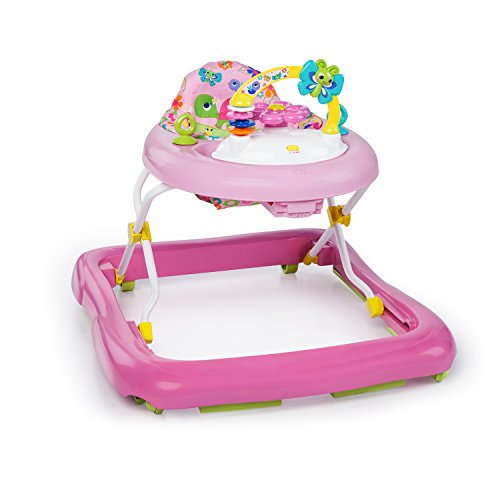
• A removable toy station with a steering wheel that plays lights, sounds, and melodies.
• Volume control on the electronic toy.
• Three height positions and a high seat back.
• It fits babies 6 months and older, up to 26 pounds, and needs 3 AA batteries (not included).
The high seat back gives more upper-body support than a basic sling seat. For a baby who sits well but tires quickly, that extra support keeps them upright rather than slumping forward toward the tray.
The removable toy station works as a floor toy on its own. When the walker is folded away, your baby can still play with the steering wheel and its lights, which gives the toy a second job.
The volume control is a real advantage in homes with hardwood floors. Sound bounces off hard surfaces, so the ability to turn melodies down makes a noticeable difference in an open-plan room.
The frame folds flat for storage. The seat pad is machine-washable, and the frame and toys wipe clean (Kids2, 2026).
Pros:
- The high seat back supports a baby’s posture.
- The toy station detaches for floor play.
- Volume control keeps noise down.
- The frame folds flat.
Cons:
- It is a mobile sit-in walker, the type the AAP recommends banning.
- It lets a baby move faster than they can react on smooth floors.
- It is outgrown at 26 pounds or when your baby starts walking.
Best for: Parents who have weighed the risks and want a foldable sit-in walker for a gated, single-level room.
Not Ideal For: Any home with stairs or hot surfaces your baby could reach.
4. Radio Flyer Push & Pull Walker Wagon – Best for Long-Term Use
The Radio Flyer Push & Pull Walker Wagon is a push walker that converts into a pull-along toy wagon. It earns its place by lasting from first steps to age 4, the longest lifespan of any walker here.

• A locking handle keeps the wagon rigid in walker mode.
• The handle unlocks to become a pull wagon.
• A 4-wheel base with a controlled turning radius.
It weighs 4.54 pounds and holds up to 35 pounds
The locking handle is what makes this wagon a real walker. When locked, the handle does not flop around, so your baby can push against it with confidence. When your toddler is walking well, you unlock it and they pull the wagon behind them.
The controlled turning radius stops the wagon from spinning sideways when a baby pushes unevenly. On hardwood, a walker that swings sharply can knock your baby off balance, so a limited turn helps.
The deep plastic body turns the walker into a storage bin on wheels. Toddlers love loading it with blocks and stuffed animals, and a few heavier toys inside also slow the wagon down on smooth floors.
This model has no resistance setting. If you want speed control from the same brand, Radio Flyer’s wooden Classic Walker Wagon adds resistance clickers and a furniture-friendly bumper (Radio Flyer, 2026).
Pros:
- It lasts from about age 1 to age 4.
- The locking handle gives firm support.
- The deep body stores and carries toys.
- A limited turning radius keeps it moving straight.
Cons:
- There is no built-in speed control.
- At 4.54 pounds, it rolls easily on hardwood when empty.
- It has no activity panel for younger babies.
Best for: Parents who want one toy to cover walking and pretend play for several years.
Not Ideal For: Babies under 12 months who are still pulling up for the first time.
5. Little Tikes 3-in-1 Activity Walker – Best Light-Up Motivation
The Little Tikes 3-in-1 Activity Walker (also called the Light ‘n Go 3-in-1 Activity Walker) is a push walker that projects colored lights onto the floor. It is on this list because its adjustable wheel speed and its locking table mode both suit smooth floors.

• Three modes: push walker, standing activity table, and sit-and-play center.
• Lights project from a dome onto the floor as your baby walks.
• More than 70 activities, songs, and sounds.
• Adjustable speed control on the wheels, with 3 AA batteries included (Little Tikes, 2026).
Hardwood floors show off this walker’s main trick. The dome projects colored lights ahead of the walker, and they show up clearly on smooth, bare surfaces. Babies step forward to chase the lights, which turns walking practice into a game.
The adjustable speed control on the wheels lets you slow the walker for beginners. That is the same fix VTech offers, and it matters just as much here on a slick surface.
In standing table mode, the activity panel slides up and the wheels lock so the toy cannot roll (Outnumbered 3 to 1, 2017). A baby who is pulling up for the first time can practice standing without the table moving away from them.
The walker folds flat, both for floor play and for storage. The 9-month starting age means it suits babies who are already pulling up.
Pros:
- Floor-projected lights encourage your baby to step forward.
- Adjustable wheel speed slows it on hardwood.
- Wheels lock in standing table mode.
- Batteries are included.
Cons:
- It is not weighted, so the newest walkers may find it light (Toy Portfolio, 2016).
- The 9-month start is later than some rivals.
- More than 70 sounds can mean a lot of noise.
Best for: Babies who need extra motivation to take steps.
Not Ideal For: Parents who want a quiet, screen-free style toy.
6. Melissa & Doug Deluxe Chomp and Clack Alligator Wooden Push Toy – Best for Confident Walkers
The Melissa & Doug Chomp and Clack Alligator is a wooden push toy with three alligators that open and close their mouths as it rolls. It suits toddlers who already walk, rather than babies who need something to pull up on.

• Three alligators chomp and make a clacking sound as the toy moves.
• Fish designs on the wheels and spinning butterfly and ladybug beads on the handle.
• Solid wood construction with no batteries.
• It fits ages 12 months to 2 years and stands 15.5 inches tall after assembly.
This is one of two walkers on the list with no electronics at all (the Hape Wonder Walker is the other). The sound comes from the alligators’ wooden mouths clacking, which appeals to parents who want to avoid batteries and recorded music.
The toy rolls forward and backward in a straight line (Happy Little Tadpole, 2024). On a long hardwood hallway, that straight track keeps a toddler moving in one direction instead of veering into furniture.
The spinning beads on the handle supports give your toddler something to do when they stop walking. Sliding and spinning them builds finger control and hand-eye coordination.
The short handle is the trade-off. At 15.5 inches tall, it is lower than most push walkers, so it works best for a toddler who already walks and wants a toy to push, not a baby who needs to pull up.
Pros:
- Battery-free design with no recorded sounds.
- The wooden build lasts for years.
- The chomping alligators reward every step.
- Beads on the handle add fine-motor play.
Cons:
- The low handle suits confident walkers only.
- There is no speed control.
- The clacking gets louder the faster your toddler goes.
Best for: Toddlers who already walk and parents who prefer wooden toys.
Not Ideal For: Babies who are still pulling up to stand.
7. Hape Wonder Walker Push and Pull Toy – Best for Protecting Hardwood Floors
The Hape Wonder Walker is a wooden push walker with rubber-trimmed setback wheels and five built-in activities. It earns its spot as the most floor-friendly walker in this guide, because its wheels are designed specifically to protect floors (Hape, 2026).

• Rubber-trimmed setback wheels.
• Movable knobs, gears, and colored balls give five activities.
• Wood from sustainably sourced forests with non-toxic finishes.
• It weighs 8.8 pounds, measures 13 x 18 x 20 inches, and meets EN 71 and ASTM F963 toy safety standards.
The rubber-trimmed wheels are why this walker suits hardwood. Rubber grips a smooth surface better than bare plastic, and it is far less likely to leave scuffs or scratches on a finished floor.
The setback wheels sit further back under the frame. This design gives your baby a sturdy base to pull up on, because the walker does not tip forward when they lean on the front (Hape, 2026).
At 8.8 pounds, the Wonder Walker is almost twice the weight of the Radio Flyer wagon. That extra weight means it rolls slower on hardwood, which gives a new walker time to move their feet.
The Wonder Walker won a Parents’ Choice Approved Award in 2011 (Parents’ Choice, 2011). The movable knobs and gears keep it useful as a busy box for toddlers who stop to play.
Pros:
- Rubber-trimmed wheels protect hardwood floors.
- Its 8.8-pound weight slows it down.
- Setback wheels give a stable base for pulling up.
- No batteries and no recorded sound.
Cons:
- There is no adjustable speed setting.
- It costs more than plastic push walkers.
- The 12-month starting age suits older babies.
Best for: Parents with finished hardwood who want to avoid scratches.
Not Ideal For: Babies under 12 months or parents on a tight budget.
8. Baby Einstein Around We Grow 4-in-1 Walker – Best Stationary Option (No Rolling)
The Baby Einstein Around We Grow 4-in-1 is a stationary sit-in walker: the seat travels 360 degrees around an activity table, but the unit itself stays in place. It is on this list because it gives a seated baby movement without letting them roll across a slick floor.

• A 3-position height-adjustable seat that moves around the table on a track.
• More than 15 toys, including a light-up piano that teaches colors and animals in English, Spanish, and French.
• Four modes: sit-in walker, walk-around table, art table, and detachable floor toys.
• It fits ages 6 months to 3 years and needs 3 AA batteries (not included).
The stationary design removes the main hardwood risk. Your baby can push with their feet and travel around the table, but the base does not roll toward stairs or a hot stove. The AAP has suggested stationary activity centers as an alternative to mobile walkers (AAP, 2001).
When your baby outgrows the seat, you remove it and the table becomes a walk-around station. A toddler can cruise along the edge while holding on, which is how most babies practice before walking alone.
The table later converts into a flat art surface, and the toy stations detach for floor play. That long lifespan, from 6 months to 3 years, helps justify the higher price.
The downside is size. Assembled, it measures 22.9 x 53.5 x 23.3 inches (Babylist, 2026), so you need a clear area of floor.
Pros:
- The unit does not roll, so it cannot slide on hardwood.
- Four modes cover 6 months to 3 years.
- The trilingual piano adds early language exposure.
- The table fits more than one child for shared play.
Cons:
- It takes up a large area of floor.
- It is the priciest type of walker on this list.
- It does not teach balance the way a push walker does.
Best for: Parents who want a contained, seated play space with no rolling risk.
Not Ideal For: Small apartments or parents who want a walker that travels room to room.
9. Delta Children Learn2Walk Balancer Baby Walker – Best for Babies Who Love to Bounce
The Delta Children Learn2Walk Balancer is a mobile sit-in walker that hangs the seat from bungee cords, so your baby can bounce and tilt. It is included for parents interested in its bungee design, but it is still a mobile sit-in walker, so the AAP’s warnings apply.

• Bungee cords let your baby tilt, then pull them back upright.
• Three modes: bouncer, balancer, and play station.
• A 4-position height adjustment and a removable toy tray with lights and sounds.
• It fits babies up to 25 pounds and under 33 inches tall, and it is JPMA certified (Delta Children, 2026).
The bungee seat is the main difference from other sit-in walkers. Instead of a fixed seat, the bungees let your baby lean and shift their weight, and then bring them back to center. A physician invented the design, according to the manufacturer (Delta Children, 2026).
In bouncer mode, the walker works like a jumper. For a baby who loves to bounce, that gives you a jumper and a walker in one frame.
Parents report it moves easily on hardwood. One reviewer said it rolls well on hardwood floors (Buy Buy Baby, 2021). On smooth floors, that easy rolling is a safety concern as much as a benefit.
Some owners say only the two front wheels swivel, while the rear wheels are fixed (Shop Abunda, 2020). The frame is also large at 28.35 x 24.21 inches, so it may not fit through narrow hallways.
Pros:
- Bungee seat lets babies bounce and shift their weight.
- Works as a bouncer and a stationary play station.
- Four height settings.
- JPMA certified.
Cons:
- It is a mobile sit-in walker, the type the AAP recommends banning.
- The large frame struggles in tight spaces.
- Some parents report the rear wheels and sound effects stop working properly.
Best for: Parents who want a bouncer and are prepared to use the walker mode only in a gated, stair-free room.
Not Ideal For: Small homes, homes with stairs, or parents looking for the safest option.
10. Graco Discovery Walker – Best Compact Sit-In Walker
The Graco Discovery Walker is a mobile sit-in walker with single-direction rear wheels, anti-slip grips, and an ultra-flat fold. It rounds out the list as the most compact sit-in walker for storage, with the same safety caveats as the other mobile sit-in walkers.
Key features:
- Single-direction rear wheels control the walker’s movement.
- Anti-slip grips help stop the walker at the edge of a step.
- Four height positions and a removable play tray with music and lights.
- It fits babies from about 6 to 12 months, up to 12 kg (about 26.5 pounds), and needs 2 AA batteries.
The single-direction rear wheels limit sideways sliding. On hardwood, wheels that spin in every direction can let a sit-in walker drift sideways, so fixed rear wheels give it a more predictable path.
The anti-slip grips are Graco’s stair-fall protection. Since 2010, the CPSC has required walkers sold in the US to have features that stop them at a stair edge (Pediatrics, 2018). Grips reduce risk, but the 2018 study shows falls still happen.
The ultra-flat fold is this walker’s best practical feature. It folds to about 24 cm (9.4 inches) deep (Home Bargains, 2026), so it slides under a sofa or into a closet.
The seat cover is washable and the play tray lifts off for cleaning. Note that the Discovery is sold mostly outside the US, so check the Amazon listing for the specific version and US availability.
Pros:
- Single-direction rear wheels limit sideways drift.
- Anti-slip grips add stair-edge protection.
- It folds very flat for storage.
- Four height settings.
Cons:
- It is a mobile sit-in walker, the type the AAP recommends banning.
- It is outgrown by about 12 months or 12 kg.
- US availability and model details can vary.
Best for: Parents with little storage space who have decided on a sit-in walker.
Not Ideal For: Homes with stairs or parents who want a walker that lasts past the first birthday.
How to Make Any Baby Walker Safer on Hardwood Floors
You can make any walker safer on hardwood by slowing it down and limiting where it can go. These steps work for push walkers and sit-in walkers alike.
- Set the wheels to the slowest setting. If your walker has adjustable tension, like the VTech or Little Tikes, start on slow and only switch once your baby walks steadily.
- Add weight to a push walker. A few board books in a wagon or storage bin slow the rolling speed and lower the center of gravity.
- Lay down a rug runner. A low-pile runner along your baby’s favorite path adds grip and softens falls.
- Block stairs and doorways. Install hardware-mounted gates at the top of stairs, even with a push walker.
- Check wheels every week. Hair and grit collect in wheels and can scratch hardwood, so wipe them clean.
- Stay within arm’s reach. Walkers move faster on smooth floors than on carpet, so supervise closely.
Do baby walkers scratch hardwood floors?
Baby walkers can scratch hardwood floors, mostly when grit gets stuck in hard plastic wheels. Rubber or rubber-trimmed wheels, like those on the Hape Wonder Walker, are the gentlest option. Cleaning the wheels regularly and keeping floors swept prevents most marks.
How do I stop a push walker from going too fast?
Choose a walker with adjustable wheel tension, then set it to the slowest option. For walkers without speed control, add weight to the base or cargo area, or let your baby practice on a rug until their balance improves.
Frequently Asked Questions
What is the best baby walker for hardwood floors?
The VTech Sit-to-Stand Learning Walker is the best baby walker for hardwood floors for most families. It has two adjustable wheel-speed settings, a removable play panel, and a budget price. For the most floor-friendly wheels, choose the Hape Wonder Walker.
Are baby walkers safe on hardwood floors?
Push walkers are safe on hardwood floors with close supervision and speed control. Mobile sit-in walkers are riskier, because babies can move multiple feet per second in them (Consumer Reports, October 2024). The AAP recommends a ban on mobile sit-in walkers.
What is the difference between a push walker and a sit-in walker?
A push walker has a handle your baby stands behind and pushes, so they move at their own walking pace. A sit-in walker holds your baby in a seat on a wheeled frame, so they can move before they can walk. A stationary sit-in walker has a seat but does not roll.
What age should a baby start using a push walker?
Most push walkers suit babies from 9 to 12 months, once they can pull up to stand. Some, like the Fisher-Price Zebra Walker, start at 6 months in a seated play mode. Wooden push toys like the Hape and Melissa & Doug models start at 12 months.
Do baby walkers help babies learn to walk?
Push walkers give babies something stable to hold while they practice. Mobile sit-in walkers do not help babies learn to walk and can delay normal motor development, according to the AAP (AAP, 2001).
Why are baby walkers banned in Canada?
Canada banned the sale, import, and advertising of baby walkers in 2004 because of serious injuries from falls (Health Canada, 2004). The ban covers mobile sit-in walkers, not push toys that a standing child pushes from behind.
How long do babies use a baby walker?
Sit-in walkers are rated from about 6 months until your baby walks or reaches the 25 to 26.5 pound limit, so most families use one for a few months. Push walkers last longer, often until age 2 or 3. The Radio Flyer wagon lasts up to age 4.
Final Verdict: Which Baby Walker Should You Buy for Hardwood Floors?
The VTech Sit-to-Stand Learning Walker is the best baby walker for hardwood floors, because its two-speed rear wheels slow it down on slick surfaces at a budget price. If floor scratches worry you more than speed, the Hape Wonder Walker is the runner-up, thanks to its rubber-trimmed wheels and heavier wooden frame. For a baby who needs a seat, pick the stationary Baby Einstein Around We Grow 4-in-1 over any mobile sit-in walker.