
How Negative Parenting Affects Child Development: What the Research Shows
- Published October 11, 2026
- Updated October 11, 2026
- 9 min read
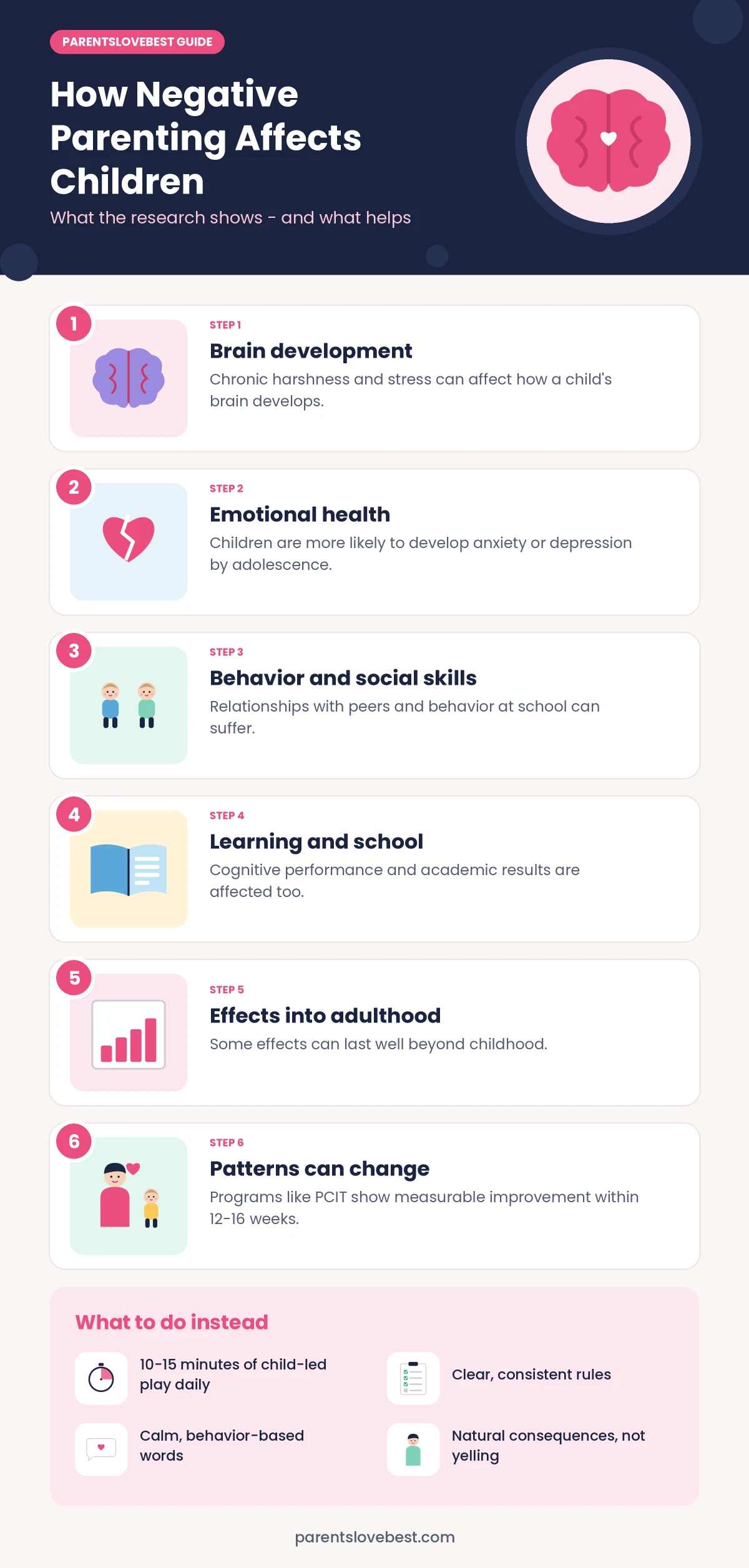
Negative parenting – including harsh discipline, emotional unavailability, and verbal criticism – directly disrupts brain development in children under 12, with effects measurable into adulthood.
Consistent harsh discipline, coldness, guilt-based control and unpredictable rules raise the risk of anxiety, aggression and learning problems. Occasional mistakes are normal – and patterns can change at any age.
TL;DR: The Quick Answer
- Negative parenting – including harsh discipline, emotional unavailability, and verbal criticism – directly disrupts brain development in children under 12, with effects measurable into adulthood.
- Children exposed to chronic negative parenting are more likely to develop anxiety or depression by adolescence.
- The damage is not limited to emotions: cognitive performance, social skills, and physical health are all affected.
- The two most harmful patterns are emotional rejection and unpredictable discipline – not occasional frustration or raised voices.
- Parenting patterns can change. Evidence-based programs like Parent-Child Interaction Therapy (PCIT) show measurable improvement within 12-16 weeks.
How Negative Parenting Affects Children at a Glance
What Is Negative Parenting?
Negative parenting is any consistent pattern of behavior toward a child that undermines their emotional safety, sense of worth, or ability to trust caregivers. It is not the same as imperfect parenting – every parent loses patience, snaps, or makes mistakes. The word “consistent” matters here.
Researchers group negative parenting behaviors into four main categories (Maccoby & Martin, 1983; updated Baumrind, 2013):
| Category | What It Looks Like |
|---|---|
| Harsh discipline | Yelling, hitting, shaming, excessive punishment |
| Emotional unavailability | Ignoring emotional needs, coldness, lack of warmth |
| Psychological control | Guilt-tripping, manipulation, love withdrawal |
| Inconsistency | Unpredictable rules, erratic responses to the same behavior |
Good to know
None of these categories requires intent to harm. Many parents repeat patterns from their own upbringing without recognizing them.
How Negative Parenting Changes Brain Development
The brain is most plastic – most open to being shaped by environment – during the first five years of life, and again during adolescence. During these windows, chronic stress caused by negative parenting literally alters brain structure.
The stress hormone cortisol, when chronically elevated in early childhood, shrinks the hippocampus - the brain region responsible for memory, learning, and emotional regulation (Lupien et al., 2009). Children raised in high-stress home environments also show reduced activity in the prefrontal cortex, which governs impulse control and decision-making (see Harvard's Center on the Developing Child).
This is not metaphor
Brain imaging studies of children aged 3-5 raised in neglectful or hostile environments show measurably less gray matter volume compared to children raised in warm, responsive homes (Hanson et al., 2015).
What This Means for Parents
The brain changes above are not permanent in most cases. The same plasticity that makes young children vulnerable also makes them responsive to improvement. When the home environment shifts - even in middle childhood - measurable neurological recovery is possible (Sheridan et al., 2012).
Effects on Emotional Development
Children develop emotional regulation by co-regulating with a calm, responsive caregiver first. When that caregiver is consistently unpredictable, cold, or frightening, the child never builds the internal architecture for managing their own emotions.
The clearest documented outcomes are:
Anxiety and depression.
Children with emotionally unavailable or harshly critical parents are more likely to develop an anxiety disorder or major depression by age 14.
Emotional dysregulation.
These children struggle to identify, name, and manage their own emotional states - a skill set formally called "affect regulation" that underpins almost every social interaction.
Attachment insecurity.
Children who cannot predict how a caregiver will respond develop insecure attachment styles - anxious, avoidant, or disorganized - which affect relationship patterns for decades (Ainsworth, 1979; updated meta-analysis: Groh et al., 2017).
Good to know
Emotional unavailability can be as damaging as harsh discipline, particularly for children under age 5.
Effects on Behavior and Social Skills
Children learn social behavior by watching how the adults around them handle conflict, frustration, and relationships. Negative parenting models the wrong patterns – and children absorb them.
The behavioral outcomes most consistently linked to negative parenting include:
Aggression.
Children who experience harsh physical punishment are more likely to use physical aggression with peers, not less (Gershoff & Grogan-Kaylor, 2016 - a meta-analysis of 75 studies).
Defiance and oppositionality.
Inconsistent discipline - where rules change based on the parent's mood rather than the child's behavior - produces children who test limits constantly because the limits mean nothing.
Social withdrawal.
Emotionally rejected children often struggle to initiate or maintain friendships, expecting rejection from peers as they received it at home.
Risk-taking in adolescence.
Teenagers from high-control or emotionally cold homes show elevated rates of substance use, early sexual activity, and delinquency (Steinberg et al., 1994; Pettit et al., 2001).
The Discipline Trap
Parents who use harsh punishment to stop bad behavior typically see short-term compliance and long-term escalation. The child behaves when the parent is present and acts out when they are not - because they have learned to fear the parent, not to understand why the behavior was wrong.
Effects on Cognitive Development and Academic Performance
Academic performance requires a child to feel safe enough to make mistakes. A child who has been shamed for errors, or who comes to school carrying chronic stress from home, cannot access that state.
Research findings are consistent across income levels and cultural groups:
Children with authoritarian (high control, low warmth) parents score lower on standardized reading and math tests from age 6 onward, even after controlling for income and school quality.
Chronic home stress raises baseline cortisol, which directly impairs working memory - the cognitive function most closely linked to academic learning (Blair & Raver, 2015).
Children who hear fewer warm, back-and-forth conversations at home tend to show slower language development (Hart & Risley, 1995; Romeo et al., 2018).
Long-Term Effects Into Adulthood
The effects of negative parenting do not end at age 18. Adults who experienced consistently negative parenting in childhood show elevated rates of:
Major depressive disorder and generalized anxiety disorder (Spinhoven et al., 2010)
Personality disorders, particularly borderline and avoidant presentations (Johnson et al., 2001)
Difficulty with intimate relationships and parenting their own children - the mechanism through which negative parenting repeats across generations (Belsky et al., 2005)
Poorer physical health outcomes, including higher rates of cardiovascular disease and autoimmune conditions - a finding replicated across the ACE (Adverse Childhood Experiences) studies (Felitti et al., 1998)
Good to know
The original ACE Study, which followed over 17,000 adults, found a strong, step-by-step link between childhood abuse, neglect and household dysfunction and adult health problems such as heart disease (Felitti et al., 1998). The CDC's ACEs overview summarizes the findings.
The Difference Between Strict and Harmful
Strict parenting is not negative parenting. The distinction researchers draw is between demandingness (high expectations, clear rules) and responsiveness (warmth, emotional availability).
Authoritative parenting - high on both - produces the best outcomes across nearly every metric. Authoritarian parenting - high demands, low warmth - produces obedient younger children but poorer outcomes in adolescence. Permissive parenting - low demands, high warmth - produces socially confident but impulsive children (Baumrind, 2013).
What separates all three from genuinely negative parenting is the baseline: do children feel loved, safe, and worth caring for? That baseline, even imperfect, buffers children from many other stressors.
What Parents Can Do Instead
Awareness of a pattern is the first step. The second is replacing it with something specific – vague intentions to “be kinder” do not hold under stress.
Practical replacements for the four negative patterns:
Harsh discipline
Replace with natural consequences and brief, calm explanations. "You left your bike outside - it rained, now it's rusty. That's the consequence." No yelling required.
Emotional unavailability
Schedule 10-15 minutes of undivided, child-led play daily. No phones. No agenda. Research calls this "special time" and it rebuilds attachment faster than almost any other single intervention (Eyberg, 1988).
Psychological control
Replace guilt-based statements ("You're breaking my heart") with behavior-based statements ("That behavior is not OK"). Separate the child's worth from their actions explicitly and often.
Inconsistency - Write down three to five non-negotiable rules
Apply them the same way every time, regardless of your mood - the AAP recommends clear and consistent rules for the same reason. Children need predictability more than they need perfect.
Good to know
If patterns are entrenched, Parent-Child Interaction Therapy (PCIT) is the most evidence-backed structured program available, showing significant improvement in parent-child relationships within 12-16 weeks across multiple randomized trials (McNeil & Hembree-Kigin, 2010).
Frequently Asked Questions About Negative Parenting and Child Development
What counts as negative parenting?
Negative parenting is any consistent pattern that leaves a child feeling unsafe, unloved, or worthless – including harsh discipline, emotional neglect, verbal criticism, and unpredictable rule enforcement. Occasional mistakes or moments of frustration do not meet this definition. The pattern and frequency matter far more than isolated incidents.
How early do the effects of negative parenting show up?
Effects are measurable in infancy. Even babies react with stress when caregivers are consistently unresponsive. Language delays appear by age 2-3. Behavioral problems are often visible by the time children enter preschool.
Can the damage from negative parenting be reversed?
In most cases, yes — especially when the child is still young and the environment changes. The brain’s plasticity means that a sustained shift to warmer, more consistent parenting produces measurable recovery in emotional regulation and cognitive function. The earlier the change, the greater the recovery, but improvement is documented even in adolescence.
Is spanking considered negative parenting?
The research consensus is that physical punishment — including spanking — is associated with increased aggression, lower self-esteem, and damaged parent-child relationships, even when used without anger (Gershoff & Grogan-Kaylor, 2016). No major pediatric or psychological association currently recommends it – the American Academy of Pediatrics advises against spanking. Whether it crosses into “negative parenting” depends on frequency, severity, and the overall emotional climate of the home.
What is the single most damaging parenting behavior?
Emotional rejection — the consistent message, verbal or behavioral, that the child is unwanted, burdensome, or unworthy of love — produces the most persistent long-term damage across the research literature (Rohner, 2004). It causes harm even in the absence of physical punishment or material deprivation.
How does negative parenting affect teenagers differently from young children?
Teenagers are in a second critical window of brain development, particularly in the prefrontal cortex. Harsh or psychologically controlling parenting during adolescence increases the risk of depression, substance use, and identity instability — partly because teens are actively building a sense of self, and parental rejection attacks that process directly (Steinberg, 2001).
Does negative parenting always repeat across generations?
Not automatically. The intergenerational transmission of parenting patterns is well-documented but not inevitable. Parents who reflect on their own upbringing, seek support, and deliberately practice different behaviors break the cycle at measurable rates. Therapy, parenting programs, and strong social support all reduce transmission risk (Belsky et al., 2005).
Key Takeaways
- Negative parenting is defined by consistent patterns – emotional rejection, harsh discipline, psychological control, and unpredictability – not by occasional imperfection.
- The effects are biological: chronic stress from negative home environments shrinks the hippocampus and reduces prefrontal cortex activity in developing children.
- Emotional unavailability can be as damaging as harsh discipline, particularly in children under five.
- The four outcomes most reliably linked to negative parenting are anxiety and depression, aggression, academic underperformance, and relationship difficulties into adulthood.
- Change is possible. Structured programs like Parent-Child Interaction Therapy show significant improvement within 12-16 weeks. The brain remains responsive to a better environment throughout childhood and adolescence.