
How Do You Know If Your Child Is Spoiled? Signs, Causes, and What to Do
- Published October 11, 2026
- Updated October 11, 2026
- 9 min read
A spoiled child consistently refuses to accept “no,” melts down when they don’t get their way, and treats others as a means to get what they want.
A spoiled child has learned that demanding behavior works: they cannot accept no, show little gratitude and treat rules as optional. The fix is consistent limits, natural consequences and real responsibilities.
TL;DR: The Quick Answer
- A spoiled child consistently refuses to accept “no,” melts down when they don’t get their way, and treats others as a means to get what they want.
- The core problem is not that a child gets too much – it is that they have learned that demanding behavior works.
- Common signs include refusing to share, expecting instant gratification, showing no gratitude, and treating household rules as optional.
- Spoiled behavior is correctable at any age, but the earlier parents set consistent limits, the easier it is to change the pattern.
- The fix is not deprivation – it is consistency: clear expectations, firm follow-through, and letting children experience the natural consequences of their behavior.
Is Your Child Spoiled? Signs and Fixes at a Glance
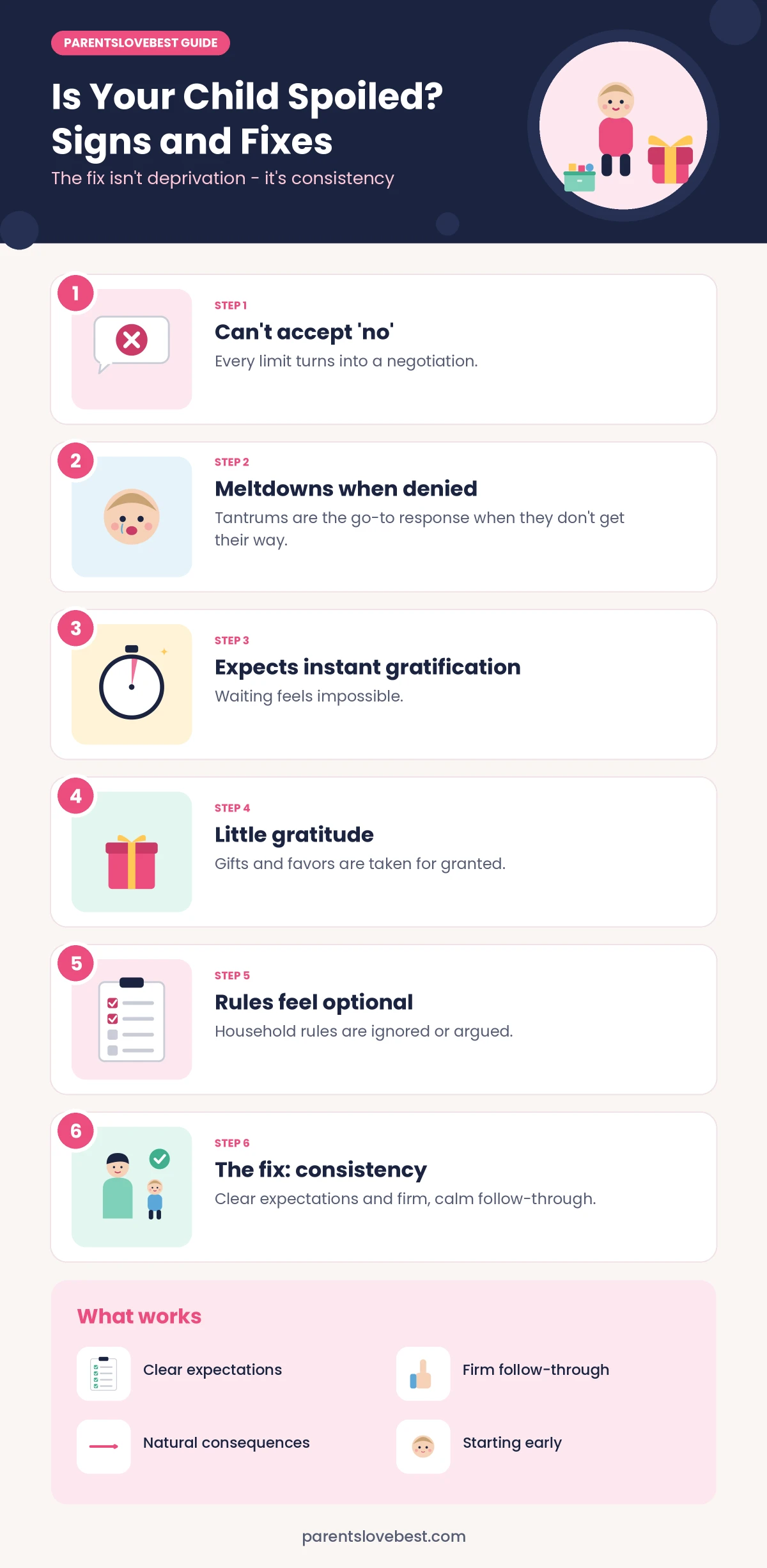
What Does "Spoiled Child" Actually Mean?
A spoiled child is one who has learned – through repeated experience – that they can get what they want by pushing hard enough. The behavior is not about personality or character flaws. It develops when a child’s demands are consistently rewarded, especially after tantrums, whining, or persistent pressure.
A useful way to think about spoiling
giving children too much of what they want and too little of what they need. What they need most is the experience of being told no - and having that no stick.
Spoiling is not the same as generosity
A child can receive gifts, love, and attention without becoming spoiled. The difference is whether limits exist and whether adults enforce them.
9 Clear Signs Your Child May Be Spoiled
These behaviors, when they appear regularly and across different settings (home, school, other people’s houses), are reliable signs that a child has not learned to accept limits.
1. They cannot tolerate being told no.
A spoiled child treats "no" as a negotiating opener, not a final answer. They argue, whine, beg, or escalate until the answer changes - and it often does, which reinforces the pattern.
2. They melt down over minor inconveniences.
Missing a favorite snack, having to wait five minutes, or losing a game triggers a reaction disproportionate to the situation. This happens because the child has little practice tolerating frustration.
3. They do not say thank you - or they say it only when prompted.
Gratitude requires perspective: understanding that someone did something they did not have to do. A child who treats gifts and favors as their due has not developed that perspective.
4. They refuse to share or take turns.
This goes beyond normal toddler behavior (which peaks around ages 2-3). By age 5-6, most children understand turn-taking. A spoiled older child still treats everything within reach as theirs by default.
5. They manipulate adults to get what they want.
Playing parents against each other, using guilt, flattery, or fake emotional distress to change an adult's decision - these are learned strategies that work when adults have been inconsistent.
6. They treat siblings, friends, or classmates as accessories.
Friendships are primarily useful to a spoiled child as a source of what they want: attention, compliance, entertainment. When the other child asserts their own needs, the spoiled child becomes hostile or dismissive.
7. They have no tolerance for boredom.
A child who has always had adults intervene to provide stimulation never develops the ability to self-entertain. They demand constant input and treat quiet time as a problem adults must solve.
8. They ignore or argue against household rules.
Rules around screen time, bedtime, chores, or language are treated as suggestions. The child negotiates every limit rather than accepting it.
9. They show little empathy when others are upset.
If a parent is sick, a sibling is hurt, or a friend is upset, the spoiled child's primary concern remains their own needs. This is not cruelty - it is the result of not having had to consider others consistently.
What Causes Spoiled Behavior in Children?
Spoiled behavior develops from consistent patterns in how adults respond to a child’s demands. The three most common causes are:
Giving in after saying no.
This is the most direct cause. When a parent says no, the child protests, and the parent reverses their decision to restore peace, the child learns that protest works. Every time this happens, the behavior gets stronger.
Rescuing children from consequences.
When adults step in every time a child faces a natural consequence - redoing the homework they refused to finish, replacing the toy they broke in a tantrum, making excuses to a teacher - the child never learns that their choices have costs.
Confusing love with accommodation.
Some parents equate saying yes with good parenting and saying no with being harsh. Research by developmental psychologist Diana Baumrind (1967, updated 1991) identified this as "permissive parenting" - high warmth, low expectations - and linked it to lower self-regulation and higher rates of behavioral problems in children compared to authoritative parenting (high warmth, clear expectations).
How Spoiled Behavior Differs by Age
Knowing what is developmentally normal helps parents distinguish a phase from a pattern.
| Age Range | Normal Behavior | Sign of Spoiling |
|---|---|---|
| 2-3 years | Tantrums, possessiveness, “mine” | Same behaviors at age 7-8 with no improvement |
| 4-6 years | Testing limits, some negotiation | Refusing all limits, no ability to wait |
| 7-10 years | Wanting more independence | Treating all rules as optional, no chores |
| 11-13 years | Pushing back on authority | Entitlement to devices, money, special treatment |
| 14+ years | Arguing for autonomy | Zero accountability, blaming others for consequences |
Good to know
The key signal at every age is whether the behavior is improving over time or getting worse.
The Difference Between a Spoiled Child and One With Unmet Needs
Not every demanding child is spoiled. Some children are unusually demanding because they have unmet needs that adults have not identified yet. Before concluding that a child is spoiled, check whether:
They are consistently getting enough sleep
Sleep deprivation dramatically increases irritability and meltdowns in children
They have had a recent major change: a new sibling, a move, a change in school, or a family disruption.
They show signs of anxiety, ADHD, or sensory processing differences
All of which can look like defiance but have different causes and require different responses.
Good to know
A spoiled child is demanding because demanding has worked. A child with unmet needs is demanding because something is wrong. The distinction matters because the fixes are different.
How to Stop Spoiled Behavior: What Actually Works
Say No and Mean It - Every Time
The single most effective change a parent can make is to hold the line after saying no - the AAP also advises clear, consistent rules and following through on consequences. This means accepting that the child will escalate at first - because they are testing whether this time is different. It usually takes several consistent refusals before a child stops pushing.
Child behavior researchers at Oregon Social Learning Center found that parental consistency in limit-setting is the strongest predictor of improved child compliance, more so than the specific discipline technique used (Patterson, 1982).
Let Natural Consequences Happen
If a child refuses to wear a coat and it is cold, let them be cold. If they do not finish dinner, they are hungry until the next meal. If they lose a toy to rough treatment, do not replace it immediately.
Natural consequences teach what lectures cannot: that choices have costs that are not negotiable. The book Parenting with Love and Logic is built around this idea.
Assign Chores With No Payment
Unpaid household responsibilities give children a stake in the family's functioning. Research from the University of Minnesota found that children who did chores from an early age were more self-sufficient and had better relationships in adulthood than those who did not (Rossmann, 2002).
The chores do not need to be elaborate. Making their bed, setting the table, and tidying their room are enough at ages 5-7.
Stop Rescuing Before the Consequences Land
This is the hardest part for most parents, because stepping in feels like care. But finishing a child's project, negotiating with the teacher on their behalf, or replacing what they broke in anger removes the feedback loop that changes behavior.
Require Gratitude - and Model It
Expecting a child to say thank you, to acknowledge when something was done for them, and to wait patiently for things they want are small practices that build the perspective spoiled behavior lacks. A gratitude journal for kids can turn this into a simple daily habit.
Common Mistakes Parents Make When Trying to Fix Spoiled Behavior
Giving consequences and then not following through.
This teaches the child that consequences are also negotiable.
Removing all privileges at once.
Extreme punishment is hard to sustain and creates resentment. Start with one consistent boundary.
Inconsistency between parents or caregivers.
If one adult holds the line and another gives in, the child learns to route around the firm parent.
Confusing giving less with being cold.
Warmth and limits are not opposites. Children need both, and consistent limits from a warm parent are the most effective combination.
Frequently Asked Questions About Spoiled Children
How do you know if your child is spoiled or just going through a phase?
A phase is temporary and tied to a specific developmental stage or life change. Spoiled behavior is a consistent pattern across different settings and over time. If your child argues against every limit, shows no gratitude, and manipulates adults to get what they want – and has done so for six months or more – it is a pattern, not a phase.
Can a child be too young to be spoiled?
Children under age 2 cannot be spoiled in the behavioral sense because they do not yet have the cognitive ability to manipulate or understand consequences. Responding to an infant’s or young toddler’s crying does not spoil them. The risk of spoiling becomes real around ages 3-4, when children begin to understand cause and effect in social situations.
What is the difference between spoiled and entitled?
These terms are often used interchangeably, but entitlement typically refers to a belief – that one deserves special treatment by default. Spoiled behavior is the learned pattern that reinforces that belief. A child can be spoiled (the behavior) without yet having a fixed sense of entitlement, and correcting the behavior early prevents the belief from hardening.
Does spoiling a child cause long-term problems?
Yes, if the pattern is not corrected. Children who never practice accepting limits can struggle with authority, relationships and money as young adults – a theme Julie Lythcott-Haims explores in How to Raise an Adult. The behaviors that look like spoiling in a 7-year-old look like entitlement in a 25-year-old.
How long does it take to change spoiled behavior?
Expect 4-8 weeks of consistent limit-setting before behavior improves noticeably. In the first 1-2 weeks, behavior typically gets worse before it gets better – this is called an extinction burst, and it means the child is testing whether the new limits are real. Holding firm through that period is what makes the change stick.
Is it too late to unspoil an older child or teenager?
It is harder with teenagers because the habits are more ingrained and they have more leverage (phones, social lives, driving, etc.). But it is not too late. The approach shifts from natural consequences to negotiated responsibilities with clear accountability. Family therapy is genuinely useful at this stage because a neutral third party changes the dynamic.
Should I feel guilty for spoiling my child?
Spoiling usually comes from trying to be a good parent – giving children what they want, protecting them from disappointment, keeping the peace. The fact that it has unintended consequences does not make it a character failure. The more productive question is: what changes now?
Key Takeaways
- A spoiled child is one who has learned that demanding behavior gets results – the problem is the learned pattern, not the child’s character.
- The clearest signs are: inability to tolerate no, absence of gratitude, manipulation of adults, and treating rules as optional.
- Spoiling comes from inconsistency – saying no and then giving in, rescuing children from consequences, and confusing accommodation with love.
- The fix is consistent limits, natural consequences, and assigned responsibilities – applied by all caregivers, not just one.
- Behavior typically worsens for 1-2 weeks when limits are first introduced, then improves steadily with consistency.