
How to Get Kids to Clean Up: A Step by Step Guide for Parents
- Published October 11, 2026
- Updated October 11, 2026
- 8 min read
Kids clean up more reliably when tidying is part of a predictable routine, not a one off demand
Match the task to your child’s age, use reachable, labeled storage, make cleanup part of a daily routine with a 2-minute warning, give one instruction at a time and praise specifically.
TL;DR: The Quick Answer
- Kids clean up more reliably when tidying is part of a predictable routine, not a one-off demand
- Matching the task to the child’s age is the biggest factor in whether they can actually follow through
- Praise the effort and the action, not just the result – “You put all the blocks in the bin” beats “Good job”
- Avoid cleaning as punishment; kids who associate tidying with consequences resist it longer
- Most children aged 3-4 can handle one-step cleanup tasks independently; two-step tasks become manageable around age 5-6
- What You Need Before You Start
- Step 1: Match the Task to Your Child's Age
- Step 2: Set Up Storage They Can Actually Use
- Step 3: Build Cleanup Into a Routine, Not
- Step 4: Give One Instruction at a Time
- Step 5: Acknowledge What They Did
- Step 6: Stop Rescuing the Mess
- Common Problems and How to Fix Them
- FAQ
- Summary
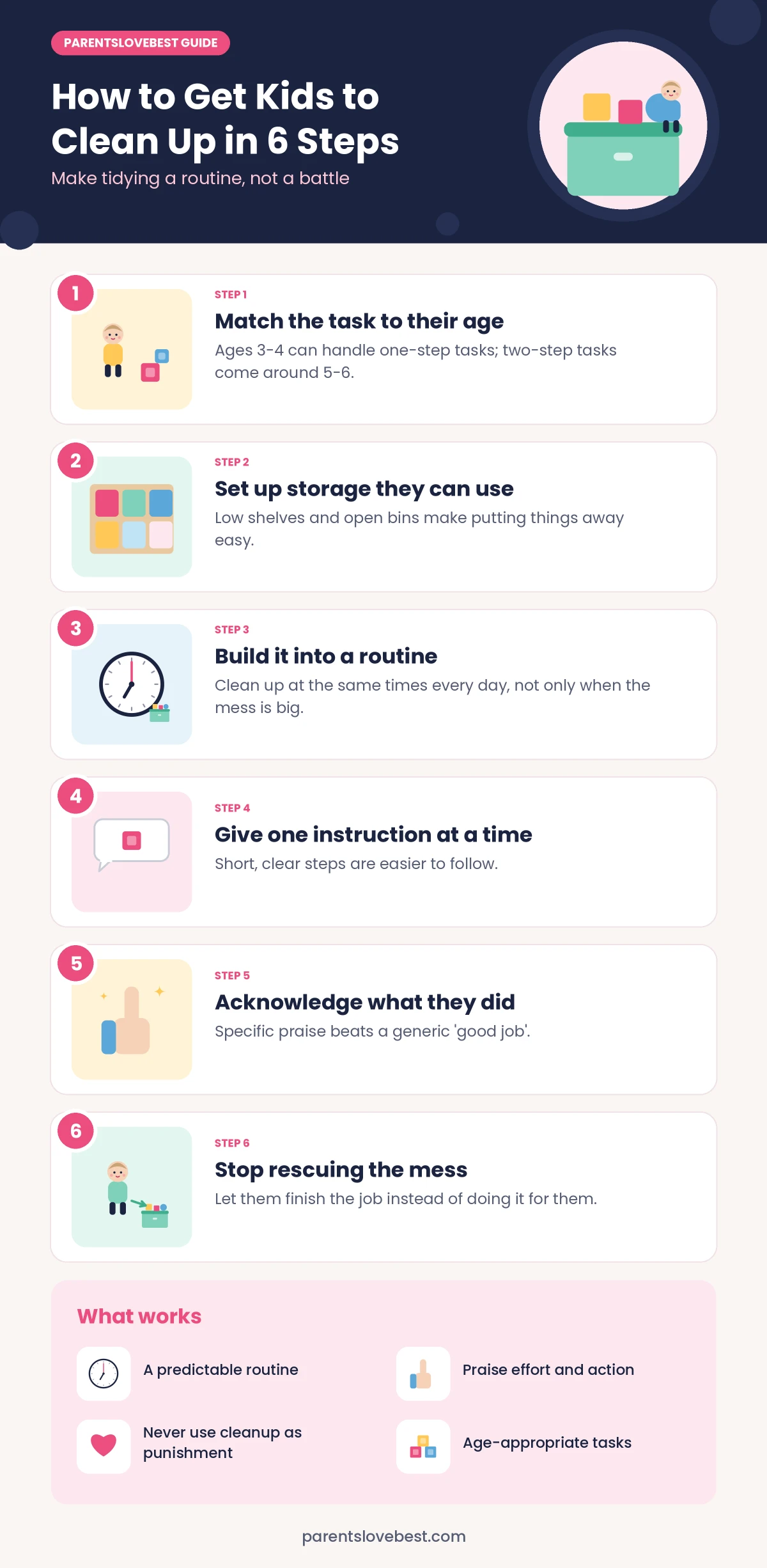
How to Get Kids to Clean Up at a Glance
What You Need Before You Start
A consistent time slot for cleanup (after play, before dinner, before bed)
Storage your child can physically reach and use without help
Age-appropriate expectations written down or agreed on in advance
5-10 minutes to spare - rushed cleanup sessions usually end in conflict
Step 1: Match the Task to Your Child's Age
Kids fail at cleanup most often because the task is too abstract or too big for their developmental stage – not because they are being defiant.
Here is a rough breakdown of what to expect at each age (the AAP’s age-appropriate chores guide has more ideas):
| Age | What They Can Do |
|---|---|
| 2-3 years | Put one type of toy in a bin when shown where it goes |
| 4-5 years | Sort toys into two or three labeled containers |
| 6-8 years | Tidy a whole play area with general instructions |
| 9-12 years | Manage their room independently with a checklist |
Good to know
If your 4-year-old stares blankly when you say "clean your room," that is not defiance. "Room" is too large a concept. "Put your stuffed animals on the bed" is workable.
Step 2: Set Up Storage They Can Actually Use
Before asking a child to clean up, check whether the system makes it physically possible. A bin on a high shelf, a lid that is hard to open, or a drawer they cannot reach all but guarantee failure.
Storage that works for young children:
Open-top bins at floor or knee height
Picture labels on containers (a photo of blocks on the block bin)
One category per container - mixed storage bins lead to mixed results
Fewer containers, not more - three clear options beat ten confusing ones
Good to know
IKEA KALLAX units, shallow baskets, and labeled shoeboxes are practical starting points. The goal is that a 4-year-old should be able to return every toy without asking where it goes.
Step 3: Build Cleanup Into a Routine, Not a Reaction
The single most common trigger for cleanup battles is the demand coming as a surprise – mid-play, with no warning. Children (especially under 8) struggle to shift tasks without transition time.
Add a two-minute warning before cleanup begins
"In two minutes we're putting the Legos away, then we're having dinner." This is not a negotiation - it is information. State it once and follow through.
Effective routine anchors for cleanup
Before every meal
Before leaving the house
Before screen time starts
At the end of each play session
Good to know
Pick one or two that fit your household. Consistency matters more than which slots you choose. Children who clean up at the same time each day usually argue about it less once the routine sticks - the CDC's positive parenting tips also recommend letting preschoolers help with simple chores.
Step 4: Give One Instruction at a Time
“Clean up your room” is not an instruction – it is a category. Children under 8 process single, concrete steps more reliably than open-ended directives.
Instead of
"Go clean up." Say: "Put your shoes by the door." Once done - "Now put your jacket on the hook."
Work through the task one step at a time, side by side, until the child has done it enough times to internalize the sequence. This is not doing it for them - it is teaching the routine so they can eventually run it alone.
Step 5: Acknowledge What They Did, Specifically
Generic praise (“Good job!”) does not reinforce the behavior you want. Specific acknowledgment connects the praise to the action.
What this looks like in practice:
"You put every single car back in the box That took a while - thank you."
"I noticed you cleaned up without me asking That is a big deal."
"The Legos are all sorted Now I can vacuum in there."
The last example also shows impact
The child sees why tidying matters beyond just pleasing a parent. That builds internal motivation over time.
Avoid using cleanup as leverage ("You can have screen time when the room is clean") every single time. Occasional natural consequences are fine, but children who only clean for a reward stop cleaning when the reward disappears.
Step 6: Stop Rescuing the Mess
If a child knows you will eventually clean up their toys, they have no reason to do it themselves. This is not about being harsh – it is about removing the safety net long enough for the habit to form.
Practical ways to do this without conflict:
Toys left out at bedtime go into a "toy jail" box for 24-48 hours
No yelling, no lecture, just a quiet consequence
Do not clean their space while they are present and able to help
Wait. Silence and a pointed look are more effective than repeated requests
Good to know
The goal is not punishment. It is making the natural consequence of not cleaning up (not having the toy) more noticeable than the effort of putting it away.
Common Problems and How to Fix Them
| Problem | Likely Cause | Fix |
|---|---|---|
| Child refuses every time | Instructions too vague or task too big | Break into one-step tasks, do first step together |
| Works with one parent, not the other | Inconsistent expectations between adults | Agree on the same routine and language before talking to the child |
| Goes well for a week then stops | Praise dropped off, routine shifted | Re-anchor to a consistent time slot, re-introduce specific praise |
| Younger sibling undoes the work | Normal for under-3s | Separate cleanup zones or involve the younger child with a simple sub-task |
| Meltdown every single time | Child is tired or overwhelmed | Move cleanup earlier in the day; reduce the scope |
Frequently Asked Questions About Getting Kids to Clean Up
At what age should a child start cleaning up after themselves?
Children as young as 18 months can begin putting objects into a container when shown where they go. By age 2-3, most children can follow a simple one-step cleanup instruction. The expectation should be participation at every age, not perfection – the level of independence increases as they get older.
Why does my child clean up at school but not at home?
School environments usually have clear systems (labeled bins, defined cleanup times, peer modeling) and teachers who give one instruction at a time. At home, the storage is often less clear, the timing is unpredictable, and the emotional stakes are higher. Copying the structure of a classroom environment – labeled storage, consistent timing, calm one-step instructions – typically closes the gap.
Should I pay my child to clean their room?
Payment works short-term but tends to backfire long-term. Children who are paid for basic household tasks often refuse to do them without compensation as they get older. Tying modest allowances to age-appropriate chores is different from paying per task – the distinction is whether the child understands tidying as a household responsibility or a transaction.
How do I get multiple kids to clean up without fighting over who does what?
Assign ownership of specific zones rather than shared tasks. “Your job is the Lego bin, his job is the books” removes the negotiation. Rotate zones monthly if fairness is a recurring issue. Avoid tasks that require two children to agree on something – they rarely do.
What if my child has ADHD or sensory sensitivities?
Children with ADHD often struggle with task initiation and sequencing, which makes open-ended cleanup requests particularly difficult. A visual checklist with pictures (for younger children) or written steps (for older ones) helps externalize the sequence. Sensory sensitivities may make certain textures or sounds during cleanup aversive – identify the specific trigger and adapt around it. An occupational therapist can give targeted strategies if cleanup is a consistent source of distress.
How long does it take for cleanup habits to stick?
Research on habit formation varies, but consistent daily repetition over several weeks is what makes a routine feel automatic. The key word is consistent – skipping the routine on weekends or during holidays resets the clock.
Summary
- 1Match the task to the age: young children need one-step, concrete instructions
- 2Set up storage they can use without help - reachable, labeled, open-top
- 3Build cleanup into a daily routine with a two-minute warning before it starts
- 4Give one instruction at a time, walk through it together until the habit is formed
- 5Use specific praise that names what the child did, not just "good job"
- 6Let natural consequences do the work - avoid always cleaning up for them
Related Guides
- How to Clean a Stroller Bag: A Step by Step Guide
- What to Write in a Baby Shower Card: Messages, Tips and Examples
- How to Prevent Breastfeeding Shoulder Pain: A Step by Step Guide
- When To Have a Baby Shower: Timing, Traditions and What Actually Works
- How Negative Parenting Affects Child Development: What the Research Shows
- How to Keep Your Family Healthy Through the Colder Months (2026 Guide)