
How to Keep Your Family Healthy Through the Colder Months: A 7-Step Guide for 2026
- Published July 15, 2026
- Updated October 17, 2026
- 11 min read
Keeping your family healthy in winter is mostly planning. Colds and flu show up every year. These seven steps help you get ready this week.
The plan that works best combines a yearly flu shot, indoor humidity between 40% and 60%, handwashing at two fixed moments, and steady sleep, because no single habit covers every way germs spread.
TL;DR: The Quick Answer
- The plan that works best combines a yearly flu shot, indoor humidity between 40% and 60%, handwashing at two fixed moments, and steady sleep, because no single habit covers every way germs spread.
- Flu vaccination cut children’s risk of flu-related intensive care admission by 74% (CDC, 2014), and CDC recommends a flu shot for everyone 6 months and older for the 2026-27 season (CDC, 2026).
- Babies under 8 months entering their first RSV season should get an RSV antibody shot unless the mother received the RSV vaccine during pregnancy (CDC, 2026).
- Adults who slept less than 6 hours a night were 4.2 times more likely to catch a cold after exposure than adults who slept more than 7 hours (Prather et al., Sleep, 2015).
- Any fever of 100.4°F (38°C) or higher in a baby under 3 months means calling your pediatrician right away (AAP, 2020).
- You Need Before You Start Your
- Step 1: Book Flu Shots and RSV
- Step 2: Keep Indoor Humidity
- Step 3: Make Handwashing Automatic
- Step 4: Protect Sleep Hours on School Nights
- Step 5: Cover Vitamin D Through
- Step 6: Set Up a Sick-Day Plan
- Step 7: Keep Food and Fluids
- Common Winter Health Problems
- Your Winter Health Checklist for This Week
- FAQ
What You Need Before You Start Your Winter Health Plan
To keep your family healthy through the colder months, you need three things in place before the first sniffle: a doctor you can reach quickly, a small supply kit, and a written sick-day plan. Buying supplies in October means you are not hunting for a thermometer at 2 a.m. in January.
Save your pediatrician's after-hours nurse line in your phone and your partner's phone.
Write down each family member's health baseline, such as asthma, frequent ear infections, or a history of hard flu seasons.
Stock the winter health kit below while store shelves are full.
| Item | Why You Need It | Where to Buy |
|---|---|---|
| Digital thermometer (rectal for babies under 3 months, temporal for older kids) | Rectal readings are the most accurate for young babies, and the AAP fever rules are based on them (AAP, 2020). | Check price on Amazon |
| Digital hygrometer | Shows your indoor humidity so you know when to run a humidifier. | Check price on Amazon |
| Cool-mist humidifier | Brings dry, heated air back into the 40-60% range in bedrooms. | Check price on Amazon |
| Saline drops and a nasal aspirator | Clears stuffy noses in babies who cannot blow their nose yet. | Check price on Amazon |
| Infant vitamin D drops | Covers the 400 IU daily need for breastfed babies (AAP, 2008). | Check price on Amazon |
| Infant or children’s acetaminophen | Eases fever discomfort; dose by weight from the label or your pediatrician. | Check price on Amazon |
| Oral rehydration solution | Replaces fluids when a sick child is not drinking well. | Check price on Amazon |
| Hand sanitizer with at least 60% alcohol | Backup for the car, diaper bag, and stroller when soap is not nearby. | Check price on Amazon |
Winter Health Kit: What to Buy Now
Your Winter Health Plan at a Glance
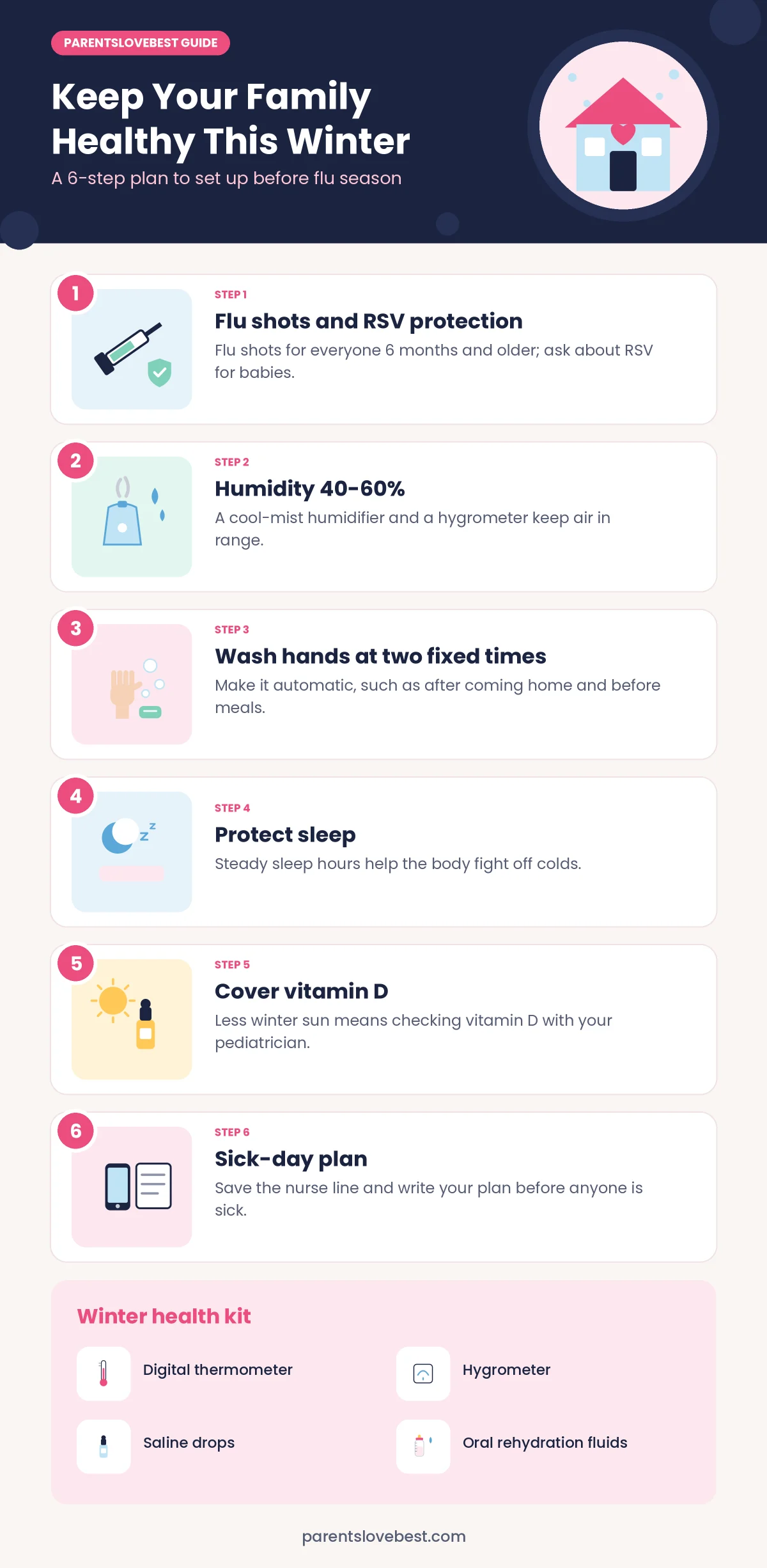
Step 1: Book Flu Shots and RSV Protection Before Flu Season Peaks
The single biggest step you can take this winter is getting everyone 6 months and older a flu shot now, and asking your pediatrician about RSV protection if you have a baby under 8 months. CDC and the American Academy of Pediatrics (AAP) both recommend yearly flu vaccination for every child 6 months and older without a medical reason to skip it (CDC, 2026; AAP, 2026).
The flu shot does not stop every infection, but it sharply lowers the chance of a severe one. In a CDC study across two flu seasons, vaccinated children were 74% less likely to land in a pediatric intensive care unit with flu (CDC, 2014). The 2026-27 vaccines protect against three flu strains, and all three were updated from last season (CDC, 2026).
Some young children need two doses.
Children 6 months through 8 years who have never had a flu vaccine, or whose vaccine history is unknown, need two doses given at least four weeks apart (CDC, 2026). CDC and AAP advise giving the first dose as early as possible so the second one lands by the end of October. If your child needs two doses, book the first one this week.
The nasal spray flu vaccine is an option for many healthy children 2 and older. It is not recommended for children under 2, pregnant people, people with weakened immune systems, or some children with asthma or recent wheezing (CDC, 2026). Ask your pediatrician which version fits your child.
How to Protect a Baby Who Is Too Young for a Flu Shot
Babies under 6 months cannot get a flu shot, so the people around them need to be vaccinated instead. CDC recommends yearly flu shots for parents, siblings, grandparents, and babysitters partly to shield infants who are too young for their own (CDC, 2026). A flu shot during pregnancy also passes protection to the baby for the first months after birth (CDC, 2026).
Why RSV Protection Matters for Babies
Respiratory syncytial virus (RSV) is a common cold-like virus that can cause serious breathing problems in babies. It is the most common cause of hospitalization in US infants (California Department of Public Health, 2026). CDC recommends an RSV antibody shot (nirsevimab or clesrovimab) for babies under 8 months born during or entering their first RSV season, unless the mother received the RSV vaccine during pregnancy (CDC, 2026). Nirsevimab reduced RSV hospitalizations and health care visits in infants by about 80% (CDC, 2023).
Step 2: Keep Indoor Humidity Between 40% and 60%
The target for winter indoor air is 40-60% relative humidity, especially in bedrooms. Once the heat runs all day, indoor humidity often falls below 40%, which dries out the lining of the nose and throat and helps flu virus survive longer in the air.
Think of the lining of your nose as a damp lint trap
When it dries out, it catches fewer germs before they reach deeper into the airways. Dry air also changes how long the virus itself stays infectious.
One modeling study of school classrooms estimated that about 75% of flu virus survived one hour at the lowest winter humidity, compared with about 35% when humidity was raised to 60% (Koep et al., BMC Infectious Diseases, 2013). That is a lab-based estimate, not a guarantee of fewer infections, but it is a cheap change to make.
- Place a hygrometer in each child’s bedroom and check it after the heat has been on for a full day.
- If the reading is below 40%, run a cool-mist humidifier in that room overnight.
- Turn the humidifier down or off if the reading climbs above 60%, since damp air feeds mold and dust mites.
- Empty, rinse, and dry the humidifier tank daily, and follow the maker’s cleaning instructions so it does not spray bacteria into the room.
Pediatricians recommend cool-mist humidifiers over warm-mist or steam models in children’s rooms because hot water can scald a curious toddler (AAP). Many video baby monitors also display room temperature and humidity; see our Best Baby Monitors guide if you want both in one device.
How to Set Up Your Home's Humidity
Open Windows Briefly Every Day
Fresh air lowers the amount of virus floating in a room. CDC lists better room ventilation as one of the basic ways to cut respiratory virus spread at home (CDC, 2024). Open a window for 5 to 10 minutes in the morning and again in the afternoon, even on cold days, and keep babies bundled or in another room while you do.
Step 3: Make Handwashing Automatic at Two Fixed Moments
The most reliable handwashing rule for a busy household is to wash at two moments every single day: the minute you walk in the door and right before eating. A vague “wash your hands often” rarely sticks with kids, but two fixed moments become habit within a few weeks.
Handwashing education reduced respiratory illnesses such as colds by 16-21% in the general population (Rabie and Curtis, 2006, as cited by CDC). Children bring home most winter germs from school and daycare, so the door-arrival wash stops germs before they reach siblings, toys, and the kitchen.
On arriving home
Everyone washes before touching anything else, including the baby, the fridge, or the TV remote.
Before eating
Every meal and snack, including the after-school snack.
Good to know
Scrub for 20 seconds with soap and water, about the time it takes to sing "Happy Birthday" twice. Hand sanitizer with at least 60% alcohol works as a backup in the car or stroller (CDC), but soap and water is better when hands look dirty. Keep a pump bottle and a step stool at the sink nearest the front door so small children can do it without help.
Step 4: Protect Sleep Hours on School Nights
Steady sleep is one of the simplest ways to lower your family’s odds of catching a cold. In a study where adults were exposed to a cold virus, those who slept less than 6 hours a night the week before were 4.2 times more likely to get sick than those who slept more than 7 hours (Prather et al., Sleep, 2015).
Children need more sleep than adults. For newborns, see our bassinet sleep routine. The American Academy of Sleep Medicine (AASM) recommends these totals per 24 hours (AASM, 2016):
| Age | Recommended Sleep (per 24 hours) |
|---|---|
| 4 to 12 months | 12 to 16 hours, including naps |
| 1 to 2 years | 11 to 14 hours, including naps |
| 3 to 5 years | 10 to 13 hours, including naps |
| 6 to 12 years | 9 to 12 hours |
| 13 to 18 years | 8 to 10 hours |
Winter brings more screen time and later bedtimes
Set a family "devices off" time 60 minutes before bed, and keep bedtimes within 30 minutes of the same time on weekends.
Daylight saving time ends on Sunday, November 1, 2026, and many young kids start waking an hour earlier. Shift bedtime by 15 minutes every couple of days that week, and use blackout curtains so early sunrises do not cut sleep short.
Step 5: Cover Vitamin D Through the Winter Months
Everyone in the family needs enough vitamin D in winter, and breastfed babies need a daily supplement. The AAP recommends 400 IU of vitamin D a day for breastfed and partially breastfed infants, starting in the first few days of life (AAP, 2008). Babies and older children who drink less than about 32 ounces (one quart) of vitamin D-fortified formula or milk a day also need 400 IU daily (AAP, 2008).
Shorter days and more time indoors mean less vitamin D from sunlight
A large analysis of 25 trials found that regular vitamin D supplements reduced the odds of a respiratory infection by about 12% overall (Martineau et al., BMJ, 2017).
The benefit was much larger in people who started out very low in vitamin D. In that group, 4 people needed to take supplements to prevent one infection, compared with 33 people in the overall group (Martineau et al., BMJ, 2017). Daily or weekly doses helped; occasional very large doses did not.
How to Give Vitamin D Without a Daily Fight
- Babies take liquid drops, given on the nipple, on a pacifier, or mixed into a small amount of breast milk.
- Toddlers who refuse drops often accept a chewable or gummy made for their age group.
- Teens and adults should ask their doctor about a dose before starting, because more is not better and very high doses can cause harm.
Step 6: Set Up a Sick-Day Plan Before Anyone Gets Sick
A written sick-day plan stops one cold from moving through the whole house. Most household spread happens in the first day or two of symptoms, before anyone has decided the runny nose is “real,” so deciding the rules now saves time when it counts.
What to Do When Someone Shows Symptoms
When a family member has a fever, cough, sore throat, or runny nose, take these four steps the same day:
- Give them their own sleeping space if you can, or at least keep them out of a shared bed with siblings.
- Give them their own towel, cup, and toothbrush holder spot.
- Wipe door handles, light switches, faucet handles, and remote controls once a day with a household disinfectant.
- Keep them home from school or daycare until they have been fever-free for 24 hours without fever medicine and their symptoms are improving (CDC, 2024).
Many daycares have stricter rules than CDC, so check your provider's handbook before you need it.
When to Call Your Pediatrician
The AAP says to call your child's doctor right away if your child has a fever and any of the following (AAP, 2020):
- Your baby is younger than 3 months and has a temperature of 100.4°F (38°C) or higher.
- Your child looks very ill, is unusually drowsy, or is very fussy.
- Your child has had a seizure.
- Your child still acts sick after the fever comes down, or seems to be getting worse.
- The fever lasts more than 24 hours in a child under 2, or more than 3 days in a child 2 or older.
Call 911 or go to the emergency room for trouble breathing, blue or gray lips, or a child who is hard to wake.
Medicine Safety for Young Children
The FDA advises against over-the-counter cough and cold medicines for children under 2. Never give aspirin to children or teens because of the risk of Reye's syndrome, a rare but serious condition. Do not give ibuprofen to babies under 6 months unless your doctor tells you to, and always dose acetaminophen by your child's weight using the label or your pediatrician's instructions.
Step 7: Keep Food and Fluids Simple This Winter
Your family does not need a special winter diet. Regular meals with fruit, vegetables, protein, and whole grains cover most needs, and the biggest food-related change is keeping everyone drinking enough when the heat dries the air.
Fluids
Fever and dry indoor air both increase fluid loss. Offer water, breast milk, or formula more often when a child is sick, and watch for fewer wet diapers as an early sign of dehydration.
Vitamin C from food
Regular vitamin C supplements did not prevent colds in the general population, though they slightly shortened how long colds lasted (Hemilä and Chalker, Cochrane Review, 2013). Oranges, kiwi, strawberries, and bell peppers are easy ways to get it.
Honey for coughs (age 1 and older only)
A review of 14 studies found honey improved cough frequency and severity better than usual care (Abuelgasim et al., BMJ Evidence-Based Medicine, 2021). A spoonful at bedtime or stirred into warm water works well.
Good to know
Never give honey to babies under 12 months. It can cause infant botulism, a rare but serious illness.
Common Winter Health Problems and How to Fix Them
| Problem | Likely Cause | What to Do |
|---|---|---|
| Child keeps getting sick from school or daycare | Germs come home on hands and backpacks | Enforce the door-arrival handwash from Step 3 every day without exceptions. |
| One cold spreads to the whole family | No plan to separate the sick person early | Set up the sick-day plan in Step 6 before anyone gets ill. |
| Dry cough or nosebleeds at night | Indoor humidity below 40% | Check with a hygrometer and run a cool-mist humidifier overnight (Step 2). |
| Baby refuses vitamin D drops | Taste or dropper feel | Put the drop on the nipple before a feed, or ask your pediatrician about a single-drop formula. |
| Toddler fights an earlier bedtime | Screens and later evenings in winter | Set a devices-off time 60 minutes before bed and use blackout curtains (Step 4). |
| Missed the October flu shot window | Busy fall schedule | Book it now; a late flu shot still protects through the rest of the season. |
Your Winter Health Checklist for This Week
Book flu shots for everyone 6 months and older, and ask your pediatrician about RSV protection if you have a baby under 8 months.
Buy a hygrometer and a cool-mist humidifier, and check bedroom humidity once the heat is running.
Put soap, a step stool, and sanitizer by the front door to start the door-arrival handwashing habit.
Start vitamin D drops for breastfed babies and set a devices-off time for the whole family.
Write down your sick-day plan and your pediatrician's after-hours number and stick it on the fridge.
For more seasonal guides, browse our Tips & Advice section.
This guide is general information, not medical advice. Talk to your pediatrician about your child's specific health needs.
Frequently Asked Questions About Keeping Your Family Healthy in Winter
How do you keep your family healthy in winter when kids are in school or daycare?
Get everyone a flu shot, make handwashing on arrival home a fixed rule, and keep school-night bedtimes steady. These three habits target the main ways kids catch and bring home winter germs. Keep sick children home until they are fever-free for 24 hours without medicine and improving (CDC, 2024).
Does cold weather actually make you sick?
Cold weather does not cause illness on its own; viruses do. Winter raises the risk because people crowd indoors, heated air dries the nose, and less sunlight lowers vitamin D. Research from Yale found that the common cold virus also copies itself more easily at the cooler temperatures inside the nose (Foxman et al., PNAS, 2015).
Dressing kids in warm layers keeps them comfortable outdoors, so keep going outside. For babies in strollers, a stroller bunting bag keeps them warm without bulky coats, which should never be worn under car seat straps.
When should I take my child to the doctor for a winter illness?
Call right away for any fever of 100.4°F (38°C) or higher in a baby under 3 months, a child who looks very ill or unusually drowsy, or a fever lasting more than 24 hours in a child under 2 (AAP, 2020). Trouble breathing or a child who is hard to wake needs emergency care. When in doubt, call your pediatrician’s nurse line.
Is it too late to get a flu shot in October or November?
No. Flu season usually peaks between December and February, so a shot in October or November still protects your family for most of the season. Children who need two doses should start as soon as possible, since the second dose comes at least four weeks later (CDC, 2026).
Do kids need vitamins in winter?
Most children who eat a varied diet only need to cover vitamin D in winter. Breastfed babies need 400 IU of vitamin D daily, and so do kids who drink less than about 32 ounces of fortified milk or formula a day (AAP, 2008). Ask your pediatrician before adding a multivitamin or any higher-dose supplement.
Is it safe to run a humidifier in a baby's room?
Yes, as long as you use a cool-mist model, keep it out of the baby’s reach, and clean it every day. Aim for 40-60% humidity and turn it down if the windows fog or the hygrometer reads above 60%. A dirty humidifier can spray mold and bacteria into the room, so daily cleaning matters more than which brand you buy.
How do I stop a cold from spreading through the whole house?
Act on the first day of symptoms. Separate the sick person’s sleeping space, towel, and cup, wipe shared surfaces once a day, and have everyone wash hands more often than usual. These steps work best when they are written down before anyone gets sick.