
When To Have a Baby Shower: Timing, Traditions and What Actually Works
- Published October 11, 2026
- Updated October 11, 2026
- 8 min read
Most baby showers are held between weeks 28 and 36 of pregnancy – typically in the third trimester (the Emily Post Institute suggests about four to six weeks before the birth).
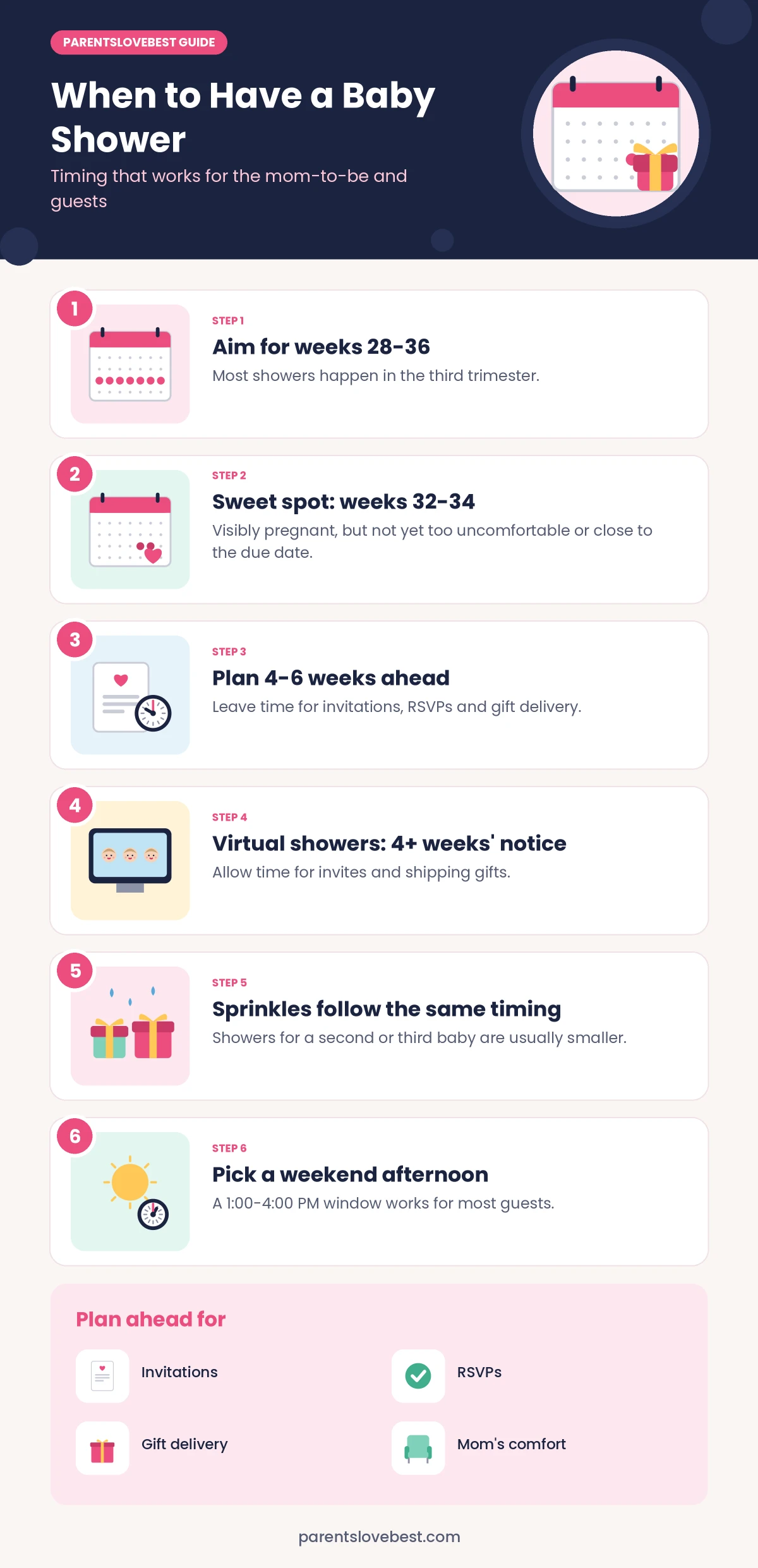
Hold the shower between 28 and 36 weeks of pregnancy, ideally weeks 32-34. Start planning 4-6 weeks ahead and pick a weekend afternoon.
TL;DR: The Quick Answer
- Most baby showers are held between weeks 28 and 36 of pregnancy – typically in the third trimester.
- Week 32 to 34 is the most common sweet spot: the mother is visibly pregnant but not yet uncomfortable or close to her due date.
- Second and third baby showers (called “sprinkles”) follow the same timing rules but are usually smaller.
- Virtual baby showers work on the same timeline and need at least 4 weeks of lead time for invitations and shipping.
- Plan the shower 4 to 6 weeks in advance to allow time for invites, RSVPs, and gift delivery.
- When Is the Best Time To Have a Baby Shower?
- Why the Third Trimester Is the Standard Timing
- How Far in Advance Should You Plan a Baby
- Can You Have a Baby Shower Too Early or Too
- When To Have a Baby Shower for a Second
- When To Have a Virtual Baby Shower
- What Day and Time Works Best for a Baby
- FAQ
- Key Takeaways
When to Have a Baby Shower at a Glance
When Is the Best Time To Have a Baby Shower?
The best time to hold a baby shower is between 28 and 36 weeks of pregnancy. This window gives the mother enough time to rest before the event, keeps the baby’s arrival far enough away to avoid scheduling conflicts, and ensures gifts arrive before they are needed.
Good to know
Most hosts aim for weeks 32 to 34 specifically. At this point, the pregnancy is well-established, the gender (if being revealed) is known, and the mother is typically still comfortable enough to enjoy a few hours of celebrating with guests.
Why the Third Trimester Is the Standard Timing
Baby showers happen in the third trimester for practical reasons, not tradition alone.
Before week 28, many parents prefer to wait until after standard prenatal screenings are complete. Scheduling a large celebration before that point can feel premature for some families.
After week 36, the mother may be too close to her due date for comfort. Travel becomes harder, energy drops, and there is a real risk the baby arrives before the shower does.
Weeks 28 to 36 hit the middle of those two concerns
Babies born from 37 weeks are considered early term (full term starts at 39 weeks, as the NIH explains), so a shower at week 33 or 34 leaves a comfortable buffer on both sides.
How Far in Advance Should You Plan a Baby Shower?
Plan the shower 4 to 6 weeks before the event date. This timeline covers the main logistics without dragging the planning out unnecessarily.
Here is what that planning window looks like in practice:
| Timeline Before the Shower | Task |
|---|---|
| 6 weeks out | Set the date, book the venue, confirm the guest list |
| 5 weeks out | Send invitations (physical or digital) |
| 4 weeks out | Confirm RSVPs, order decorations, plan the menu |
| 2 weeks out | Order or make the cake, finalize headcount with the venue |
| 1 week out | Prepare party favors, confirm all vendors or helpers |
| Day before | Set up the space, prepare food if making it yourself |
Good to know
If guests are traveling from out of town, send invitations 6 to 8 weeks out instead of five. This gives them time to book travel without the shower feeling like a distant event.
Can You Have a Baby Shower Too Early or Too Late?
Yes to both, though neither is a disaster.
Too early
(before week 20) means the pregnancy may still feel uncertain to the parents, gender-specific themes are harder to plan around, and gifts may sit unused for months. Some families choose to wait until after their anatomy scan at around week 20 before accepting celebrations.
Too late
(after week 36) risks the mother being too uncomfortable to travel or sit for extended periods. There is also the real possibility of an early arrival. A shower at week 37 or later is doable but requires flexibility from everyone involved.
If the shower is being planned for a mother who is already past week 36, consider a smaller gathering at her home rather than an event that requires her to travel.
When To Have a Baby Shower for a Second or Third Child
A shower for a second or third child – often called a “sprinkle” rather than a full shower – follows the same timing window of weeks 28 to 36. The main differences are size and scope, not scheduling.
Sprinkles tend to be smaller, focused on close family and friends, and centered on items the family genuinely needs for the new baby rather than a full registry. The timing logic is identical: close enough to the due date that gifts are useful, far enough away that the mother can attend comfortably.
Some families skip the sprinkle entirely for subsequent pregnancies and opt for a small dinner or lunch instead. The timing for that works the same way.
When To Have a Virtual Baby Shower
A virtual baby shower works on the same 28-to-36-week timeline as an in-person one. The planning, however, needs slightly more lead time to account for shipping.
If guests are sending gifts directly to the mother rather than bringing them to a physical venue, add at least one to two extra weeks to the planning window. This ensures gifts arrive before the event date rather than after.
For virtual showers, send digital invitations 5 to 6 weeks out, include the registry link immediately, and schedule the video call at a time that works across time zones if guests are geographically spread out.
What Day and Time Works Best for a Baby Shower?
Weekend afternoons are the standard choice for a reason: most guests are available, the timing does not require anyone to take time off work, and a 1:00 PM to 4:00 PM window covers lunch or light refreshments without committing to a full dinner.
Sunday afternoons work particularly well if Saturday conflicts with other weekend plans for guests. Avoid hosting late on a Sunday evening - the mother and guests need time to travel home and recover.
Weekday showers work when the guest list is small or when most attendees are retired, work from home, or have flexible schedules. A Thursday or Friday lunch shower is a reasonable option for a tight-knit group.
Frequently Asked Questions About Baby Shower Timing
How many weeks pregnant should you be for a baby shower?
Most baby showers happen between 28 and 36 weeks of pregnancy. The most common timing is weeks 32 to 34, which gives enough buffer before the due date while the mother is still comfortable attending.
Is it bad luck to have a baby shower before the baby is born?
Some cultural and religious traditions prefer to wait until after the birth before celebrating. In most Western traditions, however, having the shower before birth is standard practice. The decision is personal – what matters most is what feels right to the parents.
Can you have a baby shower after the baby is born?
Yes. A post-birth shower, sometimes called a “sip and see,” lets guests meet the baby in person. These are typically less formal than a traditional shower and are held in the first few weeks after birth when the mother feels ready to receive visitors.
How long does a baby shower last?
Most baby showers run 2 to 3 hours. This is enough time for guests to arrive, eat, play a game or two, watch gifts being opened, and say goodbye without the event becoming exhausting for the mother.
Who traditionally plans the baby shower?
The shower is most often planned by close friends, a sister, or a sister-in-law of the mother-to-be. It is less common for the expectant mother to plan her own shower, though it does happen. The host does not need to follow any strict rule – the priority is that someone takes charge early enough to give the planning window its full 4 to 6 weeks.
How early is too early to plan a baby shower?
Starting the planning process before week 20 is generally too early. Until the anatomy scan (usually around weeks 18 to 22) confirms the pregnancy is progressing well, most parents prefer to hold off on large celebrations. Begin planning in earnest around week 24 to 26 so the shower lands in the ideal week 32 to 34 window.
Key Takeaways
- Hold the shower between weeks 28 and 36, with weeks 32 to 34 being the ideal target for most families.
- Start planning 4 to 6 weeks before the event date; add one to two extra weeks for virtual showers where gifts need to ship.
- Weekend afternoons (1:00 PM to 4:00 PM) work best for attendance and energy levels.
- Second-baby sprinkles follow the same timing as a first baby shower – just smaller in scale.
- Post-birth showers (“sip and see”) are a valid alternative if the traditional pre-birth timing does not work for the family.